Rheem’s Refreshed ProTerra Heat Pump Water Heater — Manufacturer Interview
 May 25, 202620 minutes
Joe Wachunas
0 Comments
Support CleanTechnica's work through a Substack subscription or on Stripe.
May 25, 202620 minutes
Joe Wachunas
0 Comments
Support CleanTechnica's work through a Substack subscription or on Stripe.
I try to interview every manufacturer that brings a new or refreshed heat pump water heater (HPWH) to market. My nerdy thought is that we in the cleantech space should be as up to speed on new, efficient water heaters the way we know about the latest model of Rivian, Tesla, or BYD.
Rheem brought out a refreshed, fifth generation HPWH last year, so I thought it was time to sit down with one of the “big three” companies in the water heater market. Rheem has an exclusive contract with Home Depot, which means that both contractors and DIYers (a surprisingly high percentage of the market) are installing its HPWHs. Rheem has also partnered up with big homebuilders like Clayton Homes.

Rheem has also been making its own HPWH since 2013, the ProTerra, and with this refresh, is on its fifth-generation unit. The company was also the first to bring 120-volt plug-ins to market in 2022. Rheem has seen ups and downs as HPWHs have gained market share over the last decade plus.
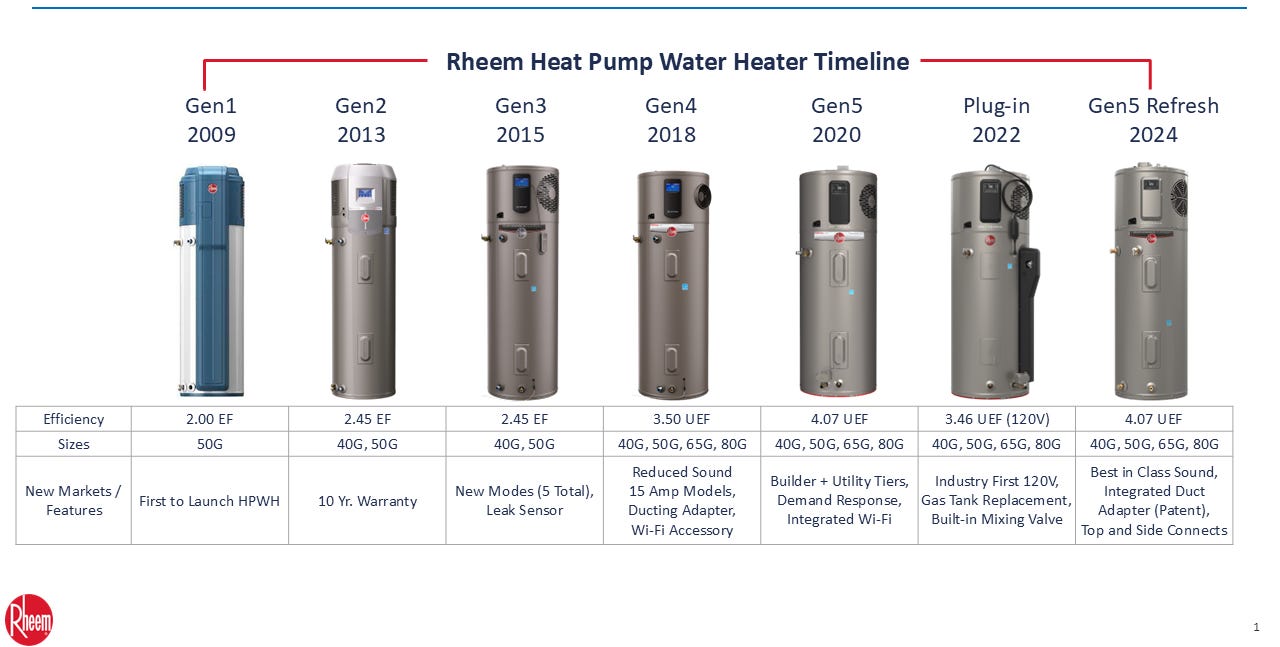
I sat down with Rheem for our nerdy podcast “Heat Pumps and Cardigans” to chat about this technology we both love. We talked about what’s new, what’s coming, and what the market needs to go bigtime by the end of the decade.
ProTerra Refresh
Early last year, Rheem brought out a refresh of its flagship HPWH — the ProTerra. The company made some updates to the product to improve installation, sound levels, and, interestingly enough, aesthetics.
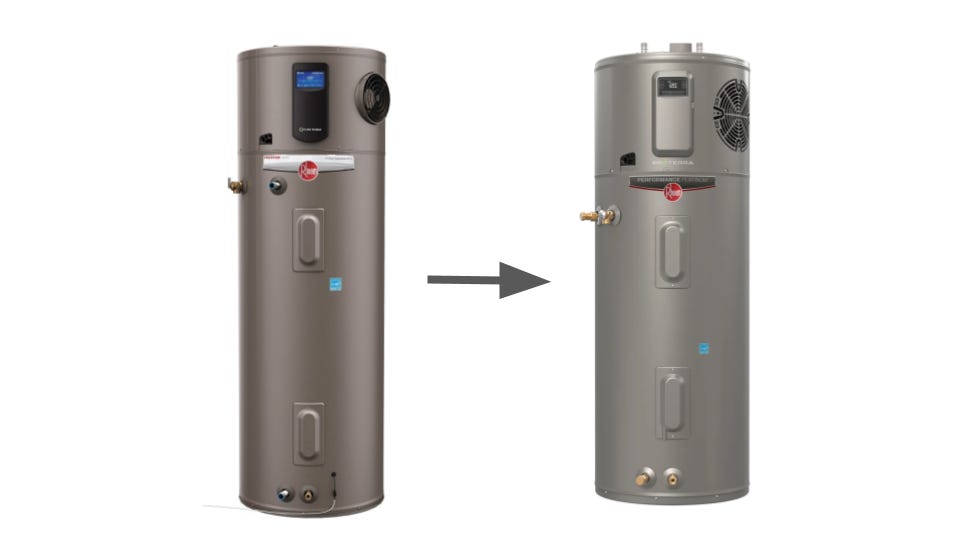
Aesthetics — I interviewed Lacy Estes-Hill from Rheem, who told me “people care about what their water heater looks like.” This surprised me because I think HPWHs already look so much cooler and more futuristic than the standard, non-descript, electric and gas water heaters sitting in basements or garages. But apparently the feedback Rheem received was that they needed to make its control panel and a couple other features look even cooler, so with this refresh, they upgraded it to make it look even more space age.
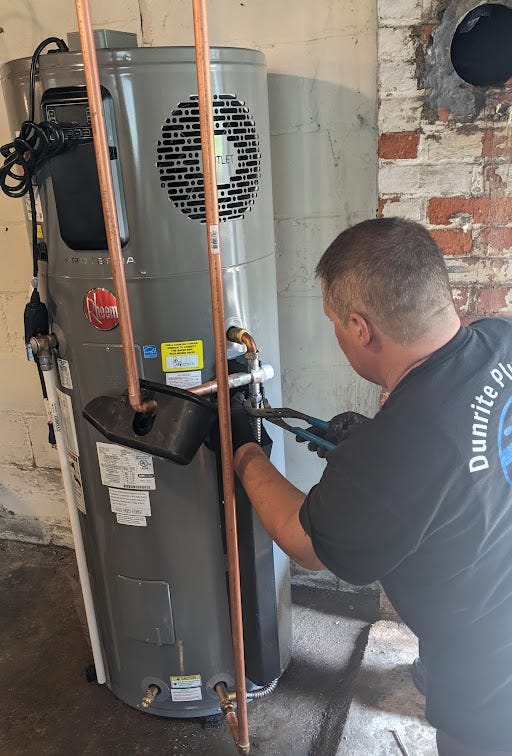
Easier water connections — Perhaps more importantly, the newest Rheem HPWH has both top and side connections for water pipes. Rheem surveyed a lot of plumbers and heard that folks wanted both top and side options, especially for retrofit scenarios where water pipes are typically coming in from the top. This means that a plumber doesn’t have to extend the water pipes to the side and bottom in the unit like they did when they installed my HPWH in 2023.
No more duct adapter — Rheem also made it easier to duct a HPWH in this new version of their product. Remember, most of the time you don’t need to worry about ducting a HPWH because they are usually in a basement or closet and can just exhaust that cool air into a room. But some situations might call for ducting, and in earlier generations, it was necessary to buy a ducting kit, or sort of a collar that would be attached to the water heater. With Rheem’s new design (other manufacturers like Navien have this as well), you can just connect the duct right to the water heater and use the integrated tabs to keep it in place.
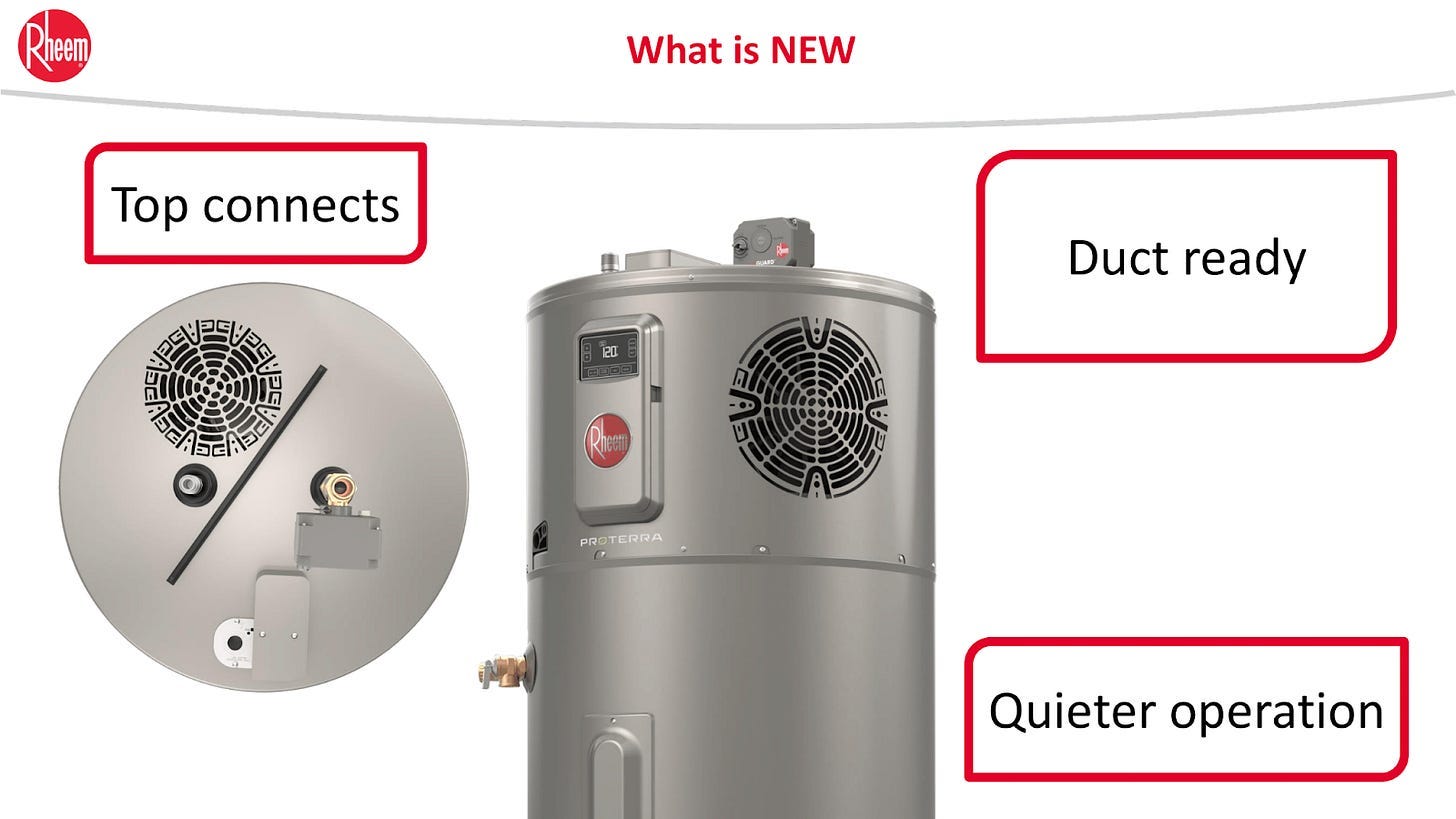
Reduced sound — HPWH manufacturers have now learned to make their HPWHs extremely quiet. Virtually all of them are now below 50 dB. Rheem’s new HPWH is below 45 dB, which is quieter than most dishwashers.
Rheem’s other HPWH products
Rheem has several other HPWH products available that we discussed in depth in our conversation.
120-volt plug-in — Rheem was first to market with a plug-in HPWH in 2022. I reviewed that product then and then bought one myself in 2023 to try it out (it was the only one on the market at the time). I think the plug-in HPWH is a very important technology for gas replacements that likely don’t have 240V of power on site. Homeowners with gas water heaters can just plug these puppies into a standard outlet. New Buildings Institute (where I work) and Slipstream both did field studies on these products and found very high user satisfaction in both California and the Midwest. Rheem was the first to market, and since then, two other manufacturers have come out with products (A. O. Smith and GE) that have added even more features to the 120V, such as backup elements to work in emergencies and the ability to convert to 240V. This might be next on Rheem’s refresh list.
15 amp model — Unbeknownst to most folks, Rheem is the only manufacturer on the market with a 15 amp, 240V HPWH model. This model is great for homes that might not have the necessary space in their panel to accommodate a 30 amp unit. The 15 amp HPWH still has two elements, but they are 2700 watts instead of 4500. Two with 2700 watts is still a lot of backup power. I only run my HPWH in heat pump mode, for example, so never use any backup electric power. Lacy told me that this 15 amp model is also popular among builders, as it sometimes means they don’t have to upgrade a lot of electrical infrastructure in the neighborhood they are building in, which saves them and the future homeowners money. Consider this model especially if you have a 100 amp panel.
Builder and utility models — HPWHs have perhaps suffered from having too much cutting edge technology on them, which makes them more expensive and out of reach for many. We probably need more lower cost models that can still deliver on the core efficiency but don’t have a ton of bells and whistles. Rheem, I think, is attempting to do this with its builder and utility models, which are similar to the ProTerra but don’t have some of the extra things like a connectivity port and leak guard.
Moving forward
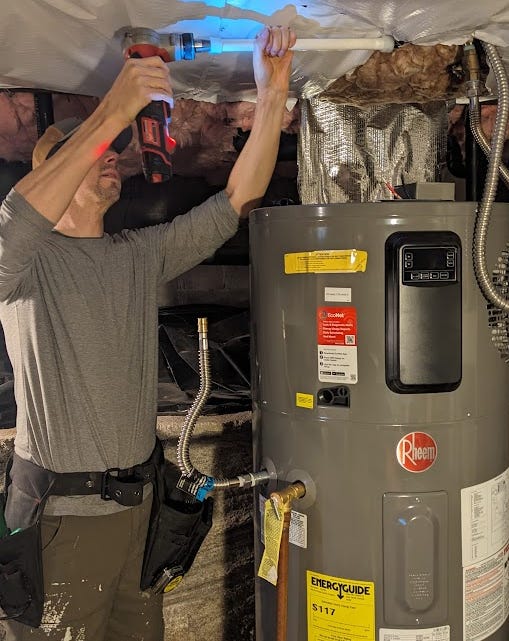
Rheem is all in on its HPWHs as the whole industry looks to 2029, when federal standards are likely to drive significant adoption of the technology. Rheem is preparing carefully for 2029 — making the needed investments and planning for a large amount of its portfolio to change.
Rheem, like all of us, has felt the loss of the US federal tax credits for energy efficient products. Some homebuilders have continued installing HPWHs, while others have scaled back plans.
Lacy pointed to the coasts for some of the strongest adoption over the next couple of years, either through incentives or policies mandating HPWH use. But she also highlighted strong programs in the Southeast where the technology makes a ton of sense.
Finally, we chatted about big hopeful trends like the surge in DIY installations (Rheem has created helpful videos to guide DIYers) and the trend towards multi-trade contractors (think HVAC companies) embracing and installing HPWHs.
All in all, it was good to hear about the products and plans of a market leader all in on HPWHs. Check out our full conversation here.
This content is provided for informational and educational purposes only. The Advanced Water Heating Initiative (AWHI) does not receive payment, free products, or other compensation for manufacturer spotlights, interviews, or articles, and does not endorse or recommend specific products or brands. AWHI’s role is to educate the market on developments in heat pump water heater technology in support of informed decision-making and market transformation. Read more about AWHI’s content policy here.
Sign up for CleanTechnica's Weekly Substack for Zach and Scott's in-depth analyses and high level summaries, sign up for our daily newsletter, and follow us on Google News! Advertisement Have a tip for CleanTechnica? Want to advertise? Want to suggest a guest for our CleanTech Talk podcast? Contact us here. Sign up for our daily newsletter for 15 new cleantech stories a day. Or sign up for our weekly one on top stories of the week if daily is too frequent. CleanTechnica uses affiliate links. See our policy here.CleanTechnica's Comment Policy