Reunion airport gets a bioclimatic terminal, the first in the tropics

 Facebook
 Twitter
 Flipboard
 Send
Send
 Reddit
 Linkedin
 Messenger
 Telegram
 VK
VK
 Bluesky
 Threads
 Whatsapp
Copy/paste the article video embed link below:
Whatsapp
Copy/paste the article video embed link below:
 Copied
The airport on the island of Reunion has been equipped with the world's first bioclimatic terminal in a tropical zone. The arrivals and baggage reclaim terminal operates without air-conditioning: the ventilation system is all-natural.
The island of La Reunion "is a pebble in the middle of the Indian Ocean, it is a bioclimatic laboratory," says Marc Delanoë, director of sustainable development at Roland Garros airport. "Eight or nine years elapsed between the idea of building an arrivals terminal and its achievement," he says. The project drew inspiration from other naturally ventilated buildings in the region, such as the bioclimatic amphitheatre in Saint Denis and traditional Reunion houses.
 ADVERTISEMENT
ADVERTISEMENT
ADVERTISEMENT
"This building consumes approximately 55-60% less energy than an equivalent air-conditioned building. We have gone from 8,000 tonnes of CO₂ in 2011; to less than 1,000 tonnes now. It's like a big Creole house. The wind comes from the east. We channel it by playing with these famous louvred windows, which in La Reunion we call: naco."Marc Delanoë Director of sustainable development, La Réunion Roland Garros Airport
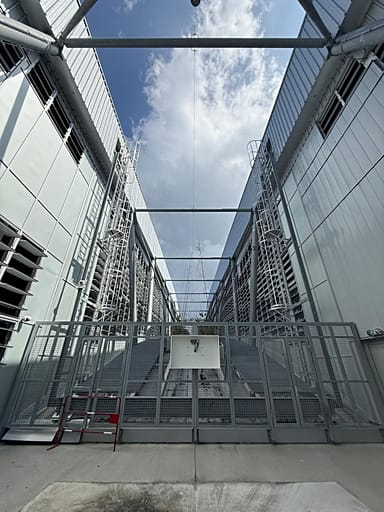
According to the European Commission, aviation generates more than 13% of greenhouse gas emissions from transport. At this international airfield, the effort to reduce them is concentrated on infrastructure. The arrivals terminal at Reunion airport is a 13,000 m² cube of glass, metal and wood that "breathes" through the roof and facades, equipped with more than 800 "vents": automated louvred windows also known as ventelles. For Thomas Dubus, chairman of the airport's board of directors, "The most striking effect when you come in here is the cathedral effect. That gigantic volume and that light that in La Reunion we call ‘inside-outside’. We are indoors, but in a large space and in direct contact with nature outside.”
 View Gallery
4 Photos
View Gallery
4 Photos
Natural ventilation and a strategy for endangered plants
Nature is also invited inside with endemic plants, chosen by the botanical conservatory of Reunion. They reinforce the feeling of freshness and contribute to the preservation of these species, some of which are endangered. They grow in the nave and on the roof, specifically in the canyon: a longitudinal structure 10 metres high and 10 metres wide. It is the architectural masterpiece of this natural ventilation system. "We’re looking for natural thermal comfort, using the speed of the trade winds." Éric Bussolino, architect and director of engineering and environment at AIA Life Designers, explains, "The bioclimatic canyon is the highlight of the project. The wind is accelerated at the top of the roof, and this creates a suction effect, causing the air to enter through the outer facades and exit through the canyon." At a speed of one metre per second in contact with the skin, it feels four degrees cooler than it actually is. The windows are automated and their movement responds in real time to indications from a weather station, located on the departures terminal deck.
"The highlight of the project is the bioclimatic canyon. The wind is accelerated at the top of the roof and this creates a suction effect, causing the air to enter through the outer facades and exit through the canyon. With an air speed of one metre per second over the skin, the body breathes and it feels four degrees cooler than the temperature measured with a thermometer."Éric Bussolino Architect, AIA Life Designers
The idea of building this bioclimatic terminal comes from the need to modernise baggage screening to European standards. The project has a total budget of around €65 million, of which 58% has been financed by the European Cohesion Policy. In addition, 91% of the companies involved in the works were local. The project has created 1,000 direct and indirect jobs.
On-site workers are also benefitting from the natural ventilation. Sabrina Almarworks at one of the stands of theFederation of Tourism Meetingsat the airport and points out that now "thecounter is ventilated, there is more space. We can also see nature. There is a transparent wall, and as soon as you arrive you can see the landscape of Reunion. It's much nicer to be here than where we worked before".
The decarbonisation of the airport continues. In the 'departures terminal, "The hall will be completely overhauled,” says Thomas Dubus, while stressing that their ambition is to "achieve energy autonomy for the airport by 2030". This international airfield has received several awards, including the Versailles 2025 award, and is listed as one of the five most beautiful airports in the world.
Go to accessibility shortcuts ShareСхожі новини
Quote of the day by German philosopher Friedrich Nietzsche: “I cannot believe in a God who wants to be praised all the time”

World’s longest wild snake in Indonesia: The 23-foot ‘Baroness’ that stunned scientists and raised conservation concerns

ChudTheBuilder breaks silence after Nashville arrest and shocking FBI questioning over restaurant dispute