Renewable Energy Puts Money In The Pockets Of Struggling Farmers
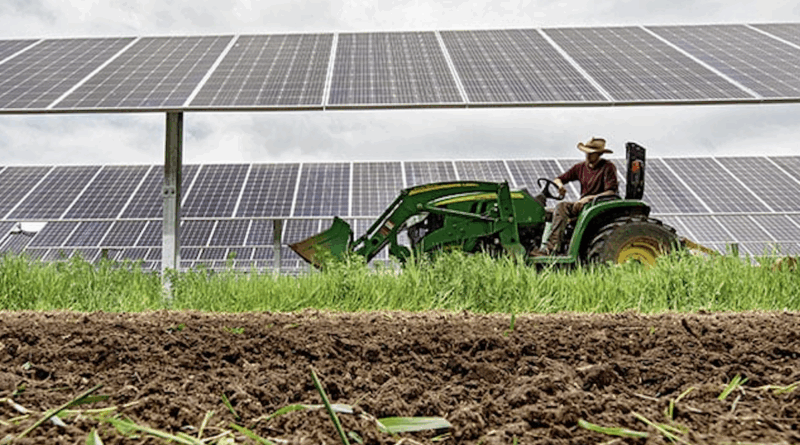 New Jersey is among the US states pursuing dual-use solar power (aka agrivoltaics) to help farmers keep farming while adding a reliable new source of revenue to their property (courtesy of NREL).
May 11, 20263 hours
Steve Hanley
0 Comments
Support CleanTechnica's work through a Substack subscription or on Stripe.
New Jersey is among the US states pursuing dual-use solar power (aka agrivoltaics) to help farmers keep farming while adding a reliable new source of revenue to their property (courtesy of NREL).
May 11, 20263 hours
Steve Hanley
0 Comments
Support CleanTechnica's work through a Substack subscription or on Stripe.
Farming is a tough business. While new fertilizers and pesticides have dramatically increased yields, they are not cheap and the costs keep going up. Irrigation is crucial to a successful growing season, but the supply of fresh water is decreasing in many parts of the world and what little is available may be contaminated by the very fertilizers and pesticides used by farmers today.
The Guardian reports that wheat farmers in Kansas are struggling because wild temperature extremes this spring have ruined their crop of winter wheat. Where once they harvested 40 to 50 bushels per acre, this year the yield is less than 2 bushels per acre. That’s not enough to pay for farm equipment, seeds, fertilizer, and pesticides.
Merrill Nielsen has been growing crops all his life on a farm his great-grandfather established in 1871. He says this year’s growing season was one of his worst in years. Wheat farmers throughout Kansas as well as those in Oklahoma, Texas, Colorado, and Nebraska report much the same thing.
The US Department of Agriculture has rated 44% of the wheat harvest in Kansas and 49% of the harvest in Oklahoma as being poor to very poor. Earlier this year, the agency estimated that US wheat acreage will be the lowest since 1919. Shel Winkley, a meteorologist at Climate Central based in Texas said, “It wasn’t just a weird, wonky March. We understand there’s something bigger here. Especially at the peak of the heat in March, we know that those temperatures would be rare or almost virtually impossible at that time of the year in the central Plains, without an influence of climate change.”
Theory Vs. Reality
One thing rural voters seem not to understand is that all those pretty red barns and tractors crisscrossing their land will cease to exist if farmers go broke. One bright spot on the horizon is renewable energy. No matter how much people march on their local councils and scream about how solar panels and wind turbines are a blight on the rural countryside, they pay farmers well for the use of their land — money that may be the difference between a successful farm and farmland being sold off for residential or commercial development. Or data centers!
It should be noted that policy decisions made on the banks of the Potomac are making life more difficult for farmers. Tariffs announced on social media have made the price of everything farmers need to make a living more expensive. That was bad enough, but then the ill-advised war on Iran sent the price of fertilizer and diesel fuel through the roof.
Blake Gendebien owns a 1,200 acre dairy farm with 500 cows in Lisbon, New York. He told The Guardian, “These rising costs are hitting us at the wrong time here in the north country in New York. I use 20,000 gallons of fuel to get my crops in the ground and harvested.” One year ago, diesel cost $2.65 a gallon. This year, it is closer to $5.00 a gallon. Simple math says he will spend $50,000 more for fuel this year than last. Do you think most farmers just have 50 grand they don’t need laying around? Think again.
According to the most recent statistics, 86% of farmers in America run small family farms, defined as having a gross income of $350,000 a year or less. The majority of those farms have high risk profit margins of 10% or less. So rising diesel costs pose a serious threat to their ability to stay in business. “It’s a massive cost for farmers that are already barely, barely getting by,” Gendebien said.
Renewable Energy Is A Farmer’s Best Friend
The latest research from RMI finds that revenue from rural solar and wind energy has become significant in some states. At the national level, it is approaching the scale of major agricultural commodities. Revenues from wind and solar are concentrated in a relatively small number of states, many of which are also among the country’s biggest agricultural producers.
In 2024, RMI says, nine states had wind and solar revenue that exceeded $1 billion. Combined they accounted for $23 billion or 63% of the national total. By comparison, cash receipts from cattle and calves, corn, and soybeans exceeded $5 billion in 15 states. Seven of these leading agricultural states were also among the leaders in wind and solar revenue, and four of the remaining eight states — Indiana, Minnesota, North Dakota, and South Dakota — had revenues of more than $500 million.
For farmers, wind and solar projects can provide predictable revenue that supports long term financial resilience. At the same time, wind and solar projects create new revenue streams for their host counties — revenue that supports rural communities. The payments farmers receive from wind and solar companies complement agricultural economies and provide additional income diversity, making them more resilient to economic shocks, like poor harvests. “As more energy infrastructure is built, counties that are intentional about land use and that embrace leading practices will be best positioned to capture these benefits,” RMI says.
A Wave Of Renewables Coming To America
It is estimated that 90% of projected solar infrastructure through 2050 will be sited on rural lands. Research institutions such as Lawrence Berkeley National Laboratory and Columbia’s Sabin Center, which track public views on energy development, find that rural residents are optimistic about economic opportunities from solar and wind. However, they are also concerned about farmland loss, visual impacts on the landscape, and potential effects on property values.
Solar and wind affect agricultural land differently and need not directly compete with agricultural practices, RMI says. Large wind projects mostly leave surrounding farm activity intact. A USDA study found that between 2012 and 2017, less than 1% of wind sites located on cropland or pasture shifted out of agriculture after installation. Solar arrays have a larger direct footprint, and the same study found that 15% of solar sites shifted away from agricultural use.
A key benefit of solar and wind development is the stable income they can provide to farmers. Income from agricultural production can fluctuate as commodity prices, production levels, and input costs change. Farmers who choose to host energy projects typically receive annual land lease or royalty payments that can help offset that volatility. For some farms, the additional revenue from a solar or wind facility can provide the stability needed to remain in operation during challenging years.
There are wider community benefits from wind and solar installations. Rural municipalities and counties receive tax payments that help fund road maintenance, schools, and other public infrastructure and services. Energy projects also create construction jobs and long term local employment opportunities.
In addition, some energy projects use community benefits agreements and other negotiated commitments to align projects with local priorities and deliver benefits that meet local needs. In Howard County, Iowa, three wind projects totaling 244 MW paid $2.7 million in taxes in 2024 — equal to 14.5% of the county’s total tax revenue.
A Host Of Benefits For Communities
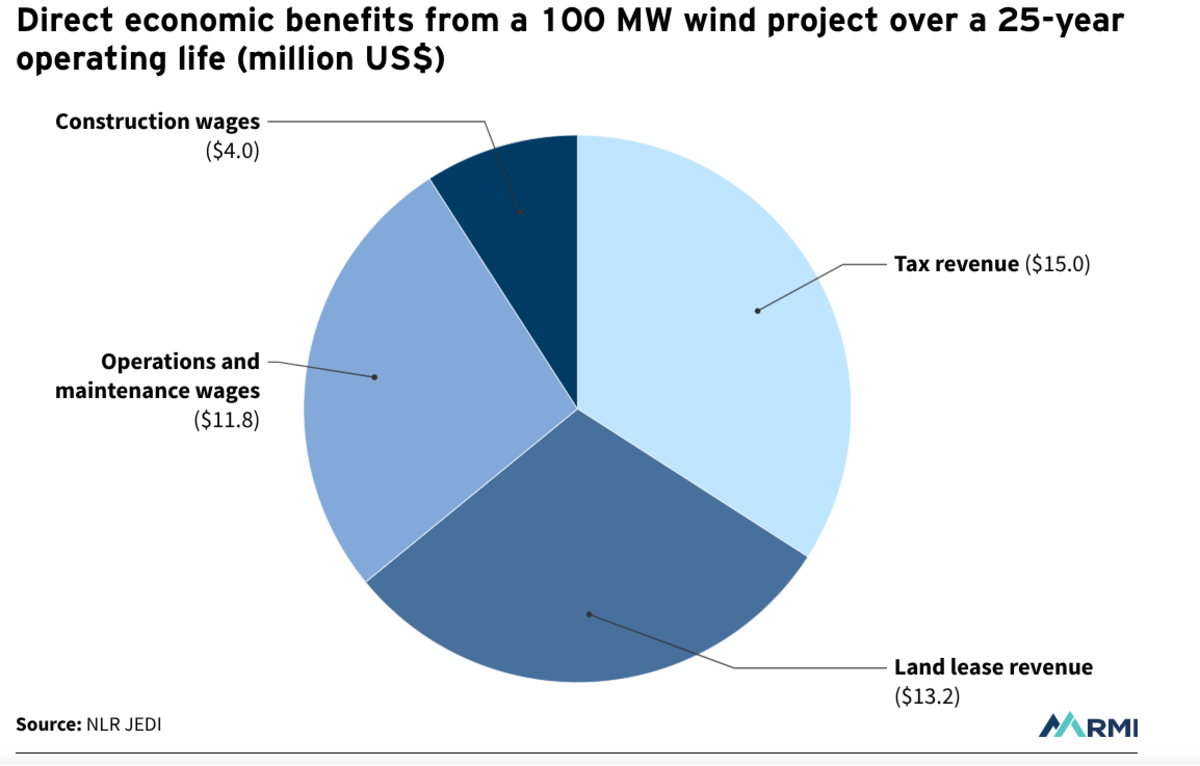
The chart above illustrates the approximate direct economic benefits that a 100 MW wind project can generate for farmers and rural communities over a 25-year operating life. The benefits of a solar project are comparable.
“Wind and solar projects are increasingly contributing to economies in rural America. These projects support financial stability and resilience for farmers and contribute to local tax revenue and employment,” RMI says. “As development continues in many rural areas, farmers, counties, and other stakeholders that are intentional about land use and structuring community benefits will position themselves well to capture this local economic value.”
The debate over “rural character” will go on (and on), powered in large part by pressure groups funded by the fossil fuel industry. Instead of bemoaning the loss of red barns, it might be better to ask farmers if they could use extra money to prevent their farmland from being sold to developers. If you are not a farmer, you probably don’t fully appreciate how stressful it is to have a pile of bills on your desk waiting to be paid while the crops you planted months ago fail to produced the hoped for harvest. “Rural character” is all well and good, but it is no substitute for having enough money to pay those bills when they come due.
Sign up for CleanTechnica's Weekly Substack for Zach and Scott's in-depth analyses and high level summaries, sign up for our daily newsletter, and follow us on Google News! Advertisement Have a tip for CleanTechnica? Want to advertise? Want to suggest a guest for our CleanTech Talk podcast? Contact us here. Sign up for our daily newsletter for 15 new cleantech stories a day. Or sign up for our weekly one on top stories of the week if daily is too frequent. CleanTechnica uses affiliate links. See our policy here.CleanTechnica's Comment Policy