Ramazan Alpaut: To Be Truly Democratic, Russia’s Opposition Must Learn to Accept Scrutiny
 By Ramazan Alpaut
May 25, 2026
By Ramazan Alpaut
May 25, 2026


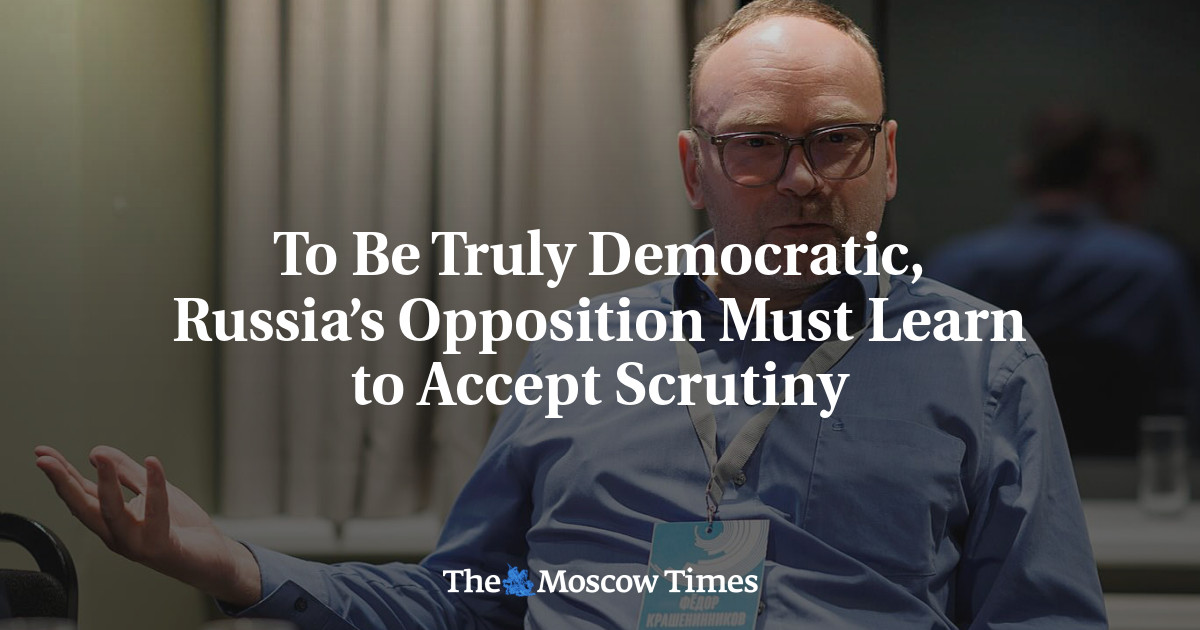
Recent revelations surrounding political commentator Fyodor Krasheninnikov have sparked outrage across the Russian-speaking internet and reminded me of a problem afflicting many members of the country’s exiled opposition.
According to media reports citing former Anti-Corruption Foundation director Ivan Zhdanov, Krasheninnikov formally worked for the organization, receiving a salary, but allegedly did not perform any actual work duties. The controversy has raised serious questions about transparency and accountability inside parts of the Russian opposition in exile.
But the problem runs deeper than one scandal.
In October 2024, I interviewed Krasheninnikov for my program Inside Out. Preparing for the interview, I noticed a clear pattern: he consistently defended the Anti-Corruption Foundation (FBK) and aggressively criticized decolonial movements inside Russia . Naturally, this raised a journalistic question — how independent was his commentary from the FBK?
I found no direct evidence at the time proving formal affiliation with FBK. However, Krasheninnikov had long-standing political and intellectual ties with one of the organization’s key figures, Leonid Volkov, having co-authored the book “Cloud Democracy” with him back in the early 2010s.
During the interview, I described FBK as an organization with which Krasheninnikov had “close ties.” He immediately denied having any connection to the foundation. There would be nothing problematic about cooperating with FBK if he openly acknowledged it. The issue was different: Krasheninnikov consistently defended the organization’s political positions — including controversial ones — while simultaneously insisting he was fully independent.
This resembles a familiar Russian political pattern: the imitation of organic civil society while informal loyalties remain hidden beneath the surface. The difference is that the Kremlin possesses vastly greater resources and coercive power.
The issue became particularly visible during debates over Russia’s potential decolonization.
In September 2024, Yulia Navalnaya spoke at the Bled Strategic Forum in Slovenia, where she argued that “decolonizing Russia” should not be part of the country’s future strategy. According to Navalnaya, those advocating urgent decolonization could not explain why people with a “shared background and cultural context” should be artificially separated. She also argued that discussing the fragmentation of Russia played into Kremlin propaganda.
The statement triggered outrage among many activists representing ethnic minorities from Russia’s republics. Krasheninnikov strongly supported Navalnaya’s position and dismissed the critics, arguing that trying to satisfy decolonial activists was politically pointless because they themselves were deeply divided.
The irony was difficult to miss. Russian opposition groups themselves are notoriously fragmented, consumed by internal conflicts, personal rivalries, and public feuds.
What happened next was even more revealing.
When I later approached Volkov for an interview to discuss the growing decolonization debate, he publicly lashed out at me on social media, insulting me personally and accusing me of “building Putinism” because I had once worked in Russian state institutions many years ago.
The reaction itself mattered less than what it revealed: for some opposition figures, independent journalism becomes acceptable only when it remains politically loyal.
A similar attitude surfaced in comments by former Navalny ally Vladimir Milov. Commenting on Ivan Zhdanov’s interview with journalist Irina Shikhman, Milov criticized journalists who, in his words, “instead of supporting us, are grading us.”
At first glance, this may sound like an emotional reaction produced by years of political struggle and exile. But underneath lies a much deeper problem: the assumption that journalists are supposed to support political opponents of the Kremlin rather than scrutinize them.
Yet journalism is not activism. Journalists are not anyone’s political allies. Their role is not to protect opposition movements from uncomfortable questions but to provide citizens with the information necessary to make informed judgments.
Ironically, this logic mirrors the political culture many opposition figures claim to oppose. The Russian state has long viewed independent journalism as disloyal precisely because journalists expose contradictions, failures and uncomfortable realities instead of serving political interests. The difference is that the state possesses the machinery of repression, while opposition figures in exile are limited mostly to moral pressure, public shaming, and social media attacks.
Milov’s comments were not an isolated slip. In a previous interview I conducted with him, I raised criticism frequently voiced online — that he tends to block people on social media simply for disagreeing with him politically. His response was revealing: “If you don’t want to be blocked, don’t be rude.” He added that blocking people “means nothing” because politics operates differently from social media.
Perhaps. But the broader issue remains.
Russian political emigration has a historic opportunity to learn democratic political culture outside the authoritarian environment of the Russian state. That includes learning to tolerate criticism, independent journalism, ideological diversity and uncomfortable questions.
Democracy does not begin when your side gains power. It begins when you accept scrutiny even when it feels unfair, inconvenient or politically harmful.
Journalists are not there to serve political movements. They are there to show society what political movements actually are.
The views expressed in opinion pieces do not necessarily reflect the position of The Moscow Times.Ramazan Alpaut
 Ramazan Alpaut is a journalist covering issues in Russia's regions.
Ramazan Alpaut
Ramazan Alpaut is a journalist covering issues in Russia's regions. Read more about: OppositionSign up for our free weekly newsletter
Our weekly newsletter contains a hand-picked selection of news, features, analysis and more from The Moscow Times. You will receive it in your mailbox every Friday. Never miss the latest news from Russia. Preview Subscribe Subscribers agree to the Privacy Policy We sent a confirmation to your email. Please confirm your subscription.A Message from The Moscow Times:
Dear readers,
We are facing unprecedented challenges. Russia's Prosecutor General's Office has designated The Moscow Times as an "undesirable" organization, criminalizing our work and putting our staff at risk of prosecution. This follows our earlier unjust labeling as a "foreign agent."
These actions are direct attempts to silence independent journalism in Russia. The authorities claim our work "discredits the decisions of the Russian leadership." We see things differently: we strive to provide accurate, unbiased reporting on Russia.
We, the journalists of The Moscow Times, refuse to be silenced. But to continue our work, we need your help.
Your support, no matter how small, makes a world of difference. If you can, please support us monthly starting from just $2. It's quick to set up, and every contribution makes a significant impact.
By supporting The Moscow Times, you're defending open, independent journalism in the face of repression. Thank you for standing with us.
Once Monthly Annual Continue Not ready to support today?
 Remind me later. ×
Remind me next month
Схожі новини

В Слуге народа отрицают обсуждение завершения «горячей фазы» войны до ноября
Внаслідок удару по Одесі пошкоджено об'єкт інфраструктури, постраждали двоє людей – МВА
Russian drone strikes high-rise building in Sumy, causing damage