Pee for the planet: How Football fans are tackling Sweden’s fertiliser problem using urine

 Facebook
 Twitter
 Flipboard
 Send
Send
 Reddit
 Linkedin
 Messenger
 Telegram
 VK
VK
 Bluesky
 Threads
 Whatsapp
Could pee hold the answer to Europe’s fertiliser crisis? Swedish football fans are taking to the toilets to find out.
Swedish football fans will take part in a very different kind of tournament this year: peeing for the planet.
 ADVERTISEMENT
ADVERTISEMENT
ADVERTISEMENT
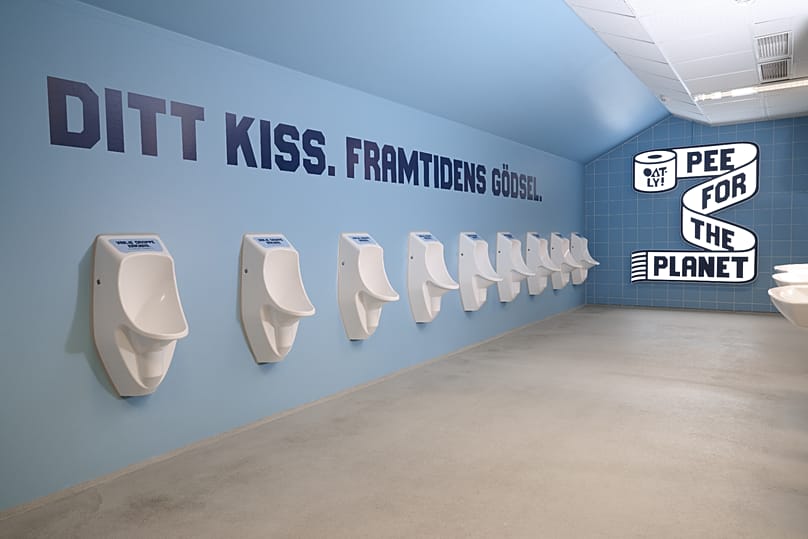
Eleda Stadion, home of Malmö FF, will open its doors – and its toilets – on Sunday (24 May) to an initiative aiming to gather 1,000 litres of human urine.
The goal? To defeat Sweden’s dependence on imported fossil fuel-based synthetic fertiliser.
Globally, these nitrogen-based fertilisers generate 1.13 billion tonnes of CO2 equivalents annually – exceeding those of the total aviation sector, according to research by the Center for International Environmental Law (CIEL).
While these emissions have long raised concern among climate experts, synthetic fertilisers have come under additional fire in recent weeks as geopolitical instability threatens supplies.
With Iran’s continued blockage of the vital Strait of Hormuz shipping route, around a third of the world’s fertiliser trade has been put on hold, threatening farming and food security around the world.
The Strait is also key for transporting natural gas exports – critical in the production of synthetic nitrogen-based fertilisers, which are widely used in Europe and beyond.
RelatedIs human urine a viable alternative to synthetic fertilisers?
Human urine is rich in ‘the big three’ nutrients essential to plant growth: nitrogen, phosphorus and potassium. These are also key ingredients of synthetic fertilisers.
The Swedish University of Agricultural Sciences (SLU), oat milk maker Oatly, Malmö FF and Sanitation360 have teamed up to research the viability of urine as a circular and safe alternative to fertilise crops, which they will do by converting the urine collected at the stadium into fertiliser.
“It’s about making use of a resource we currently waste,” says Björn Vinnerås, Professor at SLU and expert at Sanitation360.
“We also need to challenge the way we think, because collecting and reusing urine is really no stranger than doing the same with plastic. Today, we already use manure from cows, pigs and chickens as fertiliser – and that is completely normalised.”
RelatedA testing ground for scaling the concept
Malmö FF’s home stadium has been fitted with 15 urinals and one toilet capable of collecting urine for the project.
From kickoff this Sunday up until Malmö FF’s final home match of the Swedish season on 29 November, it will be a testing ground for this urine-collecting technology, as well as hygiene, logistics, and public acceptance of it.
The safety of urine-derived fertiliser for food crops is also being assessed as part of the research – a key question given concerns around pharmaceutical residues and pathogens that must be addressed before the approach can be adopted at scale.
If successful, the project could open up opportunities to adapt toilet infrastructure and design future systems capable of collecting urine on a mass scale.
It also has the potential to solve another problem: the burden of wastewater treatment at large venues such as the 22,500-capacity stadium. Some of the nutrients in human urine are currently not recovered and instead end up as pollutants in lakes and seas.
The researchers estimate that urine could theoretically replace up to 30 per cent of the synthetic fertiliser used in Sweden.
A longer-term ambition of the researchers is also to explore whether consumers are ready to embrace food produced using circular nutrients derived from urine.
Go to accessibility shortcuts Share CommentsRead more

Türkiye's sci-fi-esque solar city sets new standards for design
Схожі новини
Iran switches World Cup base from U.S. to Mexico
Gael Monfils thankful to have inspired other Black tennis players