Olly Robbins refused to give Mandelson vetting summary to Cabinet Office, says Cat Little
In evidence to MPs, Cabinet Office top civil servant disputes that her department suggested vetting might not be needed
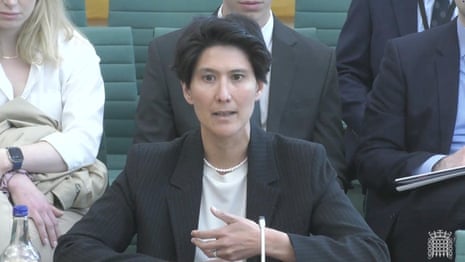
The Foreign Office refused to hand over a summary of Peter Mandelson’s security vetting to the civil servant tasked with compiling documents detailing his appointment as ambassador to the US, she has told a Commons committee.
Cat Little, the lead official in the Cabinet Office, had to instead get the document directly from UK Security Vetting (UKSV) after Olly Robbins, the subsequently-sacked Foreign Office head, refused to provide it.
Giving evidence to the foreign affairs committee, Little also said she had not yet been able to track down a formal record of Keir Starmer approving Mandelson’s appointment as part of her department’s response to a Commons motion forcing the release of documents linked to the process. She said such a document would normally exist.
But she supported the prime minister’s insistence that normal processes were followed in the appointment, despite UKSV initially refusing clearance for vetting, which was ovverruled by Robbins, who gave evidence to the same committee on Tuesday. “So my view is that due process was followed,” she said.
Writing for the Guardian on Thursday, Richard Dearlove, the former head of the British Secret Intelligence Service, said it was “extraordinary” that Mandelson’s appointment was announced before vetting was completed. The appointment of Mandelson, he said, suggested that Starmer “failed to take account of the inherent risk – as did the PM’s advisers”.
Robbins told MPs he was briefed that UKSV considered Mandelson “a borderline case”, but Dearlove said: “Staff who do not meet the DV requirements for whatever reason are barred from positions that demand DV clearance. There are no grey areas or soft edges.”
Speaking later on Thursday, Starmer hit out at opposition politicians who, he said, had argued it was implausible that Robbins would have made that decision and then not inform the prime minister or anyone else in Downing Street.
“Turns out my political opponents were completely wrong about that,” he said. “Then they said that I was dishonest. It turns out they were completely wrong about that.”
Little’s evidence did nonetheless highlight the uncertainties and tensions over both the initial Downing Street decision to make Mandelson the ambassador, and the aftermath of his dismissal from the role over his links to the convicted child sex offender Jeffrey Epstein.
Questioned by Emily Thornberry, the committee chair, Little confirmed evidence from Robbins on Tuesday that there had been internal debate about whether to release vetting documents about Mandelson to parliament following the “humble address”. As part of this, she said, Robbins resisted her department seeing vetting documents.
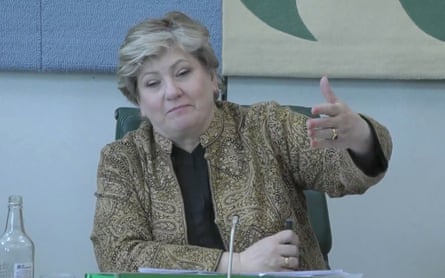
There was, she explained, “lots of debate and discussion about how to treat vetting information”, which included a meeting in mid-March with Robbins and his team, after being told about the existence of a summary as to why Mandelson was refused vetting.
“I specifically asked to see this document in any decision-making audit trail around those judgments,” she said. “At the time, it was made clear to me that that information would not be forthcoming.”
In response, Little said, she “took the very unusual judgment” to go directly to UKSV, which sits within the Cabinet Office, so she would be able to comply with the Commons instruction to provide all the information about Mandelson.
This was, she said, “a responsibility unique to me, and I take very seriously. I felt that I needed to see some relevant documentation so that I could advise the prime minister as to whether we had fully complied [with the humble address] and gathered the information that was available and within scope.”
Questioned about the claim that the Cabinet Office had suggested Mandelson might not need vetting at all, Little said this was suggested by the Foreign Office.
Emails she had seen, she said, “set out … a very reasonable policy conversation between security officials whereby the Foreign Office personnel security team get in touch with UKSV and the government security group in the Cabinet Office and ask the question: could they get some advice?
“Because the presumption had been that given Peter Mandelson had been a member of the House of Lords, that the longstanding convention that he didn’t require developed vetting was assumed, and they wanted to get proper policy advice from experts on whether that was the case.”
The response, she said, was that this was a decision for the Foreign Office, but that vetting was needed.
Asked about the delay between her first knowing in late March that Mandelson had been initially blocked and Keir Starmer being told on 14 April, Little rejected the idea that there had been an undue delay, saying she had to first seek advice.
She said: “I believe I have a responsibility to handle that sensitive information within the framework of both the law and the guidance that I am subject to, and I did not feel that I could share that information until I understood the consequences and the authority that I had to share the information.”
She added: “It took the time between 25 March and telling the prime minister on 14 April, and I truly believe that I acted as swiftly and effectively and appropriately as I could.”
The committee is due to hear more evidence relating to Mandelson’s vetting next week, when former Downing Street chief of staff Morgan McSweeney will answer MPs’ questions. On Thursday, it was announced that Robbins’ predecessor at the Foreign Office, Sir Philip Barton, will also give evidence on Tuesday.
Contact us about this story
The best public interest journalism relies on first-hand accounts from people in the know. If you have something to share on this subject, you can contact us confidentially using the following methods:
Secure Messaging in the Guardian app
The Guardian app has a tool to send tips about stories. Messages are end to end encrypted and concealed within the routine activity that every Guardian mobile app performs. This prevents an observer from knowing that you are communicating with us at all, let alone what is being said.
If you don’t already have the Guardian app, download it (iOS/Android) and go to the menu. Select ‘Secure Messaging’.
SecureDrop
If you can safely use the tor network without being observed or monitored you can send messages and documents to the Guardian via our SecureDrop platform.Our guide at theguardian.com/tips lists several ways to contact us securely, and discusses the pros and cons of each.
Show moreСхожі новини
Кличко: Київ потребує значних коштів і держпідтримки для підготовки до нового опалювального сезону
MoE Shmyhal: Ukraine restores 1 GW of TPP capacity out of planned 3.8 GW
Зеленський: Україна готова спрямувати перший транш із пакету ЄС у EUR90 млрд на армію, ППО та підготовку до зими