‘Not democratic’: opponents and backers of assisted dying bill remain divided
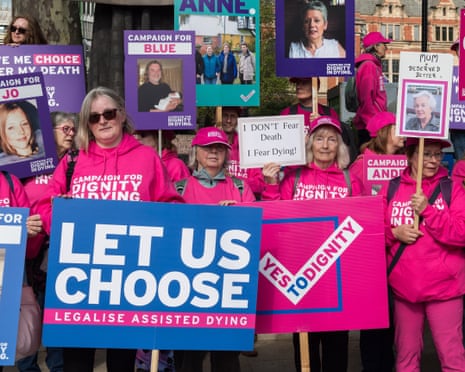
Recriminations continue over failure to bring in new laws allowing assisted dying for terminally ill people in England and Wales
Amid the failure of an attempt to bring in new laws allowing assisted dying for terminally ill people with less than six months to live, campaigners on both sides of the debate vented their anger and frustration with the opposing side.
Its supporters, including terminally ill people, blamed the failure of the terminally ill adults (end of life) bill, which passed in the House of Commons, on sabotage by a handful of unelected peers.
But opponents, who include MPs, peers and disability activists, argued the proposed legislation failed because it was poorly drafted and did not address practical concerns about how assisted dying would work in practice.
Sarah Wootton, chief executive of Dignity in Dying, said a handful of peers, whom she described as “implacable opponents of assisted dying”, had dominated debates in the Lords and rained down amendments in order to talk out the bill. “It’s absolutely shameless what a tiny group, less than 1% of the unelected, the upper house, has done,” she added. “Their role is to scrutinise, not to block.”
Hannah Slater, 38, who has terminal breast cancer, described the bill’s failure as “not democratic”. “It’s devastating for people who want to be able to choose how to die when we’ve got a terminal illness. It’s just very, very frustrating that this choice is being taken away at the last moment. It feels really cruel and unfair.”
But one of the seven peers most criticised by the bill’s supporters said she and other opponents had been unfairly lambasted. Tanni Grey-Thompson, a cross-bench peer and former Paralympian, who raised concerns including the efficacy of life-ending drugs and their administration during pregnancy, said: “The bill fell because it’s badly written. It needs to be much, much tighter than what we’ve got.”
Grey-Thompson said criticism of the 1,200 amendments added to the bill failed to acknowledge the complexity of the process. One objection would require laying multiple amendments to all relevant sections of the proposed legislation. For example, her amendment for the bill to use the accepted legal term “disabled people”, rather than people with disabilities required 12 separate amendments.
“Our role is to kind of look at the geeky technical stuff. I think it’s been difficult because of the pressure to nod stuff through has been quite intense. It’s not just a handful of people that are opposed to it.”
Pete Donnelly, a disability rights campaigner, praised the peers’ amendments, adding that without them the legislation “would have been waived through” without adequate scrutiny. Donnelly, who is concerned that assisted dying legislation would be widened to cover disabled people, described the bill as “unsafe [and] lethal”.
“This should be put through as a government bill so it is taken through that process where it will be fully scrutinised. Because at the moment it is kind of skeleton legislation with so many gaps, whether that is in terms of process, in terms of safeguards, in terms of the drugs that will be being used.”
Labour MP Josh Fenton-Glynn, who abstained on the second Commons’ reading of the bill, said he thought it still lacked sufficient safeguards to protect terminally ill people from coercion by relatives.
Fenton-Glynn, a member of the health select committee, said: “Ultimately, I think any proponent of assisted dying would want to see a safe and workable bill and I don’t think it was that. I would be very happy if they made a good faith attempt to try to fix some of these problems but just doggedly reintroducing the same bill with the same problems gives us a choice between voting against a dangerous bill or not. My position would sadly remain unchanged.”
Labour peer Luciana Berger said the bill should have received the same pre-legislative scrutiny as other private members’ bills on issues of conscience. For example, the private member’s bill that introduced abortion and stopped capital punishment “had a commission that preceded the bill arriving in the House of Commons”, she said.
“Essentially they replicated that really important piece of pre-legislative scrutiny to ensure that the bill already had engaged with those professional bodies whose members will be responsible for delivering on a bill, to ensure the legislation reflected what could practically be done.”
Humanists UK’s chief executive, Andrew Copson, said: “Nobody can seriously argue this bill has not been scrutinised enough. Assisted dying has faced unprecedented scrutiny, more than any private member’s bill in history, even before it reached the Lords. Opponents often talk as though this is an entirely novel question, when in reality, assisted dying laws are already operating in more than 36 jurisdictions serving hundreds of millions of people. This is one of the most examined reforms in parliament, not one of the least.”
Explore more on these topicsShareReuse this contentСхожі новини

Why Donald Trump’s '600% saving' claim on drug prices doesn’t add up

Міністр Федоров про 3 місяці на посаді: діагностували більшість хвороб системи; березень став рекордним за втратами російських сил

Russian forces strike Balakliia; casualties reported