Norwegian fish farms polluting fjords with waste likened to ‘raw sewage of millions of people’

Exclusive: ‘Fish sludge’ in coastal waters now has nutrient levels equivalent to those in untreated effluent of country the size of Australia, report finds
Norwegian fish farms are filling fjords and other coastal waters with nutrient pollution equivalent to the raw sewage of tens of millions of people each year, a report has found.
Norway is the largest farmed salmon producer in the world, and nutrients in fish feed are excreted directly into coastal waters. Analysis from the Sunstone Institute found that Norwegian aquaculture released 75,000 tonnes of nitrogen, 13,000 tonnes of phosphorus and 360,000 tonnes of organic carbon in 2025.
The nutrients are equivalent to those contained in the untreated sewage of 17.2 million people for nitrogen, 20 million people for phosphorus, and 30 million people for organic carbon, the report found, raising fears of destructive algal blooms.
“Norway is a small country of just 5.5 million people, and the output of aquaculture pollution in terms of these three nutrients is three to five times larger than the population,” said Alexandra Pires Duro, a data scientist at Sunstone and author of the report. “The faeces, the uneaten feed, the urine – everything goes into the water.”
Fish in farms are fed pellets of nutrient-rich feed in open-net cages as they are grown for human consumption. The analysts calculated the mass of nutrient inputs that remained in the water using data from the national fisheries directorate and veterinary institute.
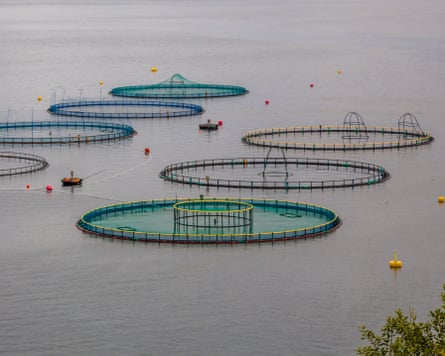
Researchers found feed consumption had increased by 14.6% over a six-year period, in line with industry expansion, producing nutrient pollution in 2025 that equated to levels expected in the raw sewage of a country about the size of Australia. In a separate analysis, the report authors found that seasonal variation aggravated the problem, with nutrient load highest in summer months when ecosystems are least able to absorb it.
Fish sludge from nutrients can fertilise phytoplankton and lead to destructive algal blooms that deplete oxygen levels. Fjords are particularly vulnerable to such effects because they are semi-enclosed bodies of water, allowing for greater accumulation of nutrients. Their oxygen levels are already declining because of global heating.
In Sognefjord, the country’s longest fjord, increased nutrient inflows – not just from fish farms – were held responsible for about two-thirds of the oxygen depletion, a study found last year, while warmer water was blamed for the other third.
Oxygen levels in deep waters have also declined in the second-longest fjord in Norway, the Hardangerfjord, according to the country governor for Vestland.
In March, officials rejected nine applications for fish farms in the fjord on account of the increased emissions they would cause. Tom Pedersen, an environmental adviser for the region who served as an expert reviewer on the Sunstone report, said the figures in its analysis were unsurprising and even “on the conservative side”.
“The major concern we experienced in the last few years is that all these algae and plankton and whatever die and they sink down to the bottom of the floor and they decompose – and that process uses oxygen,” he said. “The end result is that the oxygen level in the fjord is going down, and has gone down.”
The Norwegian fisheries ministry referred a request for comment to the fisheries directorate, which declined to comment.
Krister Hoaas, head of public affairs at the Norwegian Seafood Federation, the main industry association, said the volume of emissions reflected how much food is produced in Norway, and the degree of self-sufficiency the country would have in an emergency. He said the industry was working continuously to make its environmental footprint as small as possible.
“It is important to distinguish between current operations and questions about future growth,” he added. “The Institute of Marine Research is clear that a significant increase in production in certain fjord systems could increase the risk of eutrophication locally, but that current production is well within nature’s carrying capacity. This provides a basis for strict, site-specific management, but does not document that current operations are destroying the fjords.”
Explore more on these topicsShareReuse this contentСхожі новини
Tigers' Tarik Skubal to undergo surgery on left elbow

Why were Louis Sammartino reaction videos struck? YouTuber Outdoor Boys move fuels LosPollosTV copyright fight and online outrage

Дроны атаковали Ленинградскую область, в аэропорту ввели ограничения
