North Korea: New report sheds light on chemical weapons
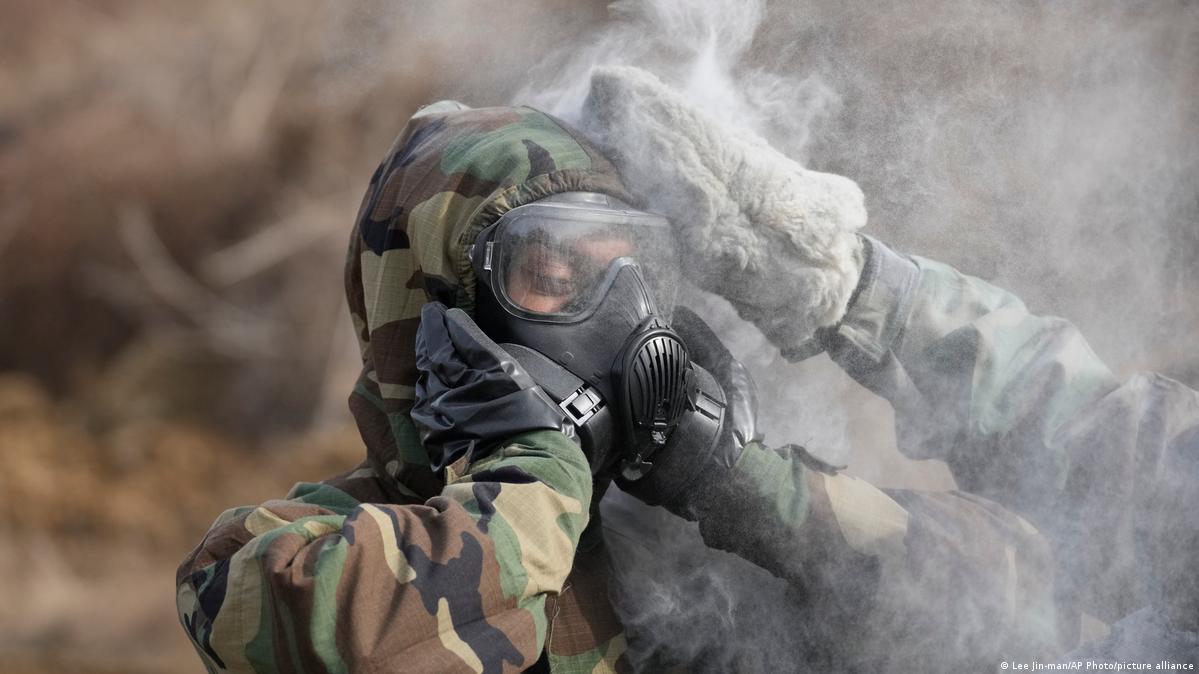
A new report released last week has revealed clues on North Korea's chemical weapons program by combining information on more than 30,000 patents and journal articles.
The report published on the 38 North website was based on research carried out under "Project Anthracite," a multi-year effort led by the Royal United Services Institute (RUSI) security think tank in London to use open source materials to produce a "networked overview" of North Korea's chemical weapons potential.
The report points out that industrial facilities, universities and government-run research institutions have the equipment and access to adequate feedstocks to produce a number of chemical weapons agents.
Although the report emphasizes that it does not prove production of chemical weapons in North Korea, it does add to the existing intelligence by "providing a feasibility baseline and identifies indicators worth monitoring."
"Taken together, the most striking insight from this analysis is not the presence of any single 'smoking gun,' but the convergence of multiple, discrete indicators that point towards embedded industrial capability," the report says.
'Little known' about North Korea's chemical weapons
And that assessment tallies convincingly with other reports and is a cause for concern among experts.
Especially as Pyongyang demonstrated in 2017 a clear willingness to use a chemical weapon, when agents assassinated Kim Jong Nam, the brother of North Korean dictator Kim Jong Un, with the VX nerve agent at Kuala Lumpur airport.
"It is absolutely clear that North Korea can and has made chemical weapons, with the use of VX in 2017 confirming that," said Professor Margaret Kosal, director of graduate studies at Georgia Institute of Technology.
"Compared to other former and suspected current offensive chemical warfare programs, we don't know a lot about the DPRK's program," Kosal told DW, pointing out that similarly little is known about the regime's biological warfare and nuclear capabilities.
"But based on what can be inferred they have capabilities to produce large amounts of sulfur mustard — often incorrectly described as 'mustard gas' — and some amount of nerve agents," said Kosal, an expert on weapons of mass destruction who advised US administrations of presidents George W. Bush and Barack Obama on the threats posed by chemical weapons.
"They can probably produce large amounts of nerve agents like sarin. And some amount of VX," she added.
It was previously believed that the program was designed to be a "poor man's nuclear weapon" to serve as a deterrent before the North had truly developed an atomic capability, but there appear to be multiple reasons why the North continues to invest in chemical weapons, Kosal said.
"Most likely is to be used operationally to hinder South Korean soldiers, including along the North-South border," she said. "In the event of conflict, use against civilian centers like Seoul is likely planned."
As much as 5,000 tons of chemical weapons
North Korea is believed to have stockpiles of between 2,500 and 5,000 tons of chemical weapons.
Dan Pinkston, a professor of international relations at the Seoul campus of Troy University, told DW the regime would have little compunction in using the weapons if it assessed its imminent collapse.
"There is paranoia within the regime and the rationale there is that any kind of lethal capacity is for its own safety," said Pinkston, who authored a report for the International Crisis Group on the North's chemical and biological weapons programs in 2009.
Despite the horrors associated with chemical weapons, Pinkston believes that should conflict break out on the peninsula, chemical weapons would be used before a nuclear attack.
"A nuclear attack by the North would be met by overwhelming retaliation that would end the regime there," he said. "But if a conflict was going against the North, and South Korean troops were advancing on Pyongyang, then the North could use chemical weapons to degrade or delay that operation."
On the battlefield, the consequences could be appalling, particularly among civilians caught up in any fighting and not equipped with protective equipment.
"It would be awful," Pinkston said. "We have plenty of examples, unfortunately, such as Iraq using chemical weapons against Iranian forces in the 1980s, Syria doing the same against rebels and civilian populations, and there are also reports of Russia using them in Ukraine."
"Some say that chemical weapons are a taboo because what they do to the human body is so horrific and so indiscriminate, but North Korea is not a signatory to the Chemical Weapons Convention and there are examples of them using this stuff, so I see no signs that they will give them up," Pinkston said.
Alarm at additional data
Ryo Hinata-Yamaguchi, an associate professor specializing in military issues at Tokyo International University, is equally alarmed at the latest data emerging from North Korea.
"This builds on information from other sources, including high-ranking defectors, so we have to take this very seriously," he said.
"Having said that, and while we know that the regime is ruthless and cruel, we do not know how effective these will be as weapons, including the systems that they need to deliver them to the battlefield," he said.
But he agrees that the regime would not hesitate to at least attempt to use them to stave off final collapse.
"They have shown that they had no concerns about using VX in a public space in 2017, the North regularly defies international law and I believe they see chemical weapons as having a useful psychological impact," he said.
"I feel they would use anything they could to level the playing field against a technologically superior opponent, so, worryingly, the likelihood of the North using chemical weapons in wartime conditions is quite high."
What lessons is North Korea learning from the Iran war?
To view this video please enable JavaScript, and consider upgrading to a web browser that supports HTML5 video
Edited by: Wesley Rahn
AdvertisementСхожі новини

Суд арештував майора поліції, підозрюваного у зґвалтуванні 14-річної дівчини в Запоріжжі, - ДБР
Війська РФ обстріляли з реактивної артилерії Прудянку на Харківщині

Угорщина не надсилатиме зброю до України, - Мадяр на зустрічі з Рютте