New alliances shakes up Nigerian political landscape

 AFP via Getty Images
Two of Nigeria's most prominent opposition figures have announced they have switched parties in a dramatic political realignment ahead of next year's presidential election.
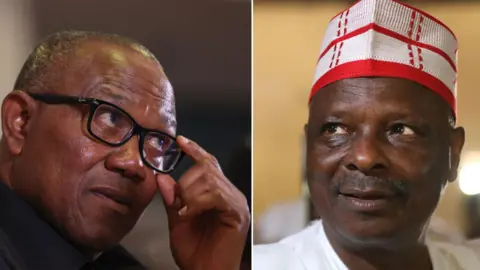
Peter Obi and Rabiu Kwankwaso, who finished third and fourth respectively in the 2023 presidential race, have both joined the Nigeria Democratic Congress (NDC), raising the prospect of a joint ticket to challenge President Bola Tinubu.
They were previously in the African Democratic Congress (ADC), along with former Vice-President Atiku Abubakar, who came second in the last election.
While this could be seen as a fragmentation of the opposition, supporters of Obi and Kwankwaso say it will give their alliance greater focus.
Both men are former governors and command significant grassroots followings.
Obi is hugely popular among young voters across the south, while Kwankwaso wields considerable influence in the north.
The move comes just nine months after Obi, Kwankwaso and Abubakar joined the ADC but that alliance quickly became mired in legal battles over party leadership - something Obi blamed on the government.
Nigeria plans to repatriate nationals willing to leave South Africa after attacks
"The same Nigerian state and its agents that created unnecessary crises and hostility within the Labour Party that forced me to leave now appear to be finding their way into the ADC," Obi said on Sunday.
He was the Labour Party candidate in the 2023 election.
Allies of President Tinubu have denied that they have been trying to sabotage opposition parties.
Obi, 64, and Kwankwaso, 69, were formally received at the NDC's national headquarters in Abuja by the party's national leader, Senator Seriake Dickson, on Sunday.
Speaking afterwards, both men called for national unity, greater opportunities for young people, and an end to the infighting that has plagued Nigeria's opposition.
However, their decision risks upsetting allies within the coalition built around the ADC, which had been positioning itself as the main vehicle for opposition unity.
Some figures within the bloc have privately expressed a sense of betrayal, raising fresh doubts about whether Nigeria's fragmented opposition can sustain a coordinated challenge against President Tinubu, 74.
In a statement, the Nigerian presidency played down the significance of the defections, suggesting they reflected "the normal fluidity of democratic politics" rather than any fundamental shift.
A presidential spokesperson said the government remained focused on governance.
"Political alliances will come and go," the spokesperson said. "But our priority is delivering economic reforms, improving security and ensuring stability for all Nigerians."
Political analyst Bala Yusuf told the BBC the move could reshape Nigeria's electoral landscape.
"If the NDC fields Obi as its presidential candidate and Kwankwaso as vice-president, they will definitely give the ruling APC a run for their money at the polls," he said.
They have not yet said who the presidential candidate will be - an issue that has broken up several previous Nigerian political alliances.
It remains to be seen how Abubakar will respond, given that he was a key figure who went to great lengths to bring opposition heavyweights into the ADC.
Meanwhile, the party's leadership crisis continues to play out in the courts.
The Supreme Court last week ordered that the dispute over who runs the party be sent back to the Federal High Court for another hearing – a decision that further reduces the time available for the ADC to get its house in order before the election campaign begins in earnest.
Elections are scheduled for early January next year - they will be the country’s eighth since the end of military rule in 1999.
More about Nigeria from the BBC:
Behind Nigeria's murky coup plot - the money, the prayers and a Nollywood arrest
Nigerian wins global prize for trying to save bats in a country that shuns them
 Getty Images/BBC
Go to BBCAfrica.com for more news from the African continent.
Follow us on Twitter @BBCAfrica, on Facebook at BBC Africa or on Instagram at bbcafrica
BBC Africa podcastsAfrica Daily
Focus on Africa
NigeriaAfricaСхожі новини
Міноборони РФ в односторонньому порядку оголосило перемир'я на 8-9 травня

Суд заарештував на 60 днів бійців "Вовків Да Вінчі", підозрюваних у викраденні людини на Дніпропетровщині
ADF neutralized 70 of 88 Russian drones since morning