Nepal: Mount Everest ice block obstructs large group of spring climbers
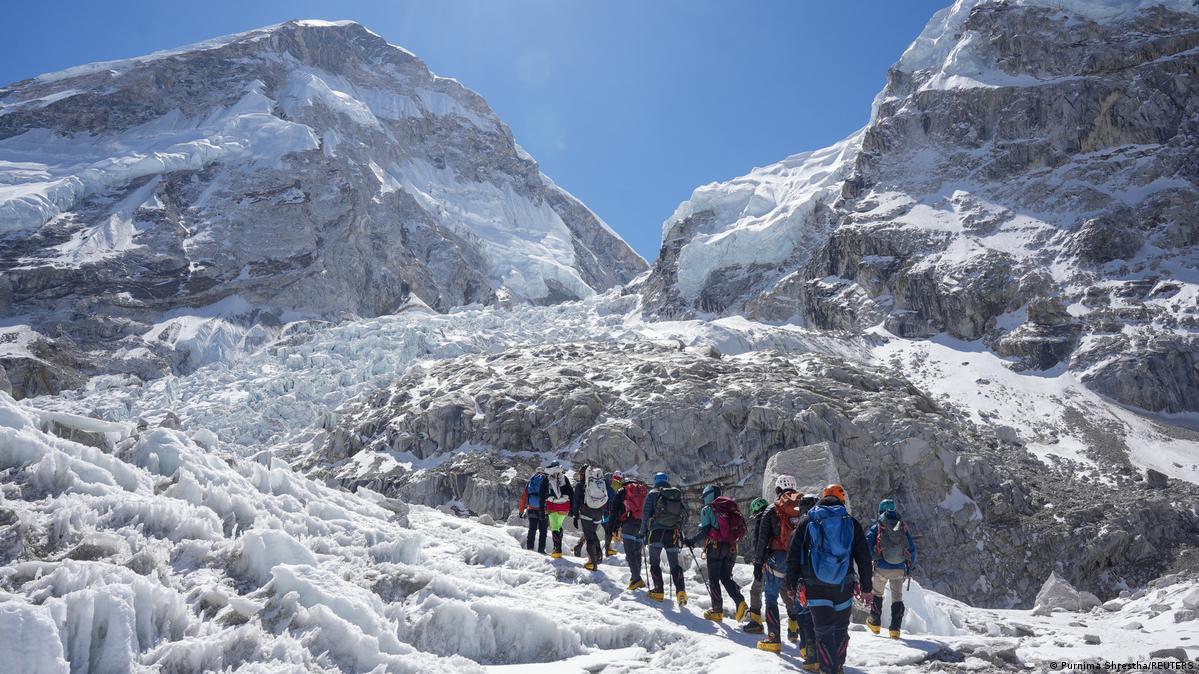
A dangerous chunk of glacial ice, or serac, not far above Mount Everest's Base Camp is blocking the climbing route to the summit and shortening the already-brief window for climbers in the busiest spring season.
Nepal's government has issued 410 permits for tourist climbers his season, with mountaineering a major revenue stream for the small country that's home to eight of the world's 10 highest peaks.
What's causing the delay and why can't it be cleared?
A team of the so-called "icefall doctors," specialist climbers who clear the path of more minor ice obstructions for the less experienced mountaineers, began fixing ropes and ladders on Mount Everest last month to prepare for the spring climbing season.
But the large serac above the treacherous Khumbu Icefall, at an altitude of more than 5,300 meters (roughly 17,400 feet), could collapse without warning and unleash a deadly avalanche.
"This is not something you can fix or move," said Himal Gautam, spokesperson for the Department of Tourism. "It's natural. We can only wait and assess."
Icefall doctor Dawa Jangbu Sherpa told the AFP news agency that the team "expect that it will clear in a few days."
The Khumbu Icefall, a constantly shifting maze of crevasses and ice blocks, is located just above Mount Everest Base Camp and is seen as one of the most dangerous parts of the South Col ascent even under normal circumstances.
Himal Gautam said that a team of experts would head to the site to monitor and "devise an alternative plan if needed."
"We are trying to ensure that there are no delays, even drop supplies by a helicopter, so that routes can be prepared on schedule," he said.
A remote tent village of around 1,000 people — foreign climbers and support staff — has built up at safer altitudes on the 8,849-meter mountain, waiting to make for the summit.
Crowded climbs amid mountaineering boom
The spring season, the busier of the two with warmer temperatures than the autumn window between September and November, typically concludes by the end of May.
Acclimatization and base camp preparations take place from March to late April, while sherpas clear the path, and the summit window tends to be in May.
Monsoon risks make the summer months unsafe for almost all climbing activity, despite the comparatively clement temperatures.
Climbing has become big business in the Himalayas, and particularly on Everest, since Tenzing Norgay and Edmund Hillary became the first confirmed duo to reach the summit of the world's highest peak in 1953.
Tibet: Rescued hiker recalls being stranded on Mount Everest
To view this video please enable JavaScript, and consider upgrading to a web browser that supports HTML5 video
The 410 permits this spring season are close to the all-time record of 479 set in 2023.
Congested climbing routes, even mountain traffic jams as groups get in each other's way have become common on the mountain, as have other signs of overcrowding like litter and detritus.
The shorter the time period teams have to try to scale the vast mountain, the more such risks are amplified.
Autumn summits in 2019 were also thwarted by a serac
The caution dealing with the vast glacial ice blocks can be traced in no small part back to 2014, when 16 Nepali guides were killed by an avalanche as a chunk of the same glacier sheared off.
It was one of the deadliest accidents in Everest's climbing history.
Edited by: Sean Sinico
AdvertisementСхожі новини

Вам знадобиться звичайна кава: чому цибуля жовтіє і як це виправити
Ця спеція захищає город від хвороб не гірше за спецзасоби: чим обробити рослини
Фонд держмайна продав з аукціону відомий аеродром біля Франківська