Mysterious green rocks in Pyrenees cave hint that prehistoric people were working copper there for 4,000 years
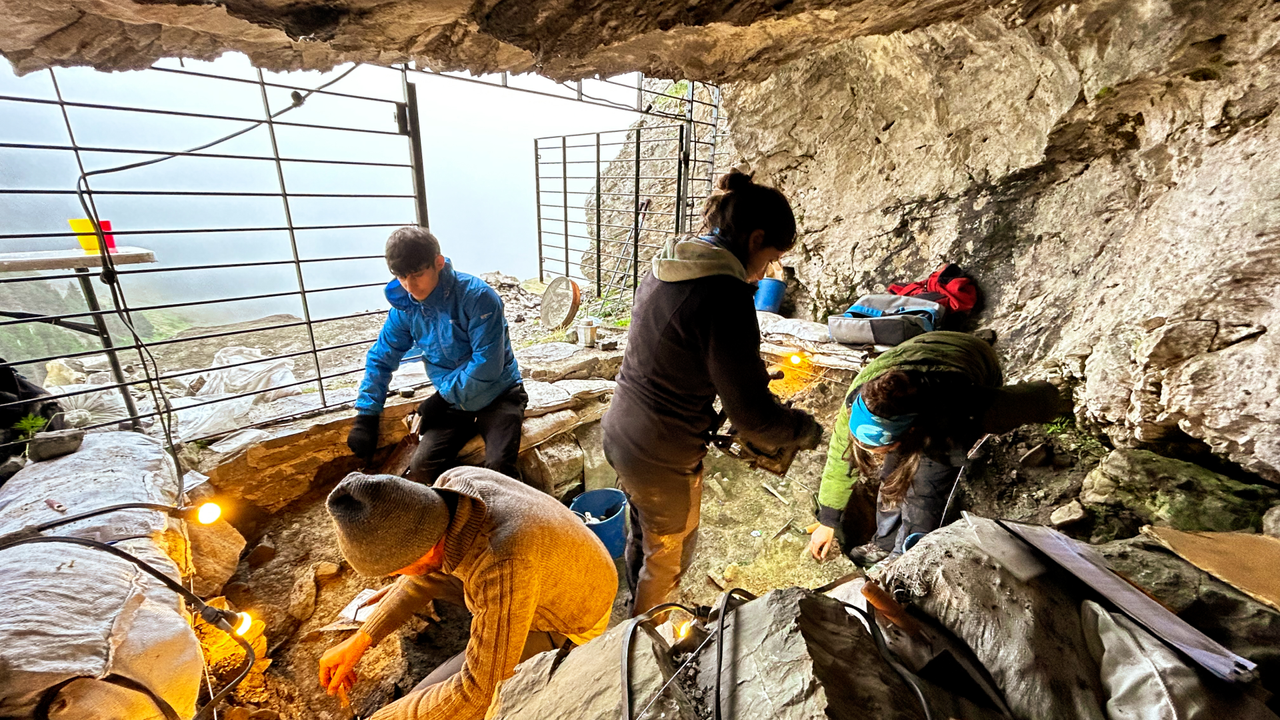
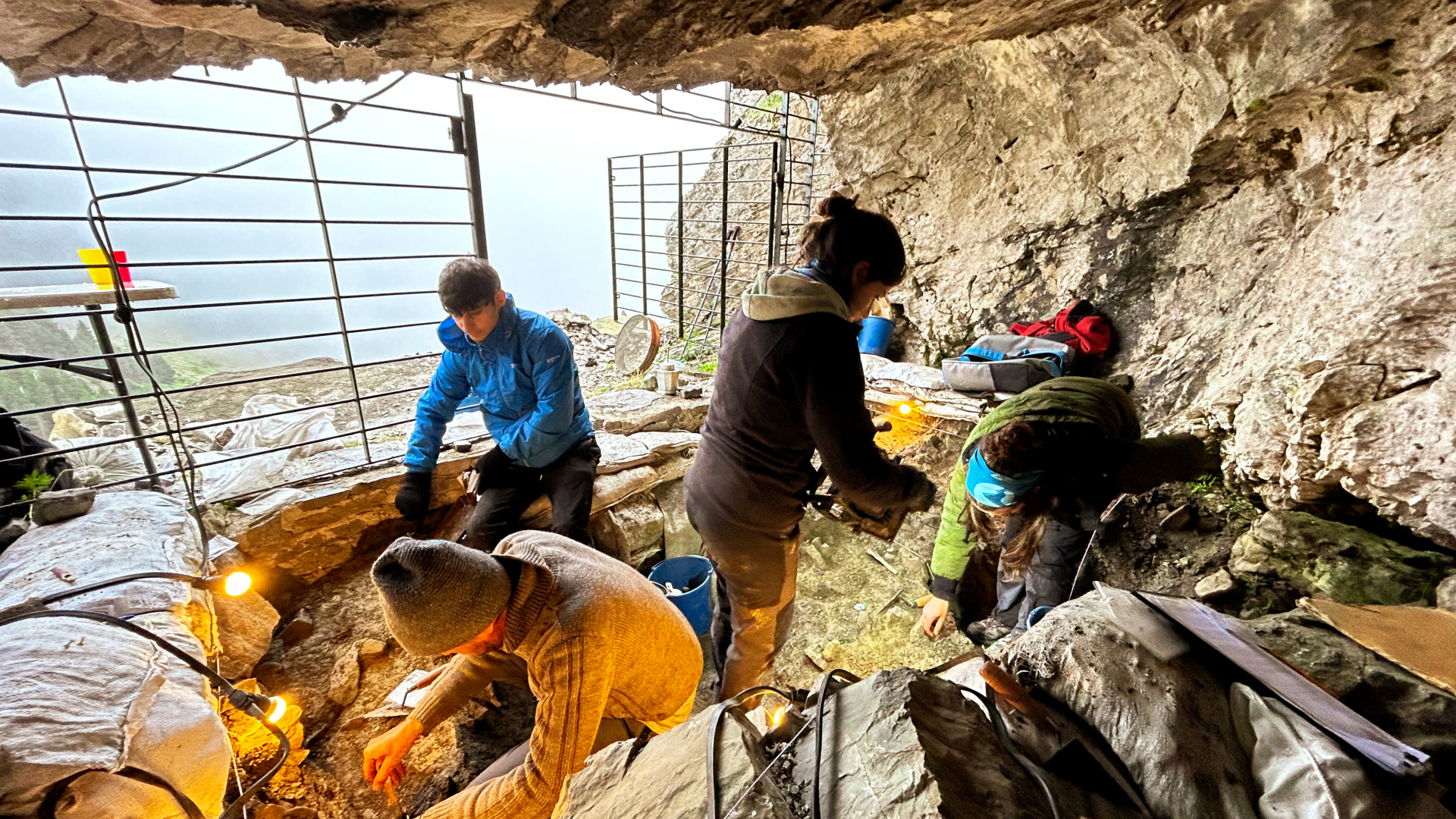
A mysterious green rock discovered high in the Pyrenees suggests that prehistoric people maintained a high-altitude copper mining camp in Spain for more than four millennia, according to archaeologists. The cave was filled with layers of green mineral fragments and abundant pieces of charcoal, which suggests that people repeatedly returned to the seasonal camp for generations.
Archaeologists discovered the cave at around 7,333 feet (2,235 meters) above sea level in the Spanish province of Girona, near the mountainous border with France. Inside, the researchers found human remains, animal bones, broken ceramic vessels and prehistoric fireplaces — all evidence that people used the cave for more than 4,000 years. They also uncovered close to 200 pieces of the mysterious green rock that was not naturally present in the cave.
The Copper Age (also called the Chalcolithic) of prehistoric Europe lasted from about 5000 to 2000 B.C. During this time, people began exploiting natural reservoirs of copper to create tools, jewelry and vessels. For example, Ötzi the Iceman had a copper ax in his possession when he died in 3300 B.C., and some experts think he may have been exploring the Alps to procure copper-rich minerals.
It is relatively simple to extract copper from a mineral like malachite. The copper-carbonate mineral is heated, which releases carbon dioxide and turns the green mineral into a black residue called copper oxide. The copper oxide is then subjected to a carbon source, like charcoal, which releases carbon dioxide and leaves a small copper nugget.
The high-altitude cave that archaeologists excavated in the Pyrenees had nearly 200 fragments of a green mineral they believe is malachite, along with dozens of combustion pits, or prehistoric fireplaces where people likely processed the mineral to extract copper.
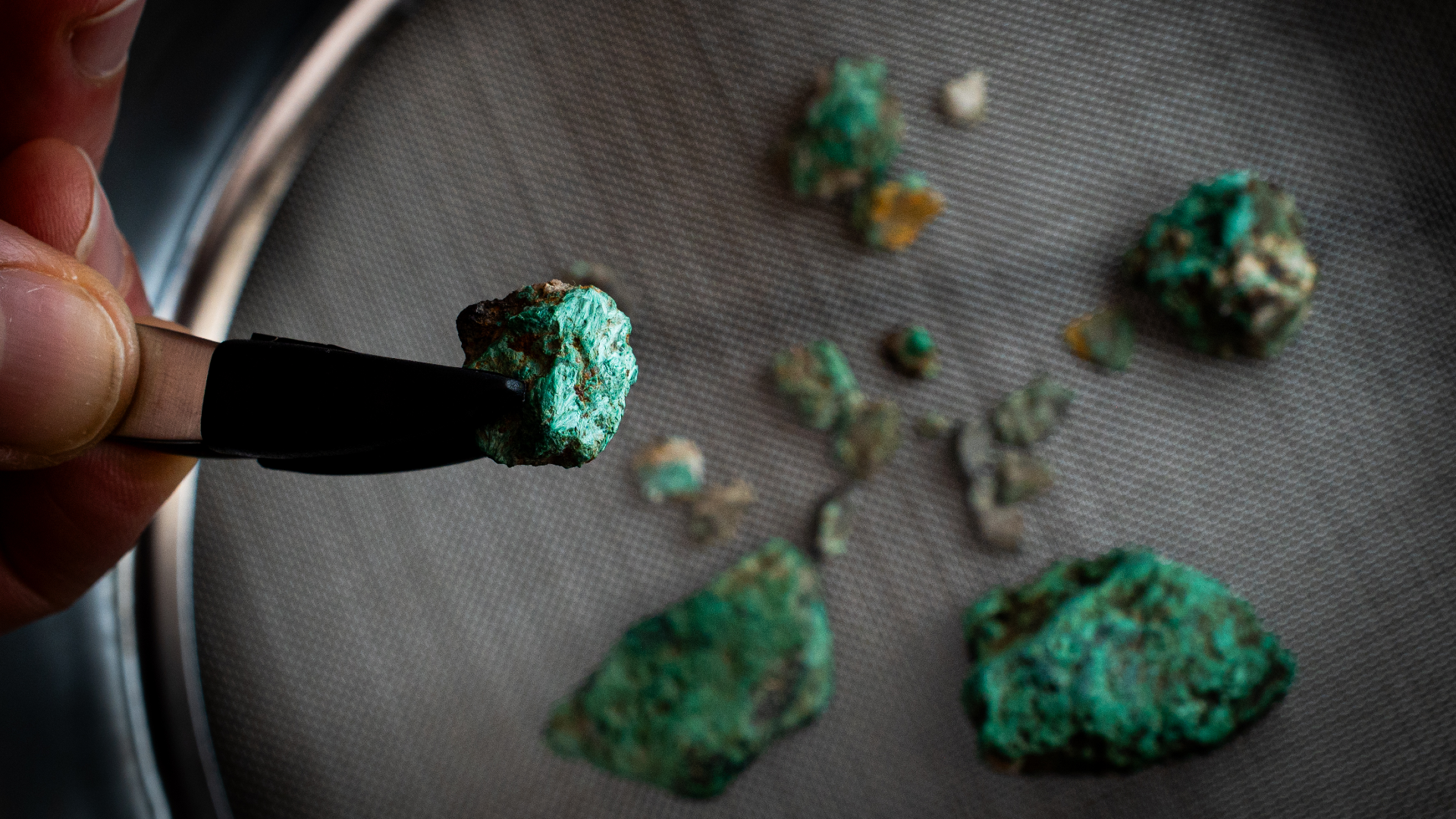
Researchers recovered dozens of fragments they suspect to be malachite, a copper-rich rock, from an archaeological site high in the Pyrenees.
"Many of these fragments are thermally altered, while other materials in the cave are not, which clearly suggests that fire played an important role in their processing and that there was a deliberate intention behind it," study co-author Julia Montes-Landa, an archaeologist at the University of Granada, said in a statement. "In other words, they weren't burned by accident."
Sign up for the Live Science daily newsletter nowThe earliest occupation of the cave happened between 5000 and 4300 B.C., according to the study, but the most intensive use was between 3600 and 2400 B.C., at the height of the Copper Age.
The archaeologists also recovered two personal ornaments and human remains from the most intensive occupation of the cave. One piece of jewelry was an elongated pendant made from a clamshell (Glycymeris), and the other was a brown bear (Ursus arctos) tooth that had been perforated to wear as a pendant. The human remains included a baby tooth and a finger bone, which could suggest that the cave was used as a funerary deposit, the researchers wrote in the study.
"For the first time in the Pyrenees, high-mountain prehistoric occupations of significant intensity have been documented, characterized by repeated activities and the direct exploitation of mineral resources within the cave," study first author Carlos Tornero, a prehistoric archaeologist at the Autonomous University of Barcelona and a researcher at the Catalan Institute of Human Paleoecology and Social Evolution, said in a separate statement.
RELATED STORIES
- 'A flash of copper caught our attention': 4,000-year-old dagger discovered deep in Italian cave
- Copper Age woman survived two skull surgeries up to 4,500 years ago
- Highest-ranking person in Copper Age Spain was a woman, not a man, genetic analysis shows
Given the intense exploitation of the cave over thousands of years, knowledge of the site and its resources must have been transmitted across generations, the researchers noted in the study.
"This site demonstrates that the Pyrenees were not a marginal territory for prehistoric communities, but a space fully integrated into their mobility strategies and territorial exploitation," Tornero said.
The team expects to continue their excavation for several years. They also plan to confirm the identification of the green rock as malachite in the near future, which will help them better understand the ultimate purpose of the processing activities that took place in the cave for thousands of years.
Article SourcesTornero, C., Diez-Canseco, C., Soler, R., Calvo, S., Delgado-Raack, S., Messana, C., Montes-Landa, J., Morales, J.I., Picornell-Gelabert, L., Soriano, E., Carbonell, E. (2026). Beyond 2,000 meters, first evidence of intense prehistoric occupation in the Pyrenees. Frontiers in Environmental Archaeology. http://dx.doi.org/10.3389/fearc.2026.1811493
See how much you know about gemstones with our gold and gems quiz!

Kristina Killgrove is a staff writer at Live Science with a focus on archaeology and paleoanthropology news. Her articles have also appeared in venues such as Forbes, Smithsonian, and Mental Floss. Kristina holds a Ph.D. in biological anthropology and an M.A. in classical archaeology from the University of North Carolina, as well as a B.A. in Latin from the University of Virginia, and she was formerly a university professor and researcher. She has received awards from the Society for American Archaeology and the American Anthropological Association for her science writing.
View MoreYou must confirm your public display name before commenting
Please logout and then login again, you will then be prompted to enter your display name.
LogoutСхожі новини

NASA just turned a retired Boeing 777 into a powerful airborne science lab: How a passenger jet became a flying laboratory for 100 scientists

NASA wants to land astronauts on the moon in 2028. Will SpaceX's Starship or Blue Origin's Blue Moon lander be ready in time?