Mercedes Adds New EQS & C-Class Electric To Line Up
 Credit: Mercedes
April 23, 20263 hours ago
Steve Hanley
0 Comments
Support CleanTechnica's work through a Substack subscription or on Stripe.
Credit: Mercedes
April 23, 20263 hours ago
Steve Hanley
0 Comments
Support CleanTechnica's work through a Substack subscription or on Stripe.
Sales of battery powered Mercedes cars have been below expectation, particularly for the top-of-the-line EQS. But the company has not hunkered down in a corner to suck its thumb the way some American manufacturers have done. Instead, it has gone back to the drawing board to give customers more of what they do want and less of what they don’t. This is a sales strategy that many commercial enterprises have used to great advantage.
Mercedes EQS Revisited
Mercedes has largely abandoned the EQ designation for its battery electric models, preferring instead to market them as electric versions of its tried and true conventional cars. Originally, the EQS was intended as a sister to the mighty S-Class sedan. Despite slow sales, the company has updated that car significantly and decided to keep the EQS designation.
There are a host of changes to this latest version, however, as detailed by Autocar. The battery now has 3 percent more oomph — 122 kWh versus 118 kWh — thanks to a chemistry change. The result is that the single-motor EQS 450+ now has 575 miles of range, making it one of the longest range electric cars available. The dual-motor version comes in slightly less at 544 miles.
The new EQS uses 800-volt architecture instead of 400-volt, which allows the car to use fast chargers with up to 350 kW of power. Mercedes says the electric motors represent a “generational leap” from those used previously. They are said to be more compact, more efficient, and more robust, while the amount of energy they can recapture during regenerative braking is one third higher at 385 kW.
The new EQS also gets an upgraded version of the Airmatic air suspension system fitted to the new electric GLC and updated S-Class. The system uses data from the cloud to prepare the dampers for potholes and speed bumps in the road ahead.

For those who want the newest new thing, the EQS is now available with a steer-by-wire system that replaces the traditional steering column with a virtual linkage to save space and weight. The icing on the cake is the old fashioned steering wheel is gone. It has been replaced by a yoke that limits movement to just 270 degrees. Gone are the days of cranking the world through two full revolutions to make a U turn. For some, that will be a “must have” feature.
Deliveries are expected to begin in the second half of this year. And the price? If you have to ask, you can’t afford it, but be prepared to fork over more than 135 large ($135,000) to put one of these beauties in your driveway.
Mercedes C-Class Electric
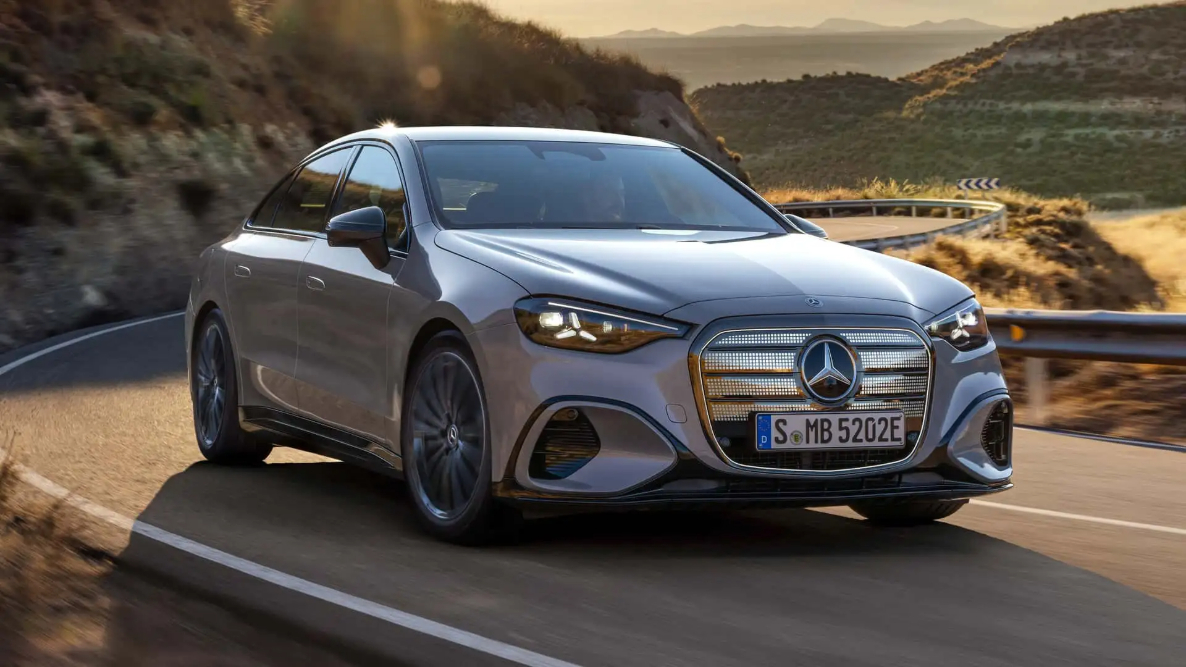
The Mercedes EQC broke cover 7 years ago, which is ancient history in the car business (except for Tesla). Like the original EQS, sales were below expectations. Now Mercedes has a successor to that car and it is called quite simply the C-Class Electric.
According to Motor1, it is the most spacious C-Class yet. Its dedicated EV platform has a wheelbase that is 3.8 inches (97 mm) longer than the conventional C-Class. That extra length translates into improved legroom for those riding up front and the standard panoramic glass roof provides increased headroom for all occupants.
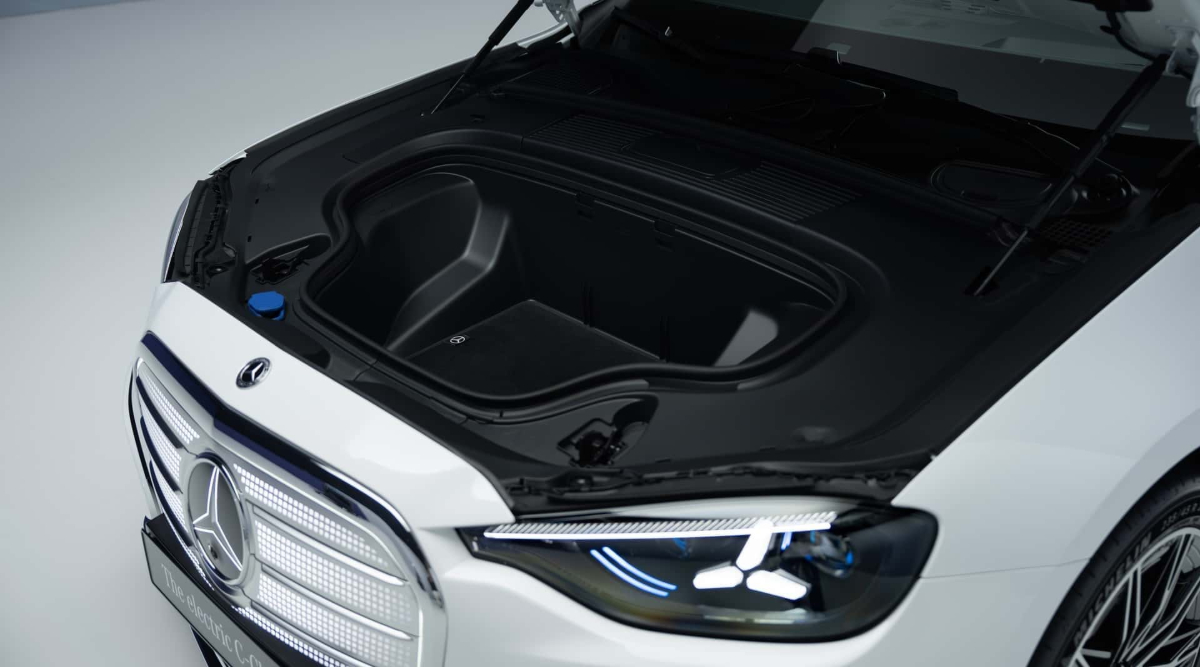
The EV architecture also allows room for a frunk with 3.5 cubic feet (101 liters) of capacity. The standard trunk in the rear offers 16.6 cubic feet (470 liters) of carrying capacity. Mercedes quotes a maximum towing capacity of 3,968 pounds (1,800 kilograms), should the need to use a trailer arise.
As with the electric GLC, Mercedes is launching the C-Class Electric lineup with a C400 4Matic variant. It features dual motors producing 482 horsepower and 590 pound-feet (800 Newton-meters) of torque, paired with a 94.5 kWh lithium-ion battery pack. Range is claimed to be 473 miles (762 km) using the WLTP cycle. EPA range is typically 10 to 15 percent less, but that still suggests an EPA range of at least 400 miles.
While that figure falls short of the smaller CLA’s 492 mile (792 km) range, it still marks a clear improvement over the GLC. The electric sedan travels about 30 miles (49 km) further than its crossover counterpart, primarily because of its more aerodynamic shape. The C-Class Electric has a drag coefficient of just 0.22, compared to the GLC’s 0.26.
When it comes to charging, the new C-Class Electric can add up to 202 miles (325 km) of range in just 10 minutes, provided it is plugged into a fast charger capable of delivering 330 kW of power. To further ease range anxiety, Mercedes plans to introduce a rear-wheel-drive, single-motor version with a range of roughly 497 miles (800 kilometers) on a full charge.
Mercedes describes the C-Class Electric as the “sportiest C-Class ever.” The electric sedan can be equipped with rear-wheel steering of up to 4.5 degrees, which reduces the turning circle to 36.7 feet (11.2 meters). At speeds below 43 mph (70 km/h), the rear wheels turn in the opposite direction to the front wheels. Above that speed, the rear wheels turn up to 2.5 degrees in the same direction as the front wheels to enhance stability.
[There is no mention of what happens if the car crosses the line between below 43 mph and above 43 mph in the middle of a corner, but we are certain Mercedes has thought of that and when we get our long term test vehicle, we intend to find out.]
Performance is brisk. 0 to 60 mph (96 km/h) takes just 3.9 seconds, which is stepping right along. Top speed is electronically limited to 130 mph (209 km/h).
The optional adaptive air suspension with predictive damping scans the road ahead using Google Maps data and cloud-based real-time inputs, preparing the suspension for upcoming imperfections. To ensure long-distance comfort comparable to the S-Class or EQS, Mercedes includes noise-insulating laminated glass for the front windows, a quieter air conditioning system, and additional sound insulation throughout the cabin.

Motor1 said that for now the C-Class Electric is “available exclusively as a sedan, although Mercedes already sells an electric CLA Shooting Brake.” Whether a direct rival to the BMW i3 Touring will follow remains to be seen. In the meantime, the C400 4Matic sedan is scheduled to arrive at US dealerships in the first half of 2027.
In the silly geegaws-we-could-do-without department, owners can specify an optional grille with 1,050 illuminated pixels. Selecting that option also unlocks lighted three-pointed stars in the glass roof. The star motif in the headlights and taillights define the car as a Mercedes for those outside the vehicle.
“Overall, the design is exactly what you would expect — essentially a sedan version of the electric GLC without the controversial egg-like styling of the larger EQE and EQS sedans and SUVs,” says Motor1.
Sedans are not in big demand in the US, where drivers prefer SUVs by a wide margin, so sales in the US may not be as robust as hoped. But an SUV version of this car should appeal to lots of people with the financial wherewithal to own a Mercedes. No pricing details have been announced as of yet, but we expect it to be within $100 of whatever an equivalent BMW costs.
Sign up for CleanTechnica's Weekly Substack for Zach and Scott's in-depth analyses and high level summaries, sign up for our daily newsletter, and follow us on Google News! Advertisement Have a tip for CleanTechnica? Want to advertise? Want to suggest a guest for our CleanTech Talk podcast? Contact us here. Sign up for our daily newsletter for 15 new cleantech stories a day. Or sign up for our weekly one on top stories of the week if daily is too frequent. CleanTechnica uses affiliate links. See our policy here.CleanTechnica's Comment Policy
Share this story!
Схожі новини
Негода в Україні: вітер повалив дерева на дороги і розтрощив «швидку», яка приїхала на виклик

АМКУ дав 10 днів найбільшим АЗС для врегулювання цін на пальне
