Meet the 18-year-old whose prize-winning invention takes on the microplastics emergency

 Facebook
 Twitter
 Flipboard
 Send
Send
 Reddit
 Linkedin
 Messenger
 Telegram
 VK
VK
 Bluesky
 Threads
 Whatsapp
Ayra Satheesh has been crowned the European winner for the 2026 Earth Prize for her work on tackling microplastics.
At just 18-years-old, Ayra Satheesh is taking on one of the biggest environmental challenges of our time.
 ADVERTISEMENT
ADVERTISEMENT
ADVERTISEMENT
The Irish student was today (11 May) announced as the European winner for the prestigious Earth Prize, the world’s largest environmental competition that empowers young people with mentorship and $100,000 (€85,000) in funding.
Satheesh received the accolade for her project Eco Purge, a biodegradable plastic that breaks down safely while releasing catalysts that help remove other existing microplastics from the environment. She has already collaborated with researchers at Irish universities UCD Dublin and ATU Letterkenny, as well as the BiOrbic Bioeconomy Research Centre, while still at school herself.
Thanks to a $12,500 (€10,624) prize, the aspiring scientist plans to scale-up her invention for real-world use in products like packaging and compost bags. It will be no easy feat, considering how difficult it is to make biodegradable plastics durable enough for everyday use.
Introducing Europe’s 2026 Earth Prize winner
“It’s a dream come true,” Satheesh said in an interview with Euronews Earth. “I still can’t believe I’m the winner.”
Satheesh, who hopes to complete a PhD in enzymatic engineering or biotech in the next 10 years, says she was inspired to create Eco Purge following one of her earlier projects that monitored water quality. She found that microplastics could easily be detected, but not removed.
“At that time, plastic and microplastics were a big common issue,” she explains, warning that microplastics have become so ubiquitous they’ve even been found in drinking water and breast milk.
Related“I just wanted to know what plastic was, and then I started my research on how microplastics and nanoplastics were formed, how they get into our body and the impacts they can have in our daily lives. Then I looked for solutions.”
Satheesh developed a plant-based plastic that can carry special enzymes. By embedding these enzymes inside the material, they remain stable and are released gradually as the plastic degrades, allowing them to continue breaking down microplastics in different environments like soil, fresh water and salt water.
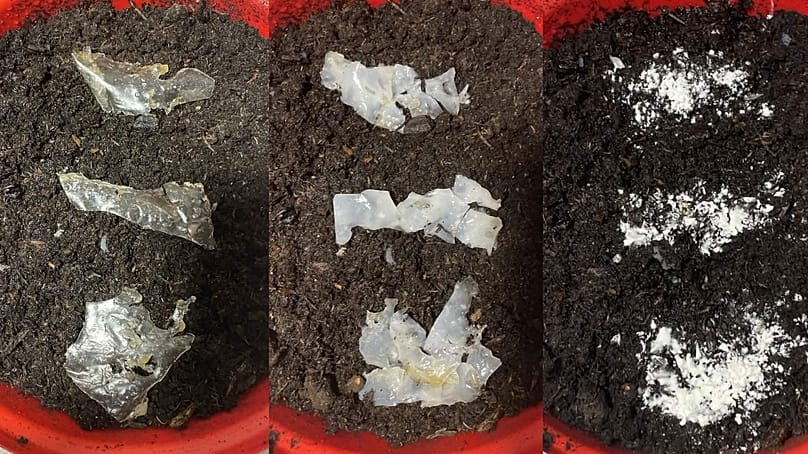
This method involves genetically modifying a bacterium to produce the enzyme, which despite high initial costs, will eventually become more cost-effective. Satheesh plans on using half of her prize money to test this theory, observing the growth and effectiveness of E.coli after the modified bacteria are introduced to produce the enzyme.
If her theory is successful, she will use the rest of the money to scale-up production. If not, she will go back to the lab to research how this can be achieved.
Addressing Europe’s plastic epidemic
As Europe’s winner, Satheesh has also urged multinational companies in the EU to stop using plastic.
She recognises such a move would be “really hard” to achieve, but argues that recycling alone will not fix the plastic epidemic, with only nine per cent of the 240 million tonnes of plastic produced annually actually being recycled.
Fossil fuel giants also profit from plastic consumption, using petrochemicals in thousands of everyday items to sustain the demand for oil and gas amid the rise in renewables.
Reusing and opting for biodegradable plastics as much as possible is still better than adding to plastic waste, Satheesh adds.
A public vote will soon open to crown the global winner of the Earth Prize on 29 May. You can find out more about the competition here.
Go to accessibility shortcuts Share CommentsRead more

Inside the race to tap into ‘superhot’ geothermal energy
Схожі новини

$200 million divorce battle: Iranian heiress accused of shielding family assets from husband

Indian-origin woman’s body found in car boot in UK; family to travel to Britain seeking justice
Three major Japan shipping firms forecast profit falls for fiscal 2026