Lost 9th-century manuscript containing earliest English poem found in a Rome library

 Facebook
 Twitter
 Flipboard
 Send
Send
 Reddit
 Linkedin
 Messenger
 Telegram
 VK
VK
 Bluesky
 Threads
 Whatsapp
Copy/paste the article video embed link below:
Whatsapp
Copy/paste the article video embed link below:
 Copied
A 9th-century manuscript held in Rome has revealed the earliest known Old English poem, Caedmon’s Hymn, hidden within a copy of Bede’s Ecclesiastical History of the English People.
In the archives of a Roman library, researchers have made an astonishing discovery: a 9th-century manuscript copy of the oldest known poem in the English language - missing, until now.
 ADVERTISEMENT
ADVERTISEMENT
ADVERTISEMENT
The lost copy of the Hymn of Caedmon was uncovered in the archives of the National Central Library of Rome.
The author of the nine-line poem is said to be a cowherd from Whitby in North Yorkshire, who was inspired after a divine visitation.
The composition praising God for the creation of the world, was composed in the 7th century, and survived thanks to its inclusion in some copies of the Ecclesiastical History of the English People, an 8th century history of England written in Latin by the venerable Bede, a northern English monk and saint.
Related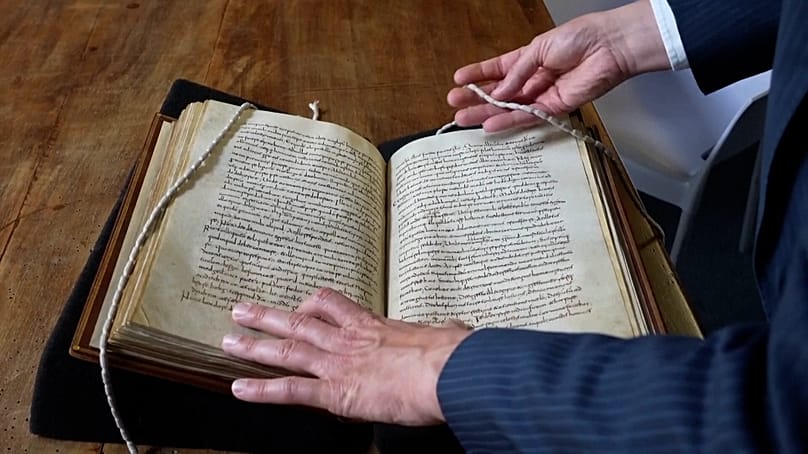
How the poem ended up in an Italian library
The story of how a piece of England's oldest literature found itself in an Italian library is, in its own way, as remarkable as the poem itself.
The copy was made in the 9th century by a monk at Nonantola, a Benedictine abbey in northern Italy - one of the great centres of medieval scholarship - who carefully transcribed the text into a volume of Bede's Ecclesiastical History.
Then, at some point lost to time, the manuscript disappeared. It was presumed gone forever - until that copy was digitised and made available around the world by the Rome library.
The two Trinity College experts who made the discovery, Dr Elisabetta Magnanti and Dr Mark Faulkner, studied the book from Dublin, thanks to the online digital copy. They travelled to Rome and finally got to handle the manuscript and see the ancient text for themselves.
"Bede's Ecclesiastical History of the English People is one of the most widely copied works in the Middle Ages, there's almost 200 manuscripts. But the most famous two are the earliest two, one of which is in Cambridge, one is in St. Petersburg," says Dr. Faulkner, an Associate Professor in Medieval Literature at Trinity College Dublin.
"Then there's a much smaller number of slightly later copies of which this is one. We're talking a handful, maybe five or six, and the fact that this has now been recognised as a copy of the Ecclesiastical History will be very important for how we understand the transmission of Bede’s text."
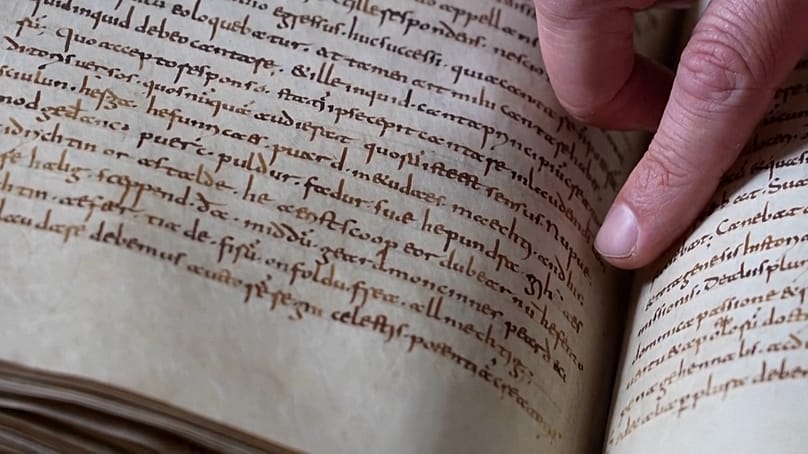
Two older copies of the text, in Cambridge and St Petersburg show the poem in Latin with the Old English text added at the end or at the edges of the pages (margins).
This newly discovered text is significant because the poem in Old English is presented within the main body of the Latin manuscript.
"The Rome manuscript is the earliest one to incorporate in the text. Prior to the discovery of the Rome manuscript, the earliest one was from the early 12th century. So this is three centuries earlier than that. And so it attests to the importance that was already being attached to the English in the early ninth century,” says Faulkner.
The academic also points out the unusual punctuation - points, or full stops - which is not present in other versions of Bede's History.
This is the first early copy of Caedmon's Hymn discovered since the 1920s and the third oldest surviving text of the poem.
A window into how English texts spread across medieval Europe
This copy of the manuscript reveals important information about the transmission of Bede's text from Northumbria southward, with some textual variations. Not only it is testimony to the presence of English text in Italy, it demonstrates pilgrimages and cross-cultural contacts between England and Italy in the Middle Ages.
Dr. Andrea Cappa, the Head of Manuscripts and Rare Books Reading Room, National Central Library of Rome, says this is part of a broader project the library has been carrying with the aim of making it possible for everybody around the world to access the vast collection of thousands of rare books the library has.
“The discovery made by the experts of Trinity College is just one starting point, a single manuscript that might pave the way for countless other discoveries, in countless other fields, through international cooperation like this, collaboration among diverse experts working as a team,” he says.
Go to accessibility shortcuts Share CommentsRead more

Spanish police find lost 17th-century manuscript for sale online
Схожі новини

Alien smuggling and ...: Iranian national pleads guilty in US court to two serious crimes
Trump becomes first U.S. leader to visit China since ’17 as high-stakes summit looms
Japan suspends Eddie Jones for verbally abusing officials