Lion's head pendant: An ancient Egyptian board game piece that was later repurposed into a magical religious object with baboons
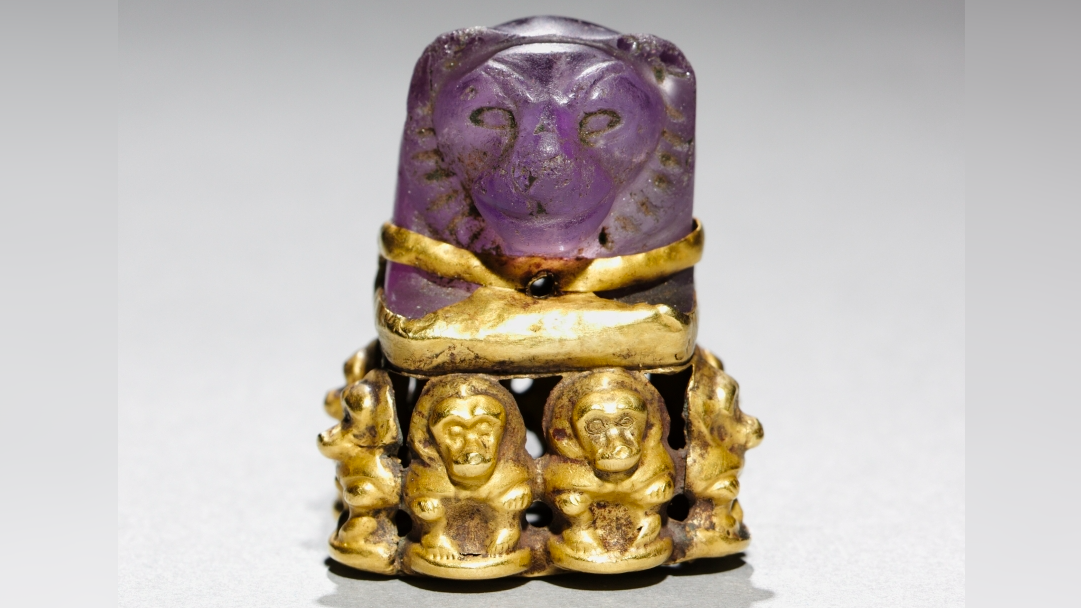
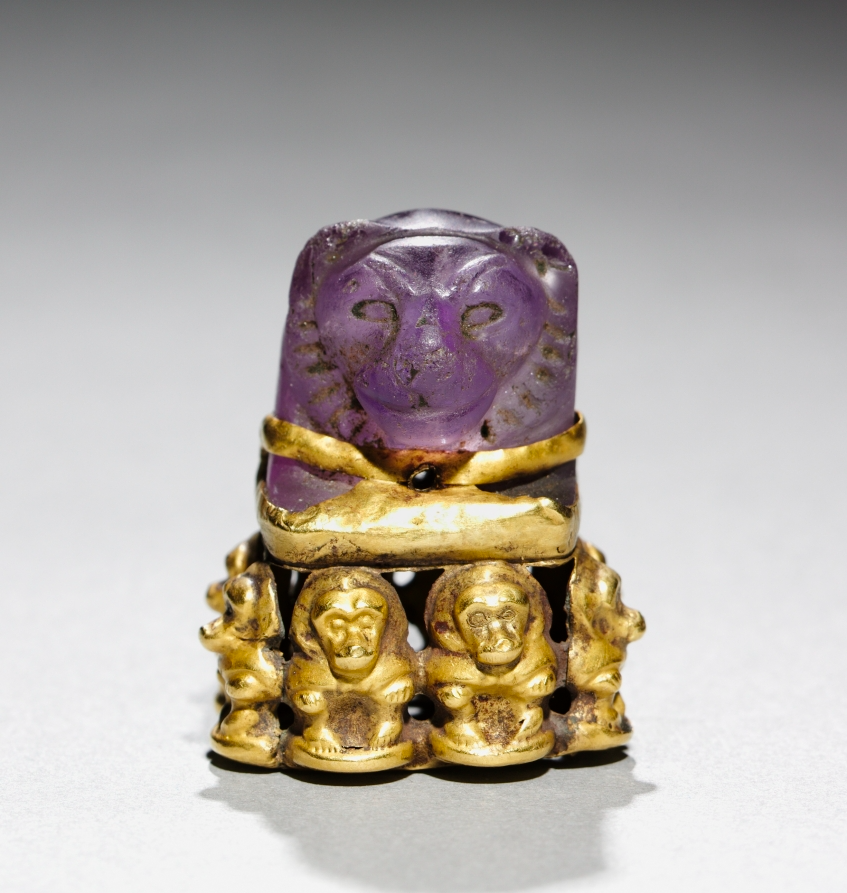
A lion's head carved out of amethyst has been set into a golden base decorated with baboons.
QUICK FACTS
Name: Lion's head pendant
What it is: An amethyst-and-gold pendant
Where it is from: Sudan
When it was made: Circa 1069 to 715 B.C.
According to the Cleveland Museum of Art, the pendant measures about 1.4 inches (3.5 centimeters) tall. A hole just under the lion's chin pierces the pendant, which would have been suspended on a string.
The purple amethyst and gold frame are a unique combination. The lion is similar to pieces found in the ancient Egyptian game senet, in which players would move their pawns across a board with 30 squares. The amethyst likely dates to the New Kingdom period (circa 1550 to 1070 B.C.), according to a 1996 study of the artifact. But the gold mount was added considerably later, likely in the Napatan period (circa 750 to 300 B.C.), named for the town that was used as the religious center of Nubia.
Recycling of old stone carvings was common among the ancient Nubians, who lived in what is now southern Egypt and northern Sudan. In the early first millennium B.C., Nubian rulers viewed themselves as descendants of Ramesses II (who reigned from 1279 to 1213 B.C.) and repurposed and retrofitted semiprecious gems into new gold mounts to show their Egyptian connections. Under the later Kushite kings (circa 712 to 664 B.C.), this practice continued in Napata as the rulers incorporated Egyptian customs into their own culture.
MORE ASTONISHING ARTIFACTS
- Athena bowl: A silver-and-gold vessel of the goddess and her owl, buried in a German forest 2,000 years ago
- Miniature camelid effigy: A 600-year-old sculpture of a llama that may have been sacrificed in an Inca ritual
- Altar to Sol: A rare 1,900-year-old monument dedicated to the Roman god of light and used in a secret underground ritual
Both the lion and the baboon were sacred in Kushite religion. The lion was associated with the god Amun, who was tasked with protecting the state and who merged with the sun god, Ra, and became known as the powerful creator deity Amun-Ra. The baboons were connected to the sun and the moon and were often depicted with their arms raised. In this pendant, the baboons lift the representation of Amun.
The lion's head pendant was meant to be worn in life, rather than as a funeral gift, and it demonstrates the ancient Nubians' clever use of Egyptian heirlooms to create new and religiously charged jewelry.
Sign up for the Live Science daily newsletter nowFor more stunning archaeological discoveries, check out our Astonishing Artifacts archives.
TOPICS
Kristina Killgrove is a staff writer at Live Science with a focus on archaeology and paleoanthropology news. Her articles have also appeared in venues such as Forbes, Smithsonian, and Mental Floss. Kristina holds a Ph.D. in biological anthropology and an M.A. in classical archaeology from the University of North Carolina, as well as a B.A. in Latin from the University of Virginia, and she was formerly a university professor and researcher. She has received awards from the Society for American Archaeology and the American Anthropological Association for her science writing.
View MoreYou must confirm your public display name before commenting
Please logout and then login again, you will then be prompted to enter your display name.
LogoutСхожі новини
Nazi-looted artwork surfaces with Dutch collaborator's heirs
Publisher Correction: Presymptomatic training mitigates functional deficits in a mouse model of Rett syndrome
Briefing Chat: Can't focus? It's not your attention span, it's your notifications