Labour poised for fresh welfare changes after scale of youth jobs crisis revealed

Alan Milburn’s landmark report says unemployment among young costs UK £125bn a year and warns of ‘lost generation’
-
‘A record of failure’: what’s in first part of Milburn report?
-
Tell us: we would like to hear from young people in the UK about their job hunting experience
Labour is poised for a fresh attempt at changing the welfare system after a major government-backed report said youth unemployment was costing Britain more than £125bn a year.
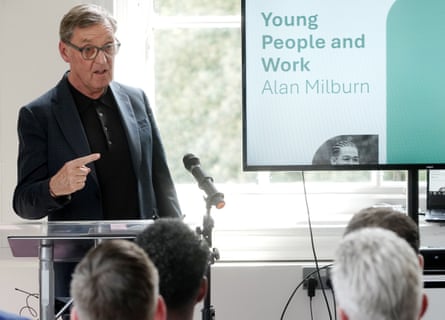
As official figures revealed the number of young people not working or studying had surpassed a million for the first time in more than a decade, Alan Milburn said the government had a responsibility to the next generation to take action.
Launching his landmark review of Britain’s youth jobs crisis, the former Labour cabinet minister said Keir Starmer’s government had shown a renewed desire to overhaul the benefits system as part of changes to tackle soaring youth unemployment and inactivity.
“As I’ve spoken to cabinet ministers about it, my sense is that there is an appetite to go back into this, and to go back into it in the right way,” he said.
His report comes with overall unemployment in Britain at its highest level since the outbreak of the Covid pandemic, with young people bearing the brunt as businesses warn about the impact of tax increases and an economic downturn from the Iran war.
The prime minister said Labour was taking action to address the “sobering” findings in Milburn’s report by ploughing money into a “youth guarantee” and funding more work experience and job placements.
Speaking on a visit to a training facility for apprentices in west London on Thursday, Starmer acknowledged further steps were required. “Clearly we need to do more,” he said.
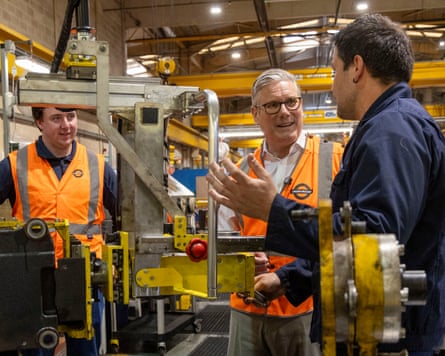
“We will now work with Alan on what more needs to be done. I’m pleased that some of the measures we’ve already put in place are coming on train next month.”
Labour has faced fierce criticism from opposition leaders and business groups who say its policy decisions, including tax increases and a rising minimum wage, have added to Britain’s crisis in youth jobs.
In the first phase of his review before making final recommendations to the government this autumn, Milburn said Britain was exposed to £125bn in annual losses from a youth jobs crisis that far outstripped almost any other country in Europe.
The report showed the lost contribution to the economy and cost to the exchequer from supporting young people through the benefits system was leaving a multibillion-pound financial hole, which he said meant a “whole system reset” involving schools, welfare and employers was needed.
It said the lifetime cost to the exchequer from a young person not in education, employment or training (Neet) between the ages of 18 and 24 was £29,000 a year on average.
Highlighting the long-term damage, the report found an individual who was Neet in the period of early adulthood could lose out on £52,000 a year on average over the course of their working life.
Launching his report, Milburn said Britain was on track for a 25% rise in the number of Neets to 1.25 million within five years’ time unless urgent action was taken to avoid creating a “lost generation”.
He said six out of 10 young Neets were not looking for a job, and a similar number had never worked amid a sharp rise in mental ill health for a “bedroom generation” of young people glued to their smartphones.
Urging ministers to consider changes to the welfare system, Milburn’s review showed the government currently spent about £8.1bn a year on benefits support for young people – with more than half going to Neets – and about £3.2bn on health and disability benefits.
The former health secretary under Tony Blair criticised the government for its botched handling of welfare changes last year which led Starmer into a chaotic U-turn to fend off a Labour backbench rebellion.
“If you frame welfare reform as all about cost-out, and taking money away from people – particularly those who are sick and disabled – you are going to get an appropriate response – and that is what has happened,” he said.
He urged Labour not to shy away from a fresh attempt, suggesting that welfare savings could be reinvested in employment support. For every £25 currently spent on welfare the state spent £1 on job support, which was shocking and shameful, he said.
“The sustainable way to reduce the benefits bill is not by plucking an arbitrary figure out of thin air and saying we’re going to cut it. The way to do it is to get more young people into work.”
As the prime minister battles to hold on to power amid the threat of a Labour leadership challenge and against the backdrop of the cost of living crisis, any fresh drive to overhaul the welfare system would come at a delicate moment.
Charity leaders and campaigners urged ministers to resist any move to weaponise the benefits system to punish or shame young people into finding work.
The chief executive of the Mental Health Foundation, Mark Rowland, said: “Pushing young people who are too unwell to work into financial hardship will worsen their mental health, while failing to adequately support a return to work can be equally damaging.”
One obvious complication would be the fact that Starmer could be ousted from Downing Street as early as the autumn, especially if Andy Burnham wins next month’s Makerfield byelection and triggers a leadership race.
None of the possible hopefuls to replace Starmer have said they would change course on overhauling benefits, but a change of leader and cabinet could well slow it down.
Labour’s first attempt to change welfare ended in a humiliating climbdown after backbench MPs threatened to rebel, and many are watching warily for what the revised proposals will involve.
Most of the party’s MPs accept, however, that not only does something need to be done, but also that Downing Street is engaging more closely this time.
The major proposals will not emerge before the second part of Milburn’s review is published, and after a report into disability benefits by the social security minister, Stephen Timms, which is also expected in the autumn.
Officials stress that in the interim, other schemes to help with the issues Milburn describes are already being introduced, such as the so-called youth guarantee for 18- to 21-year-olds over education, training or apprenticeship schemes.
Speaking at the launch of the report, the work and pensions secretary, Pat McFadden, said the government had made a “major and important start” to address youth worklessness.
“I could see in the first few weeks after being appointed as the secretary of state what was happening, both in human and in financial terms, and I knew we had to get properly under the bonnet of this problem,” he said.
Explore more on these topics- UK unemployment and employment statistics
- Young people
- Economic growth (GDP)
- Unemployment
- Economic policy
- Economics
- Office for National Statistics
- news
Схожі новини

Iran state TV claims US aircraft destroyed in Bushehr province, no confirmation from US

Asaram surrenders at Jodhpur jail after High Court upholds life term in rape case

Austrian man sentenced to 15 years for planning ISIS-inspired attack at Taylor Swift concert