Kumanjayi Little Baby: Advocates say five-year-old’s death ‘should not be politicised’ as hundreds gather at vigils

Crowds were invited to stand in silent solidarity with the family of the Warlpiri girl who was allegedly murdered in Alice Springs last week
-
Warning: This article contains references to Indigenous Australians who have died
-
Get our breaking news email, free app or daily news podcast
The national body representing First Nations children has called for an end to the politicisation of the death of Kumanjayi Little Baby, as hundreds of people gathered around the country to mourn her passing.
Community vigils were held across Australia on Thursday to honour the five-year-old Warlpiri girl, whose body was found one week ago after a frantic five-day search.
At the Aborigines Advancement League in Melbourne, about 400 people turned out to pay their respects and to honour Kumanjayi Little Baby. Flowers were laid beneath the Aboriginal and Torres Strait Islander flags which were at half mast.
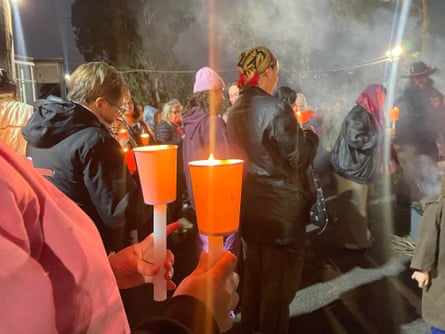
People wore pink clothing items, were given candles and welcomed with a smoking ceremony before observing a minute’s silence.
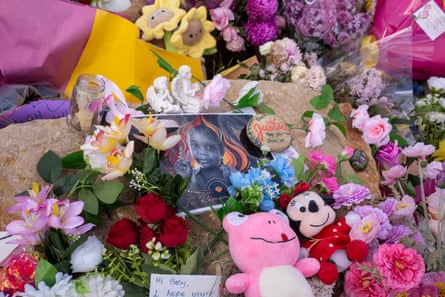
Yorta Yorta Elder, Uncle Graham “Boots” Cooper, who gave the welcome to country, told Guardian Australia that he hoped vigils being held across the country would help Kumanjayi Little Baby’s family heal.
“What we’re doing is remembering a beautiful little girl, but at the same time, to honour her and her family and to make sure that her family is strong through our presence here for that beautiful little girl,” he said. “I hope the families in Alice Springs can heal and they take it in their hearts to see what we’re here for and what we’re doing.
“I love it that our mob got together to really focus on healing families who are involved with the young girl, and by healing, it’s getting together like this and showing their support for the families.
“The words are still stuck in me mouth on what to say about it, but over my years as an Elder in community, things like this come up and all I can say to families is please be vigilant around your children.
“Watch them and look out for them. And I know it’s easy to say, but it’s a hard thing to do.”
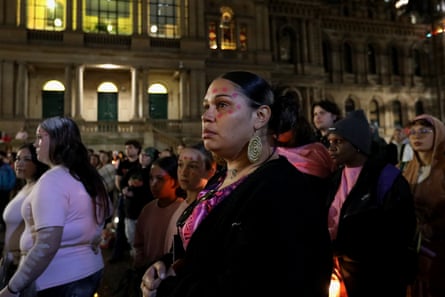
In Canberra, about a hundred people gathered at the Aboriginal tent embassy for a sombre and largely silent vigil for “precious little girl” Kumanjayi Little Baby.
Clustered around the steps not far from Old Parliament house, the crowd was silent, some crying, awash in shades of pink – beanies, tiny ribbons pinned to coats – holding candles in the cold night, with organisers saying the vigil was about holding space for family and community in Alice Springs. Flowers, wreaths and a simple cross with pink fairy wings marked the vigil as mourners watched the sunset darken over the nation’s capital.
Traditional owners on Ngunnawal country welcomed those gathering – including Elders, parents, children and babies – with a smoking ceremonywhile smoke from the embassy’s eternal fire curled and rose to a pink streaked sky.
As dozens clustered in a circle around the fire, Leah House said the memorial was about “holding space” for a grieving family – and, with few words and no speeches, the little girl was “farewelled into the dreamtime”.
A second vigil was also held at the National Carillon, where mourners laid flowers and wreaths to mark Kumanjayi Little Baby’s passing.
Kumanjayi Little Baby had been last seen by her mother at 11.30pm on Saturday 25 April, tucked into a bed in a home at the Old Timers/Ilyperenye town camp in Alice Springs. Her mother reported her missing at 1.30am, when she discovered her child missing.
Hundreds of volunteers and more than 200 police and emergency service workers searched the area for five days, before making the tragic discovery 5km south of where the child was last seen alive.
Later that same night, a 47-year-old man, Jefferson Lewis, was arrested and later charged with murder and two other offences that cannot be reported for legal reasons. Lewis was not related to the girl or her family
Kumanjayi Little Baby, whose given name is no longer used in line with cultural protocols, has been described by her family as a friendly girl who loved the colour pink. Her mother released a statement through Northern Territory police saying she and her son, Kumanjayi’s big brother, “miss and love you”.
Her family have since called for silence while they conduct sorry business, and vigil organisers told people to “leave flags at home” and gather in “shared sorrow and respect”, not in protest.
Catherine Liddle, the CEO of First Nations child advocacy body SNAICC, said that Kumanjayi Little Baby’s death had already been politicised.
Former Liberal prime ministers Tony Abbott and John Howard, as well as the current opposition leader Angus Taylor, have called for increased scrutiny over conditions in town camps in the wake of the death. Abbott claimed, in an opinion piece in the Australian on Thursday, that culture was “getting in the way” of addressing Indigenous disadvantage.
“Her family has said her death should not be politicised. Unfortunately, we are already seeing that happen,” Liddle said.
“What happened to this gorgeous baby girl was not a failing of her family or her community or Town Camps. Kumanjayi Little Baby was deeply loved.
“What happened is the direct result of multiple system-level failures and it is a painful reminder of why our work matters.”
On Wednesday, three child protection workers were stood down pending an investigation into “actions taken, or not taken” with regard to reported child protection notifications – a term used to describe concerns raised but not substantiated.
Liddle called for the First Nations advocacy and child advocacy sectors to remain united in the face of their grief.
“This is political opportunism that will only harm children,” she said. “We all know that connection to culture, family and community is what keeps our children safe and well.”
Explore more on these topics- Indigenous Australians
- Australian Capital Territory (ACT)
- Victoria
- Northern Territory
- New South Wales
- news
Схожі новини
MUFG to form strategic partnership with Google
‘Monarch: Legacy of Monsters’ loses its human touch in sprawling second season
Несыгранная роль Робина Уильямса: как Disney потеряла фильм о расстройстве личности
