Jones Act Waiver Exposes America’s Shipbuilding Gap
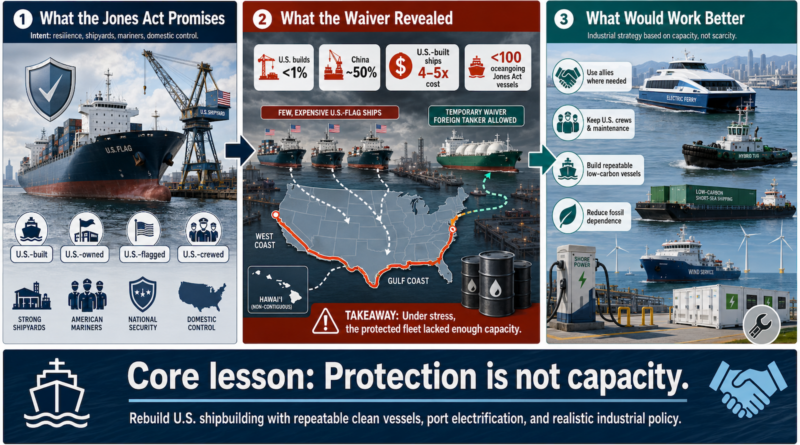 Infographic of United States' Jones Act waiver implications by author with ChatGPT
May 15, 202641 minutes
Michael Barnard
0 Comments
Support CleanTechnica's work through a Substack subscription or on Stripe.
Infographic of United States' Jones Act waiver implications by author with ChatGPT
May 15, 202641 minutes
Michael Barnard
0 Comments
Support CleanTechnica's work through a Substack subscription or on Stripe.
The Trump administration’s Jones Act waiver is a small policy exception with a much larger lesson. The same administration that says it wants to restore American maritime dominance, rebuild domestic shipbuilding, counter China’s industrial scale, and make U.S. logistics more secure also waived parts of the law usually treated as the foundation of that domestic maritime system. Foreign vessels were allowed to move selected cargoes between U.S. ports because the protected American fleet could not provide enough capacity at the right time, in the right places, at acceptable cost. The waiver does not undermine the case for rebuilding American shipbuilding. It undermines the case for pretending the Jones Act is, by itself, a shipbuilding strategy.
The Jones Act is simple in its core requirement and complex in its effects. Cargo moved by water between U.S. points must generally travel on vessels that are U.S.-built, U.S.-owned, U.S.-flagged, and U.S.-crewed. The stated purpose is resilience. The law is meant to preserve domestic shipbuilding, trained merchant mariners, control over domestic logistics, and sealift capacity in wartime or crisis. Those are serious goals. The issue is not that the United States should be indifferent to maritime capacity. The issue is that national security cannot be measured by legal exclusion alone. It has to be measured by available ships, trained crews, productive yards, repair capacity, cost, and the ability to move cargo when the system is under stress.
Protection can preserve a market. It cannot, on its own, create industrial competitiveness. That distinction sits at the heart of the Jones Act debate. The United States has protected a domestic shipping market for more than a century, but it has not converted that protected market into a large, modern, globally competitive commercial shipbuilding sector. China builds roughly half of the world’s commercial ships. South Korea and Japan remain major shipbuilding powers. The United States builds less than 1% of global commercial tonnage. That is a rounding error in a maritime-power contest. It exposes the gap in United States ambitions compared to economic reality.
U.S.-built commercial vessels cost several times more than similar ships from Asian yards. Econofact has summarized the cost gap as four to five times higher for large merchant ships built in the United States compared with comparable Asian-built vessels. The oceangoing Jones Act fleet has also shrunk. It is small, specialized, expensive, and unevenly available. The law has preserved some domestic maritime work, and that work matters to real companies, workers, ports, and communities. But protected scarcity is still scarcity. If the fleet is too small, too costly, or unavailable on the needed route, the country does not have resilience just because the law says it should.
The waiver was not repeal. It was not a general liberalization of U.S. cabotage. It was a temporary exception for selected domestic cargo movements, weighted toward fossil-energy logistics and related commodities. It allowed foreign vessels to move certain cargoes for a limited period under a stress condition. It did not invite global shipping firms to remake domestic U.S. water freight. That limited nature matters because it prevents overclaiming.
The waiver did not abolish the Jones Act. It did not create a general maritime reform pathway. It probably did not lower national gasoline prices by any visible amount. The U.S. fuel market is large, crude prices are global, refining systems are regional, and a few dozen or even a hundred waiver voyages cannot change national pump prices in a country using hundreds of millions of gallons of fuel a day. WorkBoat and the Center for Maritime Strategy were right to point out that the volumes were small relative to national fuel consumption. A policy can reveal a logistics problem without solving national fuel prices.
But the waiver still revealed something important. Cargo moved when the restriction was relaxed. Cato’s Colin Grabow looked at Maritime Administration waiver data and argued that the waiver exposed latent demand, especially for Gulf Coast to West Coast fuel movements. One cited example was roughly 1.59 million barrels of non-renewable diesel moving from PADD 3 to PADD 5 in the first 50 days, about four times the comparable waterborne movement for all of the prior year. Whether one accepts Cato’s broader ideological framing or not (and to be clear, on the rare occasions where I think I agree with the deeply Libertarian and Koch-funded Cato I fact and sense check myself), the data point matters. A market that appears when a restriction is loosened was not imaginary. It was suppressed or underserved.
That is the useful distinction. The waiver can be too small to change U.S. gasoline prices and still large enough to show that the protected fleet is not serving all viable domestic routes. It does not prove that repeal would make fuel cheap. It does prove that the existing system creates capacity limits that show up when demand, geography, or price pressure changes.
Hawaii is the clearest case because it turns an abstract maritime-law debate into a practical logistics problem. Hawaii depends on maritime supply chains for most goods and nearly all fossil-fuel products. It cannot substitute rail, road, or pipeline connections to the continental United States. Shipping is not one option among several. It is the foundation of the economy. Representative Ed Case has made this point repeatedly, including in his support for the waiver and its extension. His office noted that there are fewer than 100 oceangoing Jones Act vessels nationwide and only a small number of Jones Act-compliant oil tankers relative to the global tanker fleet.
That is the Jones Act’s island-state problem. A law defended as a domestic security measure can make an island state’s energy supply more brittle when the domestic fleet is too small or too expensive. If there are not enough qualifying U.S.-built and U.S.-flagged tankers or product carriers, domestic supply becomes harder to arrange. The result can be higher costs, less flexibility, and greater dependence on foreign energy supply chains through indirect routes. That is an odd outcome for a law sold as maritime sovereignty.
Hawaii is not alone. Alaska, Puerto Rico, Guam, and other non-contiguous markets experience the Jones Act differently from the lower 48. A mainland shipper may be able to substitute rail, truck, pipeline, or a different port. Island and remote markets often cannot. Geography turns a maritime rule into a cost-of-living issue, a fuel-security issue, and a resilience issue. The lower 48 debate is often about efficiency. The non-contiguous debate is about exposure.
The long-term answer for Hawaii and other non-48 states is not cheaper fossil-fuel shipping. It is less fossil-fuel dependence. More renewables, more storage, demand flexibility, electrified transport, port electrification, and less imported fuel would do more for energy security than a better tanker schedule. But transitions take time, and until that transition is complete, the waiver shows how brittle the existing logistics system is. If energy resilience depends on an emergency exception to the maritime law that is supposed to create resilience, the policy needs another look.
The analyst split around the waiver is useful because each side sees a real part of the problem. Free-market critics see proof that the Jones Act suppresses domestic trade. Jones Act defenders see damage to domestic shipowners, mariners, and shipyards. Pragmatic reformers see the need for structured waivers when no Jones Act vessel is available. Non-contiguous-region advocates see practical questions of cost, supply, and exposure. The reformers are right that the law blocks some economic activity. The defenders are right that unpredictable waivers weaken investment confidence. The pragmatists are right that a rigid system needs a shortage mechanism. Hawaii is right that geography changes the stakes. The failure is that U.S. maritime policy has not reconciled those truths into a coherent strategy.
Those are not new concerns in my work. I have approached them before from the angles of ferry electrification, freight mode shift, Hawaii fuel security, and the Maritime Action Plan, but the waiver brings them together in one policy event.
That matters because the Trump administration’s broader maritime agenda depends on investment confidence. The White House Maritime Action Plan talks about rebuilding shipyards, financing vessels, expanding the merchant marine, countering China’s dominance, charging fees on foreign vessels, and using federal support to rebuild a domestic maritime industrial base. Shipyard financing, workforce development, procurement reform, supplier qualification, and long-term order books are the kinds of tools that can matter. But they have to be connected to a market that can scale.
The waiver muddies that signal. Shipowners are asked to pay a large premium for Jones Act vessels because the domestic market is protected. Consumers and island states are asked to pay higher logistics costs because the protected system is supposed to produce resilience. Then, when fuel markets become politically painful, the government relaxes the rule. Waivers may be understandable in emergencies, but a system that needs waivers to function under stress cannot claim that its normal rules are delivering resilience.
The waiver is not the disease. It is the symptom. The disease is a maritime policy that has protected a market without producing enough capacity to make the protection credible. A U.S.-built requirement may support a few domestic yards, but if those yards cannot produce enough ships at tolerable cost, the requirement becomes a scarcity-management tool. It can preserve work. It does not necessarily create abundance.
China did not become dominant in commercial shipbuilding because it passed a cabotage law and waited for domestic demand to do the rest. It built scale through industrial policy, export orientation, state-backed finance, manufacturing depth, port integration, supplier density, workforce development, and repeated production of commercial vessel classes. South Korea and Japan built globally competitive shipbuilding systems through specialization, productivity, learning curves, and export markets. The U.S. is trying to rebuild from the other direction: protect a small domestic market, penalize foreign-built vessels, subsidize domestic production, and hope that scale follows.
That can preserve some activity, but it is not enough. Shipbuilding is a manufacturing ecosystem problem. It requires suppliers, repeatable designs, trained workers, production discipline, port integration, finance, and steady demand. The U.S. problem is not a lack of maritime patriotism. It is a lack of repeatable commercial production.
This is where the waiver becomes more interesting than the usual Jones Act argument. The administration created flexibility for fossil-energy logistics. Foreign vessels could help move oil, fuel, gas, fertilizer, coal, and related commodities during a stress period. But the same policy system remains rigid when the opportunity is clean maritime deployment. That is backwards.
If the United States can temporarily relax domestic-shipping rules for fossil-fuel resilience, it should be able to design structured, durable pathways for low-carbon maritime modernization. That does not require abandoning U.S. crews, safety standards, labor standards, port security, or domestic maintenance. It means recognizing that domestic yard capacity is missing in some vessel categories and that allied capacity can be used to accelerate deployment while American yards climb the learning curve.
The first wave of maritime decarbonization is not speculative deep-ocean ammonia tankers or hydrogen fantasies. It is ferries, harbor craft, tugs, barges, inland vessels, short-sea freight, port service vessels, municipal vessels, offshore wind service vessels, and other predictable-duty-cycle assets. These are the vessel classes where batteries, hybrids, shore power, and modern power electronics can make sense now or soon. Routes are known. Charging can be centralized. Maintenance can be domestic. Crews remain domestic. Ports benefit from cleaner air and quieter operations. Fuel-price exposure falls.
That is an industrial opportunity, not just an environmental add-on. American shipbuilding needs demand that is repeatable, financeable, and aligned with future markets. Decarbonization can provide that demand if policy is designed well. Standardized vessel classes could give yards repeat work instead of one-off projects. Hybrid and battery-electric harbor craft would build skills in marine electrical systems. Government procurement could create early orders for low-carbon vessels with clear performance standards. Domestic manufacturers could find roles in batteries, charging, software, controls, retrofits, and maintenance even where allied-built hulls are needed at first. A serious maritime industrial strategy would use decarbonization to create the learning curve that protection alone has not created.
A better policy architecture would start by protecting what matters. U.S. crews, safety standards, labor standards, port security, domestic repair capacity, and national-security sealift should remain central. But policy should stop pretending that U.S.-built requirements automatically create U.S. shipbuilding scale. Where domestic yard capacity does not exist, allied-built pathways should be available, tied to U.S. crewing, U.S. maintenance, domestic retrofit work, and staged domestic-content growth.
That would be more practical than the current binary. The choice is not sacred Jones Act protection or total deregulation. The choice is whether the United States wants maritime abundance or protected scarcity. For vessel classes where U.S. yards can build competitively, support them with repeatable orders and standard designs. For classes where they cannot, use allies while building domestic capability. For non-contiguous regions, create logistics rules that reflect geography rather than ideology. For clean vessels, treat deployment speed as part of industrial strategy.
National security remains the right frame, but it needs a more precise definition. Sealift matters. Merchant mariners matter. Domestic repair matters. Dependence on China for ships and maritime supply chains matters. But national security is not served by a small and expensive fleet that needs emergency waivers when energy logistics get tight. Real maritime security means the ability to build, repair, crew, fuel, power, and operate vessels at scale. It also means reducing exposure to oil shocks by electrifying the vessel classes that can be electrified and reducing fossil-fuel dependence in islanded markets.
The Jones Act waiver did not solve American fuel prices. It did not rebuild shipbuilding. It did not repeal the Jones Act. It did something more useful analytically: it exposed the difference between maritime protection and maritime capacity. The United States should rebuild shipbuilding. It should care about mariners, ports, shipyards, repair capacity, and maritime security. But it should not confuse the Jones Act with a strategy.
The law can be part of a strategy only if it is redesigned around abundance, modern propulsion, allied capacity, domestic labor, non-contiguous-region resilience, and decarbonization. The United States discovered again that it needs the global fleet when its protected domestic fleet is not enough. The answer is not to give up on American shipbuilding. The answer is to stop treating protected scarcity as shipbuilding policy. A country serious about maritime strength would build capacity where it can, use allies where it must, electrify the vessel classes that are ready, and reduce the fossil-fuel logistics risks that made the waiver necessary in the first place.
Sign up for CleanTechnica's Weekly Substack for Zach and Scott's in-depth analyses and high level summaries, sign up for our daily newsletter, and follow us on Google News! Advertisement Have a tip for CleanTechnica? Want to advertise? Want to suggest a guest for our CleanTech Talk podcast? Contact us here. Sign up for our daily newsletter for 15 new cleantech stories a day. Or sign up for our weekly one on top stories of the week if daily is too frequent. CleanTechnica uses affiliate links. See our policy here.CleanTechnica's Comment Policy
Share this story!
Схожі новини

Chud the Builder visibly disappointed as bond hits $1.25 million
Джон Траволта расплакался на Каннах — и не потому, что что-то пошло не так