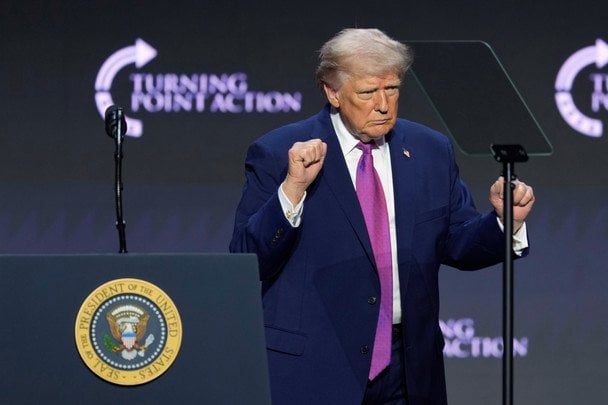
Israel, Lebanon to extend ceasefire as US-Iran talks stall

What you need to know
- Israel and Lebanon have agreed to extend the ceasefire by three weeks, US President Donald Trump said
- Trump has ruled out using nuclear weapons against Iran and said he won't 'rush' a deal with Tehran
- Iran and the US are locked in a standoff over the Strait of Hormuz
- Iran has closed the waterway, while the US is imposing its own blockade of Iranian ports and ships
- Trump has ordered the US Navy to 'shoot and kill' mine-laying boats in the Strait
- Tehran has said a full ceasefire can only hold if Washington lifts its blockade of Iranian ports
Here are the latest developments in the Iran war and the Middle East on Friday, April 24:
Skip next section WATCH: Why mine warfare is psychological, not just physical04/24/2026April 24, 2026WATCH: Why mine warfare is psychological, not just physical
US President Donald Trump has ordered his military to "shoot and kill" small Iranian boats that deploy mines in the Strait of Hormuz.
Iran is accused of laying new sea mines in this vital global shipping route — but how dangerous are these weapons really? And how much does the threat of mines matter? Former US Navy officer and mine warfare analyst Steven Wills explains what we know, what we don't, and why mine warfare is as much psychological as it is physical.
https://p.dw.com/p/5CkEaSkip next section Oil prices stay high, stocks still struggling amid Iran war impasse04/24/2026April 24, 2026Oil prices stay high, stocks still struggling amid Iran war impasse
The price of oil remained high and stocks were struggling again as Asian markets opened on Friday, with investors concerned over the stalled negotiations to end the war in the Middle East.
On Thursday, US President Donald Trump said he wouldn't "rush" a deal with Iran, after extending a ceasefire indefinitely earlier in the week.
"I have all the time in the world," Trump said on his Truth Social platform, "but Iran doesn't — the clock is ticking!"
But Iran has refused to budge, saying it won't take part in talks to secure a full ceasefire unless Washington lifts its blockade of Iranian ports.
The two sides remain locked in a standoff over the Strait of Hormuz, with Tehran insisting the waterway remains closed to maritime traffic, severely impacting the global economy and triggering an energy crisis.
The price of crude oil has risen by about 20% over the past week amid the impasse, and rose again by more than 1% on Friday.
The standoff is also impacting equity markets. Hong Kong, Shanghai, Sydney, Seoul, Singapore, Wellington and Jakarta were all down at Friday's opening.
US seizure of Iranian cargo ship drives tensions, oil prices
To view this video please enable JavaScript, and consider upgrading to a web browser that supports HTML5 video
https://p.dw.com/p/5Ck6lSkip next section WATCH: Iran seizes two container ships04/24/2026April 24, 2026WATCH: Iran seizes two container ships
Craig CrowtherTehran said it had captured two container ships seeking to exit the Gulf via the Strait of Hormuz. Both Iran and the US are now using the vitally important shipping lane as leverage.
Iran seizes two container ships
To view this video please enable JavaScript, and consider upgrading to a web browser that supports HTML5 video
https://p.dw.com/p/5Ck6ZSkip next section Why is Israel striking Lebanon as part of its war against Iran?04/24/2026April 24, 2026Why is Israel striking Lebanon as part of its war against Iran?
President Donald Trump's announced on Thursday that Israel and Lebanon had agreed to extend a ceasefire by three weeks.
Israel has been launching deadly airstrikes on Lebanon, mostly the south and the capital Beirut, since the start of the joint US-Israeli attacks against Iran on February 28.
Israel says it has been targeting Hezbollah sites and strongholds in Lebanon.
Here is what you need to know about Hezbollah and its ties to Tehran:
- Hezbollah (Arabic for "Party of God") emerged in 1982 during the Lebanese Civil War (1975-1990) and the Israeli invasion of southern Lebanon
- It is a political and militant group that is inspired by the Shiite Islamist ideology that underpinned the 1979 Islamic Revolution in Iran
- Since its foundation, it has been supported, trained and equipped by Iran's powerful Islamic Revolutionary Guard Corps (IRGC)
- It functions as a proxy of Iran, its largest benefactor
- The US government estimated in late 2023 that Iran funds Hezbollah to the tune of around $700 million (€661 million) annually
What is Iran's 'Axis of Resistance'?
To view this video please enable JavaScript, and consider upgrading to a web browser that supports HTML5 video
https://p.dw.com/p/5Ck5qSkip next section Israel, Lebanon agree to extend ceasefire by three weeks, Trump says04/24/2026April 24, 2026Israel, Lebanon agree to extend ceasefire by three weeks, Trump says
US President Donald Trump said Thursday that Israel and Lebanon would extend a ceasefire by three weeks.
"The United States is going to work with Lebanon in order to help it protect itself from Hezbollah," Trump said in a statement on his Truth Social platform.
The initial 10-day ceasefire took effect last Friday and was due to expire on Monday.
Trump's announcement followed a rare meeting with envoys from the two countries at the White House.
Trump also said he sees a "great chance" for a peace deal between Israel and Lebanon this year.
"I look forward in the near future to hosting the Prime Minister of Israel, Bibi Netanyahu, and the President of Lebanon, Joseph Aoun," he added.
While Lebanon is not an active party to the conflict between Israel and the Lebanese-based, Iran-backed militant group Hezbollah, the government in Beirut has been urging de-escalation after fighting between Israel and the militia flared again since the outbreak of the Iran war.
Lebanon and Israel do not have diplomatic relations. The last time they held direct, high-level talks was in 1993.
Despite the 10-day ceasefire, the strikes have continued in both directions, including on Wednesday when a Lebanese journalist was killed in an Israeli attack.
On Thursday, Israel's military hit targets in southern Lebanon and intercepted Hezbollah missiles that targeted northern Israel.
https://p.dw.com/p/5Ck65Skip next section IN DEPTH: Ceasefire extended: What's next in the Iran war?04/24/2026April 24, 2026IN DEPTH: Ceasefire extended: What's next in the Iran war?
David EhlWith no fixed ceasefire deadline for now, the US and Iran are looking for ways to safeguard their own interests.
DW's David Ehl takes a look at the main sticking points and explains some key issues.
https://p.dw.com/p/5Ck6TSkip next section Welcome to our coverage04/24/2026April 24, 2026Welcome to our coverage
Karl Sexton | Sean Sinico EditorHello and thank you for joining us as we bring you the latest developments related to the US-Israeli war with Iran and the impacts on the wider Middle East.
Here is a recap of the main developments on Thursday:
- US President Donald Trump said Israel and Lebanon will extend a ceasefire by three weeks, after 'high-ranking' delegations from both countries met at the White House
- Trump ruled out using nuclear weapons against Iran and said he won't 'rush' a deal with Tehran
- Earlier this week, Trump extended the temporary ceasefire with Iran, without providing a new deadline
- Despite the extension, the Strait of Hormuz remains effectively closed
- Iran said it seized two tankers, while the US military said it had seized another vessel in the Indian Ocean
- Trump ordered the US Navy to 'shoot and kill' mine-laying boats in the Strait of Hormuz
- Iran's Mohammad Bagher Qalibaf said a full ceasefire can only hold if Washington lifts its blockade of Iranian ports
Stay tuned as we bring you the latest headlines and analysis from the US-Israeli war with Iran and the related conflict between Israel and Hezbollah.
https://p.dw.com/p/5Ck5pShow more postsСхожі новини
Їхали мопедом: росіяни дроном вбили чоловіка та жінку
На пляжі викинуло сотні тисяч буревісників — вчені назвали тривожну причину

Не цукор: стоматолог назвав несподівану причину карієсу та два засоби, які нищать емаль