Israel and Lebanon meet for third round of direct talks in Washington

 Facebook
 Twitter
 Flipboard
 Send
Send
 Reddit
 Linkedin
 Messenger
 Telegram
 VK
VK
 Bluesky
 Threads
 Whatsapp
Israel and Lebanon will meet for a second day in Washington to continue its third round of direct talks, as fighting between Israel and Hezbollah continues.
Lebanon and Israel are set to hold a second day of direct talks on Friday in Washington following a round of discussions on Thursday, which a US State Department official described as "productive and positive".
 ADVERTISEMENT
ADVERTISEMENT
ADVERTISEMENT
"We look forward to continuing this tomorrow [Friday] and hope to have more to share then," the official added.
The third round of negotiations comes just days before the ceasefire between Israel and Hezbollah is due to expire. Lebanese officials hope the two-day negotiations will lead to a renewed ceasefire.
They also hope to tackle key sticking points, such as the withdrawal of Israeli forces from southern Lebanon and the disarmament of Hezbollah.
The Iran-backed militant group has not been part of the negotiations, and has vocally opposed Lebanon engaging in direct talks with Israel.
The previous round of talks between Israel and Lebanon was also held in Washington last month and mediated by US Secretary of State Marco Rubio. He was unable to attend the current round due to his presence in China alongside US President Donald Trump.
This round of talks marks a significant step up from the last round, with higher-level envoys now involved in the negotiations compared to the last session, which was led by Israeli and Lebanese ambassadors.
But the two sides still have a long way to go. Trump previously called for a meeting between Lebanese President Joseph Aoun and Israeli Prime Minister Benjamin Netanyahu, but Aoun declined to speak directly with Netanyahu at this stage.
According to a Lebanese official who spoke on condition of anonymity, Aoun spoke with Trump recently and told the US leader that if he went to Washington and shook hands with Netanyahu, and talks then fell apart, it could not only have internal repercussions in Lebanon but it would also discredit Trump.
Aoun did mention that if the two sides were able to reach a security deal, the Lebanese leader would come to the White House and "inaugurate" it, a move that Trump approved of, the official added.
Fighting continues despite ceasefire
Regardless of the ceasefire, Israel and Hezbollah have continued to exchange fire with each other.
On Wednesday, Israel struck seven vehicles in Lebanon, three of them which were on the main highway south of Beirut. The attack killed 12 people, including a woman and two children, the Lebanese Health Ministry reported.
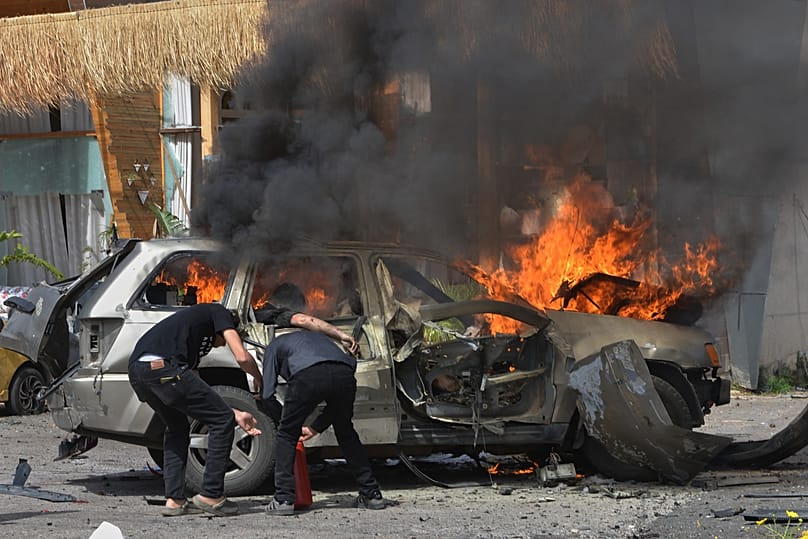
Another 10 people, including six children, were killed in later Israeli strikes in southern Lebanon, the ministry added.
Meanwhile, Hezbollah continues to fire at Israeli forces in southern Lebanon and over the border into northern Israel.
Just hours after the talks opened on Thursday, a Hezbollah drone exploded near the border in Rosh Hanikra, injuring three people, tccording to the Israeli military.
It was the first instance of civilian injuries since the ceasefire went into effect.
Renewed fighting between Israel and Hezbollah ignited on 2 March, shortly after the US and Israel launched a war against Iran and assassinated its supreme leader Ali Khamanei. In response, Hezbollah resumed rocket strikes at Israel, while Israel responded with airstrikes at Lebanon, including its capital Beirut.
Since then, 2,896 people have been reportedly killed and 8,824 wounded in Lebanon, the Health Ministry said. And 18 soldiers, two civilians in Israel and a defence contractor in southern Lebanon have been killed on the Israeli side.
Go to accessibility shortcuts Share Comments