Ireland’s Energy Poverty Problem Needs Flexible Electric Heat, Not Fabric-First Delay
 Infographic on Irish energy poverty by author with ChatGPT
May 8, 20264 hours
Michael Barnard
0 Comments
Support CleanTechnica's work through a Substack subscription or on Stripe.
Infographic on Irish energy poverty by author with ChatGPT
May 8, 20264 hours
Michael Barnard
0 Comments
Support CleanTechnica's work through a Substack subscription or on Stripe.
Ireland’s energy poverty problem is not an electricity access problem. Almost every Irish household is connected to electricity. The problem is whether households can keep a warm, healthy home without cutting back on food, medicine, transport, or other essentials. That makes Ireland different from countries where the main energy poverty questions are grid connection, clean cooking access, or a minimum number of kWh per person per year. Ireland’s problem is a cold-home affordability problem sitting on top of high electricity prices, fossil fuel volatility, a mixed housing stock, and a policy system that still leans too much toward fabric and BER sequencing before fossil heat exit. I was triggered to explore this more deeply after my recent conversation with the chief executive of Trifecta Ireland, which I assisted in setting up and continue to assist in a strategic advisor role.
The right starting point is not technology. It is a household trying to maintain healthy indoor temperatures through winter. The World Health Organization’s long-standing guidance around 18°C for healthy indoor temperature in temperate and cold climates is a useful anchor. Below that, the issue stops being a comfort concern and becomes a health, dignity, and public finance issue. Cold homes are associated with respiratory illness, damp, mould, stress, and higher health system use. Ireland’s energy poverty discussion starts there. The objective is not starting wtih lower modeled energy use or climate impacts. The objective is warm, dry, affordable, fossil-free homes that people can live in as well as low climate and cost impacts.

Global energy poverty frameworks still matter, but only when used carefully. The Sustainable Development Goal 7 access metrics ask whether households have electricity and clean cooking. The World Bank’s Multi-Tier Framework asks better questions about reliability, safety, affordability, adequacy, and quality of service. The Energy for Growth Hub’s Modern Energy Minimum, at about 1,000 kWh of electricity per person per year, is useful for development because it points beyond a light bulb and a phone charger toward schools, clinics, businesses, refrigeration, communications, and modern economic activity. But none of those frames, by themselves, diagnose Ireland’s problem.
Ireland needs a minimum energy services standard, not a simple kWh-per-person target. The key service is healthy warmth at a predictable and affordable cost. The support system should ask whether the household can maintain safe indoor temperatures, avoid arrears, avoid damp and mould, afford hot water, and escape repeated exposure to oil and gas volatility. It should also ask whether the solution is practical for the dwelling. A flat, a mid-terrace home, and a detached rural house are not the same problem with the same technology labels pasted on top.
Ireland’s distinctive profile starts with high electricity prices. Eurostat reported Ireland with the highest household electricity prices in the European Union in the second half of 2025, at about €0.40 per kWh, roughly 40% above the EU average. That matters because electrification is the correct direction for space heat, hot water, and decarbonization, but expensive electricity can sour the lived experience if policy treats the heat pump as a standalone device rather than part of a system. Heat pumps, smart controls, thermal storage, protected tariffs, and no-regrets fabric measures have to be designed together. Otherwise Ireland risks asking vulnerable households to swap one bill anxiety for another.
Heating dominates the household energy problem. This is not mostly about phone chargers or LED bulbs. Those matter at the margin, but the big loads are space heating and water heating. SEAI’s residential energy data show space heating as the largest component of household energy use, with water heating also material. This is why energy poverty in Ireland is tied to winter, damp, mould, building condition, and heating fuels. If the home is cold, the household has a health problem. If the home is heated by oil or gas, the household has a commodity exposure problem. If the home is rented, the household often has a control problem.
The housing stock makes the policy challenge harder. Flats and apartments may start from electric resistance, storage heat, gas, shared heating, or building-level systems. They may have little room for individual outdoor units or large hot water tanks. Some will be best served by individual heat pumps, some by heat pump water heaters, some by communal heat pumps, shared hot water, or district heat where viable. Terraced and mid-terrace homes often have lower exposed surface area and more repeatable upgrade pathways. They may be good candidates for standard packages: measured heat demand, right-sized heat pump, hot-water cylinder or thermal store, emitter upgrades, attic or cavity work where suitable, draught reduction, ventilation, and smart controls. Detached homes, especially rural homes, often have larger heat demand, more oil exposure, more space for equipment, and larger potential savings from getting off fossil heat.
Energy poverty is also unequal. Low-income households, renters, rural households, older people, single-adult households, people with health vulnerabilities, families in poor housing, and households already in arrears are more exposed. Ireland’s Economic and Social Research Institute (ESRI) has recommended tracking inability to afford adequate warmth, high energy spending relative to income, and low absolute energy spending, because low spending can reveal under-heating. That last measure is important. A household with a tiny winter energy bill is not always efficient. It may be cold.
Ireland’s policy machinery is not empty. Ireland has SEAI grants, the Warmer Homes Scheme, One Stop Shops, heat pump supports, Fuel Allowance, smart meters, time-of-use tariffs, consumer protections, and a National Residential Retrofit Plan. The government has targets for 500,000 homes upgraded to Building Energy Rating (BER) B2 or cost-optimal equivalent and 400,000 heat pumps in existing homes by 2030. SEAI heat pump grant levels rose in 2026, with support for heat pumps, central heating component upgrades, and renewable heat bonuses for replacing fossil heating. Fuel Allowance has been expanded. Consumer protection rules exist around disconnection, payment plans, and engagement with suppliers.
The issue is not absence of tools. The issue is ordering. The current architecture still tends to treat fabric improvement, BER movement, and heat pump readiness as the core sequence. The better sequence for energy poverty is protect bills now, remove fossil heat exposure early, add no-regrets fabric and emitter upgrades, add thermal storage and smart controls, then reserve deeper retrofit for homes where measured need justifies it. That is not anti-retrofit. It is a sequencing correction.
The phrase “fabric first” sounds prudent. In some individual projects, it is. No one should install a heat pump badly into a home with obvious heat loss problems, undersized emitters, damp, poor ventilation, and no control strategy. But as a national default, fabric first is a trap. It delays fossil heat exit while households wait for comprehensive projects. It spends scarce money chasing deeper building fabric upgrades where a right-sized heat pump, storage, controls, emitter improvements, and modest envelope measures will deliver the bill and emissions benefit. It makes vulnerable households wait for the perfect project when they need a safer, warmer, cheaper winter now.

No-regrets fabric matters. Attic insulation is usually sensible. Cavity insulation can be sensible where the building is suitable. Draught reduction, ventilation, damp remediation, heating controls, and emitter upgrades can improve comfort and heat pump performance. The point is not to skip these things. The point is to stop treating deep fabric retrofit as the mandatory gateway to clean heat. Fabric should serve warmth, affordability, health, and heat pump performance. It should not become a reason to leave households on oil or gas for another five winters.
The cost comparison makes the issue concrete. For an illustrative Irish flat or apartment, using recent dwelling-type gas consumption as the heat-service baseline, pre-shock gas heating cost was about €592 per year. Current gas at elevated 2026 prices was about €1,110 per year. Peak-shock gas at 2023 H2 prices was about €1,408 per year. A flexible electric heat package, using a heat pump with a seasonal performance factor of 3.5, modest envelope upgrades, thermal storage, and time-of-use shifting, came out at about €387 per year for the same heat service. That means the flexible electric heat package saves about €205 per year against pre-shock gas, about €723 per year against current gas, and about €1,021 per year against peak-shock gas for the sample flat.
For a mid-terrace home, the same comparison is similar but larger. Pre-shock gas was about €626 per year. Current gas was about €1,175 per year. Peak-shock gas was about €1,491 per year. The flexible electric heat package was about €410 per year. That means annual savings of about €216 versus pre-shock gas, €765 versus current gas, and €1,081 versus peak-shock gas. For a household at risk of under-heating, €765 per year is not a rounding error. It is about €64 per month over a year, or much more than that concentrated across the heating season.
For a detached house, the exposure is larger because heat demand is larger. Pre-shock gas was about €1,121 per year. Current gas was about €2,103 per year. Peak-shock gas was about €2,670 per year. The flexible electric heat package was about €734 per year. That means annual savings of about €387 versus pre-shock gas, €1,369 versus current gas, and €1,936 versus peak-shock gas. A poor household in a detached or rural home does not need an abstract lecture on commodity volatility. It sees the volatility in the winter bill.

The assumptions matter. The comparison assumes the same heat service, not a household simply turning down the thermostat and being colder. It uses Irish dwelling-average gas consumption as the baseline. It assumes a heat pump seasonal performance factor of 3.5. It assumes modest envelope upgrades, not deep retrofit. It assumes storage shifts some heat production to lower-cost periods. It excludes standing charges. If a household fully leaves gas, the avoided gas standing charge would improve the electric case. If the heat pump is poorly designed, the electric case worsens. If tariffs are not designed for heat pumps and storage, the savings shrink. If thermal storage and controls work well, the savings grow.
This is why the static “gas versus electricity” comparison is the wrong frame. Gas looked cheap before the energy shock. A heat pump using Ireland’s average electricity price without storage and tariff optimization can be close to pre-shock gas but not always beat it. That narrow comparison often dominates public debate, but households do not buy a 20-year average fuel price. They live through winters. One severe fossil-price winter can erase years of apparent cheap-gas advantage. In the earlier central case without storage, the heat pump package was only about 8% to 9% more expensive than pre-shock gas. For the sample flat, that premium was about €49 per year. For the mid-terrace, about €53 per year. For the detached house, about €95 per year. One current-shock gas year adds about €518 to €982 above pre-shock gas across those same dwelling types. One peak-shock gas year adds about €816 to €1,549. That is the arithmetic of risk.
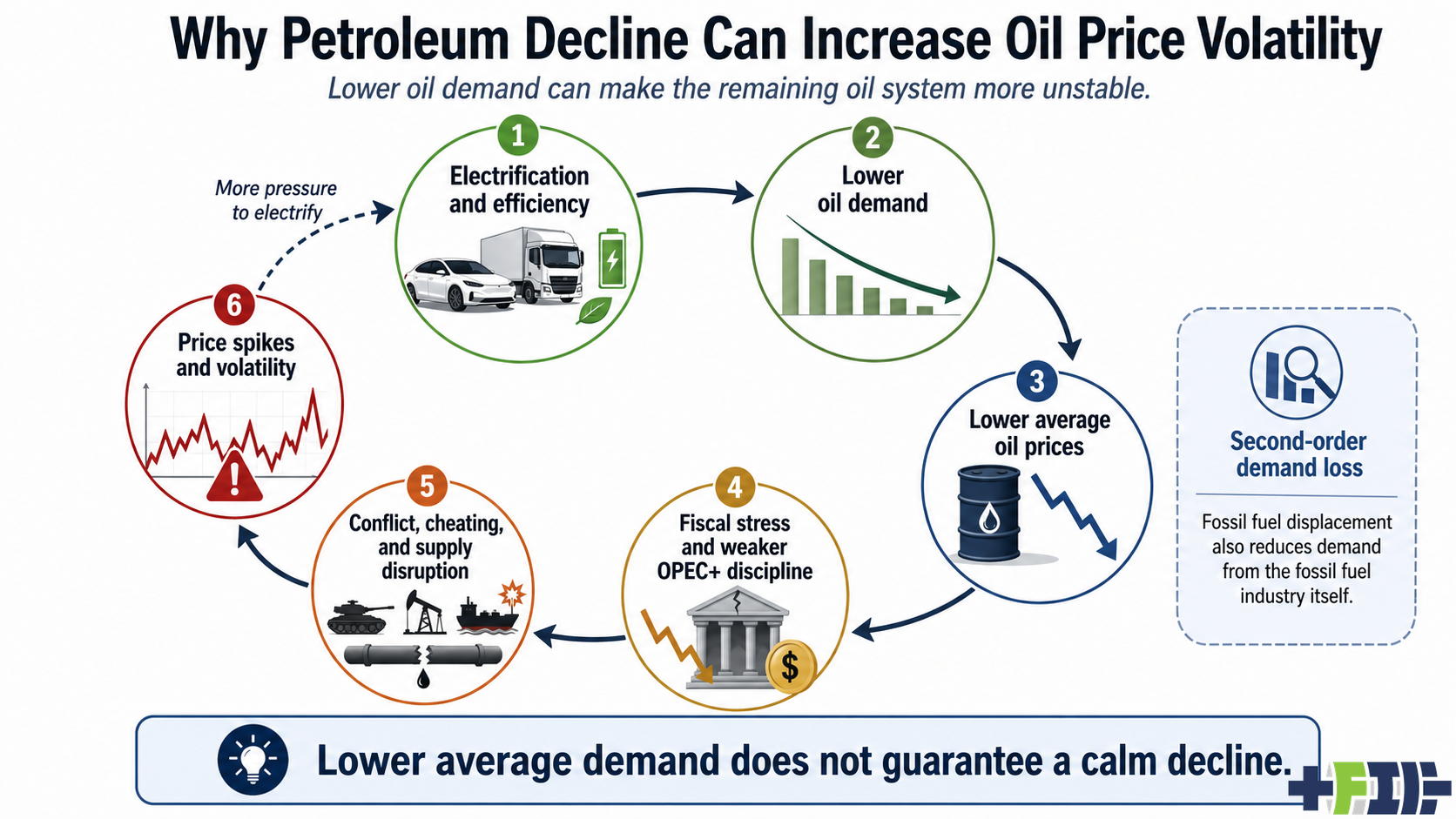
In a declining fossil-fuel world, fossil fuels do not necessarily become cheap in a calm, smooth, convenient way. The petroleum and gas systems were built around growth, long-lived assets, producer fiscal dependence, large infrastructure, shipping networks, and geopolitical leverage. Decline can create volatility because supply investment, demand, storage, contracts, shipping, producer behavior, sanctions, and weather do not all adjust in neat parallel lines. A lower average demand world can still have brutal price spikes if supply is tight, infrastructure is disrupted, or producers defend revenue. For households, the average is not the lived experience. The shock is.
For a wealthy household, volatility is annoying. For a low-income household, volatility is a choice between heat and other essentials. This is why electrification is not just climate policy. It is risk reduction. A heat pump is not just a heating appliance. When paired with storage, smart controls, and tariff design, it is a tool for reducing household exposure to fossil fuel markets. It shifts the household away from burning gas or oil directly and toward electricity, which can be increasingly supplied by wind, solar, interconnection, storage, and other non-fossil resources.
Ireland’s electricity system still has gas exposure. That caveat matters. Electrification does not make the household immune to fossil fuel prices overnight. But a heat pump with a seasonal performance factor of 3.5 delivers 3.5 units of heat for each unit of electricity. Even where gas is still on the margin in the power system at times, a heat pump reduces the fuel exposure per unit of useful heat. As the grid gets cleaner and more flexible, the exposure falls further. The household also gains access to time shifting, which a gas boiler cannot provide in the same way.
Thermal storage is the under-discussed part of this story. A tank of hot water is not glamorous. It does not have the appeal of a new power plant or the political symbolism of a large infrastructure project. But water is cheap, stable, familiar, dense as a thermal storage medium, and easy to control. A heat pump can make hot water or charge a thermal store when electricity is cheaper or cleaner, then the household can use that stored heat later. This matters because Ireland’s electricity prices are high, but smart tariffs can create wide spreads between expensive and cheaper periods.
Thermal storage does not save heat. It saves money by changing when heat is produced. A household still needs heat. The question is whether the heat pump makes that heat during a costly evening peak or during a cheaper night or low-demand period. With the right controls, the household should not have to think about this. Energy-poor households should not be turned into part-time electricity traders. The system should optimize in the background, with comfort protection and bill protection built in.
This is the core of flexible electric heat. It is not merely a heat pump. It is a delivery package: a heat pump designed from measured heat demand, no-regrets fabric where appropriate, emitter upgrades where needed, thermal storage, smart controls, and a tariff that rewards shifting without punishing vulnerable households. In many homes, solar PV may help. In some flats, communal systems may be better. In some very leaky or damp homes, deeper intervention will be needed. But the standard policy idea should be flexible electric heat, not heat pumps as isolated boxes and not deep retrofit as a universal precondition.
For flats and apartments, the starting point is mixed. Some are electric. Some are gas. Some have storage heat. Some are in shared heat systems. Some buildings may be suitable for individual heat pumps. Others may need shared systems, communal heat pumps, heat pump water heaters, or district heat where the density and infrastructure make sense. The point is to avoid forcing a detached-house solution into an apartment block. For flats, the package may be compact storage, shared hot water, smart controls, ventilation and damp fixes, and building-level heat solutions.
For terraced and mid-terrace homes, the pathway is often more repeatable. Many will start from gas heating. A measured heat demand assessment can support a right-sized heat pump. A hot-water cylinder or thermal store can shift some demand to cheaper hours. Emitter upgrades can allow lower flow temperatures. Attic insulation, cavity insulation where appropriate, draught reduction, and ventilation checks can improve comfort and performance. This is likely one of the better early scale-up archetypes because many homes are similar enough for standardized delivery while still needing enough assessment to avoid poor installations.
For detached homes, especially outside dense urban areas, the stakes are larger. Many start from oil or gas. Heat demand is larger. Exposure to fuel price volatility is larger. The opportunity for thermal storage is often larger because there may be more space for tanks and equipment. These homes need heat pumps designed from measured heat demand, not casual rule-of-thumb sizing. They need emitter upgrades and controls. They often benefit from no-regrets fabric measures. Many will benefit from solar PV as it improves bills and self-consumption. But again, the practical sequence is leave fossil heat, electrify early, add storage and controls, and target deeper works where measured need justifies it.

This is where Ireland’s existing policy framework should be adjusted. The first gap is the success gap. BER B2 targets and retrofit counts are useful administrative metrics, but they are not the same as warm, affordable, fossil-free homes. A household’s life is not improved by a metric unless the home is warmer, healthier, cheaper to run, and less exposed to price shocks. BER should remain part of the system, but it should not be the only dashboard.
The second gap is the sequence gap. A fabric or BER-first approach can delay fossil heat exit. For some homes, fabric work should happen early. For others, flexible electric heat should be delivered as a package. For the hardest homes, interim measures may be needed while specialist work is planned. The main point is that deep fabric retrofit should not be the default doorway through which every household must pass before fossil heat is addressed.
The third gap is the flexibility gap. Ireland has smart meters and time-of-use tariffs. That is useful, but it is not enough. A smart meter does not shift heat demand by itself. A tariff does not store heat by itself. Flexibility requires physical devices, automation, and consumer protection. Thermal storage and smart controls should be treated as standard heat pump infrastructure, not optional extras for enthusiasts.
The fourth gap is the equity gap. Fuel Allowance, Warmer Homes, grants, and consumer protections exist, but vulnerable households should not have to navigate a maze. The system should automatically triage households using income, arrears, health risk, tenure, fuel type, building condition, and under-heating indicators. The answer is not only more schemes. It is a more coherent lane through the schemes.

A time-structured strategy should start with protection. In the first 18 months, the focus should be keeping people warm, preventing avoidable arrears and disconnections, and identifying the households most at risk. This means targeted bill support, arrears protection, supplier engagement, and triage. The triage should record fuel type, health risk, BER or building condition, income, tenure, and signs of under-heating. A household in a damp rental with a child with asthma, a pensioner in an oil-heated rural detached house, and a low-income family in a gas-heated mid-terrace are different cases. They should not disappear into one generic retrofit queue.
The second phase, starting within six months and running to about three years, should scale electrification for suitable homes. This is not a promise that every home can be electrified instantly. It is a statement that the mainstream pathway should be clear. Heat pumps for suitable homes, shared solutions for flats, thermal storage, emitter upgrades, no-regrets fabric, and low-cost finance should be bundled. This is where Ireland can turn scattered interventions into a standard warm-home offer.
The third phase, from roughly three to eight years, should make flexible electric heat the default. Protected heat-pump tariffs, smart controls, thermal storage, and post-install performance monitoring should become normal. This is where the program stops being about individual grant transactions and starts being about system design. The household gets warmth. The grid gets flexible demand. The state gets lower fossil fuel exposure and lower emissions. The supplier gets a more manageable load profile. Done properly, this is part of the flexibility stack.
The fourth phase, from about eight to twelve years, should scale specialist solutions. This includes targeted deep retrofit for homes that need it, complex rental stock, damp and very leaky homes, heritage constraints, and homes where health vulnerability raises the standard of care. But the highest-risk homes must not wait until year eight. They need a parallel track from the start. Identify early. Stabilize comfort. Plan specialist works. Scale delivery.
That parallel highest-risk lane is essential. Some homes need interim dehumidification, ventilation, minor fabric fixes, safe heating, and health-focused intervention while full solutions are planned. Some need legal, landlord, or consent issues resolved. Some need deeper assessment. Some need specialist contractors. The mistake would be to tell those households to wait for a future deep retrofit wave. The right approach is to start them early, stabilize the living conditions, then scale the full specialist solution as capacity grows.
The fifth phase is the managed last-mile fossil exit. As wealthier households leave gas and oil faster, there is a risk that poorer households remain on shrinking fossil systems with rising network or delivery costs. That would be a familiar infrastructure injustice. The households least able to absorb volatility should not be left last. Gas network planning, oil-heating exit, rural supports, and rental standards need to be sequenced so that the last households on fossil heat are the hardest technical cases, not simply the poorest.

Renters need special attention because the split incentive is severe. Landlords own the building. Tenants pay the energy bills. Tenants may fear rent increases, disruption, or eviction if they push for upgrades. Landlords may not invest if the tenant receives the bill savings. Public grants can accidentally improve landlord assets without protecting tenants unless conditions are attached. This is not a side issue. Renters are a core energy poverty group.
The rental pathway should include minimum energy standards, landlord grants conditional on affordability protections, limits on rent increases tied to publicly funded upgrades, and targeted programs for local authority housing, approved housing bodies, and private rental stock. Rental status should be a triage factor in the highest-risk lane. A cold, damp rental home with a vulnerable occupant should not wait because the ownership structure is inconvenient.
Ireland should avoid several traps. Universal energy credits are politically easy and sometimes necessary in a crisis, but they are fiscally blunt. A €250 universal credit gives the same amount to a wealthy household and a household choosing between heat and groceries. Targeted supports can do more with less money. ESRI has estimated that closing the average energy poverty gap for vulnerable households could cost materially less than broad universal credits. That is the direction policy should move.
Ireland should also avoid mistaking metrics for outcomes. BER B2 targets and grant uptake are useful, but they are not the household outcome. The household outcome is warmth, bill stability, health, reduced damp, reduced arrears, and fossil fuel exit. A BER-led program can look successful on paper while missing households that are under-heating, renting, medically vulnerable, or stuck on volatile fuels.
Ireland should not push vulnerable households onto unmanaged dynamic tariffs or assume that smart meters create flexibility by themselves. Flexibility should not mean exposure to punitive peaks. It should mean automated comfort protection, cheap heat when available, and limits on downside risk. A protected heat-pump tariff could reward storage and shifting while shielding vulnerable households from bill shocks if weather, health, occupancy, or building constraints limit flexibility. A smart meter records. It does not insulate, heat, store, or control. The flexibility comes from devices and automation: heat pumps, hot water tanks, thermal stores, smart thermostats, controls, and tariff integration.
Ireland should measure outcomes differently. A serious warm-home dashboard would include the ability to maintain healthy indoor temperatures, actual post-upgrade bills, arrears, disconnection risk, fuel type removed, heat pump performance, flow temperature, thermal storage operation, peak demand reduction, damp, mould, ventilation, indoor air quality, tenant outcomes, rent impacts, under-heating indicators, and household satisfaction. Grant uptake and BER movement should remain, but they should not dominate.
This outcome dashboard would also improve installation quality. A heat pump that performs at a seasonal performance factor of 3.5 or higher is a different economic proposition from one performing badly. Flow temperatures matter. Emitter sizing matters. Controls matter. Hot water settings matter. Storage losses matter. If Ireland wants electrification to be trusted, it needs post-install monitoring, feedback to installers, and correction of poor outcomes. A bad installation does not merely waste energy. It damages public confidence.
The household arithmetic should remain visible because it keeps the policy honest. In the illustrative comparison, the flexible electric heat package saves about €723 per year for a flat against current gas, €765 per year for a mid-terrace, and €1,369 per year for a detached house. Against peak-shock gas, the savings rise to €1,021, €1,081, and €1,936 per year. Even against pre-shock gas, the flexible package saves €205, €216, and €387 per year. Those are energy-only costs under the stated assumptions, with standing charges excluded. They are not a promise for every home. They are a clear signal that the combination matters. Heat pump alone is not the full answer. Flexible electric heat is the answer.
The policy value of those savings is larger than the household bill line. Lower bills reduce arrears. Warmer homes reduce health risk. Removing gas or oil reduces exposure to future shocks. Flexible demand reduces peak pressure on the grid. Thermal storage helps shift heat demand away from expensive periods. Standardized archetype packages can lower delivery costs. Targeting deep retrofit to measured need preserves scarce skilled labor for the homes that need it most.
Ireland does not need to choose between insulation, heat pumps, bill support, and consumer protection. It needs to sequence them around the household problem. The first task is to keep people warm. The second is to reduce exposure to oil and gas volatility. The third is to make electric heat flexible enough to work with Ireland’s high electricity prices. The fourth is to target deeper retrofit where measured need justifies it, especially in damp, leaky, rental, and medically vulnerable homes.
That makes flexible electric heat less a technology slogan than a delivery model: heat pumps where suitable, shared heat where better, no-regrets fabric early, storage and controls as standard, protected tariffs, and deep retrofit for the homes that need it. Ireland already has much of the machinery. The opportunity is to reorder it around warm, affordable, healthy homes rather than treating BER movement and grant counts as the main measure of success.
Sign up for CleanTechnica's Weekly Substack for Zach and Scott's in-depth analyses and high level summaries, sign up for our daily newsletter, and follow us on Google News! Advertisement Have a tip for CleanTechnica? Want to advertise? Want to suggest a guest for our CleanTech Talk podcast? Contact us here. Sign up for our daily newsletter for 15 new cleantech stories a day. Or sign up for our weekly one on top stories of the week if daily is too frequent. CleanTechnica uses affiliate links. See our policy here.CleanTechnica's Comment Policy