Iran war: US says both military and merchant ships have passed through Strait of Hormuz
What you need to know
-
The US says two merchant vessels passed through the Strait of Hormuz, with a US Navy escort
-
UAE says air defense systems are responding to missile and drone attacks, reports fire at oil facility
-
Iran says interference in the Strait would be seen as a ceasefire violation
-
Tehran says it is weighing Washington's response to 14-point proposal
-
The US transfered 22 crew members of seized Iranian ship to Pakistan
Here are the latest developments from the war in Iran and the wider Middle East on Monday, May 4:
Skip next section Oil prices rise as Hormuz tensions escalate05/04/2026May 4, 2026Oil prices rise as Hormuz tensions escalate
Both benchmark oil prices rose considerably during Monday's trade as tensions flared up in the Strait of Hormuz.
Just after 1600 GMT/UTC, with European and Asian markets closed but trading ongoing in the US, a barrel of Brent Crude was selling for just over $114 (roughly €97.50). That compared to a price nearer $105 at the start of the day.
West Texas Intermediate, meanwhile, was selling at roughly $105 per barrel, compared to roughly $100 at the start of the day.
For most of February, before the attacks on Iran, a barrel of Brent Crude was selling for a little more than $65. It's peaked in isolated moments of trading at levels higher than $120 amid the war, and the highest daily average prices of recent weeks fall just shy of the prices it was commanding on Monday evening.
Related products that are exported in bulk through the Strait of Hormuz — like liquid natural gas, fertilizers and jet fuel — have also seen sharp rises in recent weeks.
https://p.dw.com/p/5DGmOSkip next section Qatar condemns Iranian attack on empty UAE oil tanker05/04/2026May 4, 2026
Qatar condemns Iranian attack on empty UAE oil tanker
Qatar's Foreign Ministry says it "strongly condemns" Iran for a reported drone attack on an unladen UAE-flagged oil tanker earlier in the day.
In a statement online, Qatar described the attack as "a blatant violation of international law and the principle of freedom of maritime navigation, as well as a flagrant breach of Security Council Resuolution No. 2817."
Resolution 2817, agreed in March this year, condemned Iran for its attacks on Gulf states and their assets in response to the US and Israeli attacks against it, declaring them a breach of international law and a threat to global peace. Russia and China had abstained, enabling its 13-0 passage in a vote.
"The Ministry of Foreign Affairs reiterates the State of Qatar's categorical rejection of using the Strait of Hormuz as a tool of pressure, calling for its unconditional reopening and affirming that freedom of navigation in this vital waterway is a firmly established principle that must not be compromised," the ministry wrote.
Although it is a far less prolific exporter than the UAE, oil and gas are crucial exports for Qatar.
https://p.dw.com/p/5DGfUSkip next section UAE reports missile and drone attacks, fire at oil facility05/04/2026May 4, 2026UAE reports missile and drone attacks, fire at oil facility
The United Arab Emirates has issued further warnings of attempted missile and drone attacks. The Defense Ministry said that four missiles were fired in its direction in total but all were either intercepted or crash landed.
"Four cruise missiles were detected approaching the country from Iran. Three were successfully intercepted over the country's territorial waters, while the fourth fell into the sea," the ministry said.
In a subsequent post, the Gulf country, located just across the Strait of Hormuz, said its air defense systems were "actively engaging operations of missiles and UAV's," meaning unmanned aerial vehicles or drones.
The ministry urged the public to remain calm and follow any instructions from officials.
Meanwhile, the media office of the port city of Fujairah reported that a fire broke out at the Fujairah Oil Industry Zone following what it described as an attack originating from Iran. It said civil defense teams were immediately deployed to the scene to contain the blaze.
There had been no such attacks in recent weeks in the UAE since the ceasefire between Iran and the US came into effect on April 8.
https://p.dw.com/p/5DGPWSkip next section WATCH — How oil-thirsty China insulated itself from the shock in the Gulf05/04/2026May 4, 2026WATCH — How oil-thirsty China insulated itself from the shock in the Gulf
China is the world's biggest importer of oil by volume — and by a hefty margin.
It is also widely considered to be the biggest buyer of Iranian oil, via so-called "teapot refineries" that can circumvent sanctions without implicating Beijing.
Although it is expanding its domestic production, around three-quarters of its oil still comes from abroad.
So why does China seem better placed than many other Asian countries amid the current delivery bottleneck? This video explains:
How China insulated itself from Gulf oil crises
To view this video please enable JavaScript, and consider upgrading to a web browser that supports HTML5 video
https://p.dw.com/p/5DGPLSkip next section South Korea says investigating cause of fire on HMM ship in Strait of Hormuz05/04/2026May 4, 2026South Korea says investigating cause of fire on HMM ship in Strait of Hormuz
South Korea's Foreign Ministry has said it is investigating the cause of a fire and explosion on a ship operated by the HMM company in the Strait of Hormuz.
It said that 24 crew members were on board.
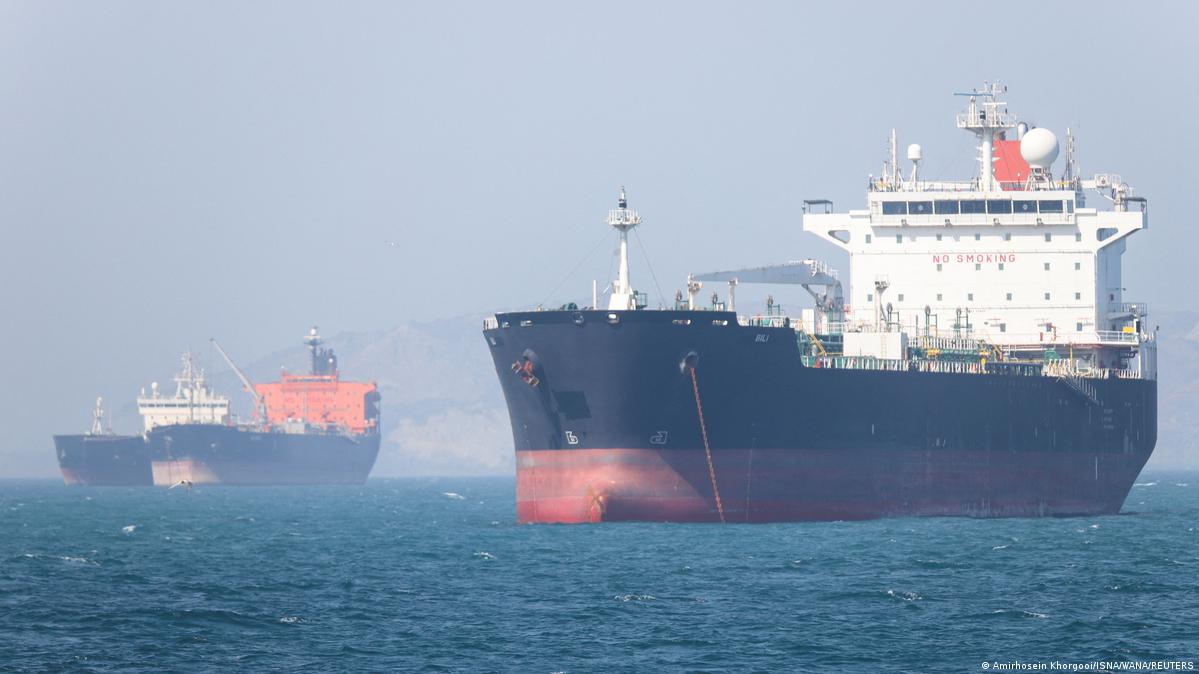
The ministry said the ship was anchored near the United Arab Emirates inside the Strait of Hormuz at the time of the fire, suggesting it was one of the series of ships waiting or hoping for passage through the waterway.
The ministry said it would coordinate closely with the relevant countries to determine the cause of the fire and details of the damage sustained.
"The consular affairs bureau is verifying information that a South Korean vessel came under attack. We have preliminarily confirmed that there are no casualties among our nationals," South Korea's Yonhap news agency quoted an official as saying.
A spokesperson for the HMM shipping company told the Reuters news agency that there were no reports of casualties or injuries, and that the fire broke out in the engine room of one of its bulk carriers.
https://p.dw.com/p/5DG51Skip next section UAE issues first missile alert in weeks, but soon sounds all clear05/04/2026May 4, 2026UAE issues first missile alert in weeks, but soon sounds all clear
Authorities in the United Arab Emirates have issued their first mobile phone alert warning of potential missile threats since early April, albeit soon sending out an all clear.
The alert went out as the dispute between the US and Iran over Donald Trump's desire to use the military to help commercial vessels navigate the Strait of Hormuz threatened to escalate.
It also came shortly after the UAE accused Iran of firing on an empty oil tanker.
The Interior Ministry said less than half an hour after sending out the SMS alert that people could resume their normal activities "while continuing to remain cautious and take the necessary precautions." It had initially told people to seek shelter in a safe place and await further instructions.
The UAE, situated just across the Strait of Hormuz, came under frequent fire in the first weeks of the war after the US and Israel's attacks on Iran, particularly during March.
But since the Iran-US ceasefire came into effect on April 8, the situation had calmed markedly.
Why the UAE is quitting OPEC now
To view this video please enable JavaScript, and consider upgrading to a web browser that supports HTML5 video
https://p.dw.com/p/5DG0hSkip next section US says 2 merchant vessels 'successfully transited' Strait of Hormuz05/04/2026May 4, 2026US says 2 merchant vessels 'successfully transited' Strait of Hormuz
The US military has said that two Navy guided-missile destroyers have entered the Gulf to break an Iranian blockade and that two US-flagged merchant vessels had transited through the Strait of Hormuz, amid Iranian efforts to block unauthorized traffic.
"US Navy guided-missile destroyers are currently operating in the Arabian Gulf after transiting the Strait of Hormuz in support of Project Freedom," Central Command (CENTCOM), responsible for operations in the region, said online, referring to Donald Trump's new proposal to help commercial vessels transit the strait.
Iran and most others refer to the sea in question as the Persian Gulf rather than the Arabian Gulf, but it's a reference to the same marginal sea of the Indian Ocean.
"American forces are actively assisting efforts to restore transit for commercial shipping. As a first step, two US-flagged merchant vessels have successfully transited through the Strait of Hormuz and are safely headed on their journey," CENTCOM said.
Iran had previously said it would consider US efforts to guide commercial ships through the Strait of Hormuz as a violation of the ceasefire.
Amid the ceasefire, the two militaries had continued to try to restrict maritime traffic — with Iran seeking to control the Strait of Hormuz and the US seeking to blockade Iran's ports.
How Iran exposed the limits of the US Navy
To view this video please enable JavaScript, and consider upgrading to a web browser that supports HTML5 video
https://p.dw.com/p/5DFasSkip next section US military says Iranian reports of missiles striking warship are false05/04/2026May 4, 2026US military says Iranian reports of missiles striking warship are false
The US military's Central Command, responsible for operations in the Middle East and the Gulf, says that Iranian reports of missiles striking a US warship are not accurate.
"Iranian state media claims that Iran's Islamic Revolutionary Guard Corps hit a U.S. warship with two missiles," Centcom wrote online. "No U.S. Navy ships have been struck. U.S. forces are supporting Project Freedom and enforcing the naval blockade on Iranian ports."
Iranian news agencies including the semiofficial Fars and the Iranian Labour News Agency had reported Iranian strikes on a US vessel southeast of the Strait of Hormuz off Iran's coast, accusing it of "violating maritime security and navigation norms."
The contesting claims come amid the launch of "Project Freedom," a contentious offer by the US Navy to guide certain commercial ships through the Strait, as Iran seeks to halt most ships' passage through the narrow waterway.
US President Donald Trump announced the plan on Sunday but details of what it might entail have been vague.
Iran responded by calling it a violation of the terms of the fragile ceasefire that has more or less halted kinetic warfare between the two sides, other than the naval wrangling over access to the strait and other waters in the area.
https://p.dw.com/p/5DFWUSkip next section UAE accuses Iran of drone attack on empty oil tanker05/04/2026May 4, 2026UAE accuses Iran of drone attack on empty oil tanker
Alex Berry EditorThe United Arab Emirates has accused Iran of using drones to attack an empty oil tanker as it attempted to pass through the Strait of Hormuz.
The "Barakah" ship belongs to the Abu Dhabi state oil company ADNOC.
ADNOC said the Barakah was attaclked by two drones, but that no injuries were reported.
"The UAE further stressed the need for Iran to halt these unprovoked attacks, ensure its full commitement to an immediate cessation of all hostilities, and the complete and unconditional opening of the Strait of Hormuz," the UAE's Foreign Minsitry said.
Iran has blocked many non-Iranian ships from passing through the Strait of Hormuz since the US and Israel began attacking it on February 28. It has threatened to attack vessels passing through the waterway without authorization.
The United Kingdom Maritime Trado Operations (UKMTO) agency had earlier reported a tanker in the region being hit by unknown projectiles.
Strait of Hormuz and the global fight over shipping lanes
To view this video please enable JavaScript, and consider upgrading to a web browser that supports HTML5 video
https://p.dw.com/p/5DFJNSkip next section Oil price rises despite Trump's plan to guide ships out of Hormuz05/04/2026May 4, 2026Oil price rises despite Trump's plan to guide ships out of Hormuz
Oil prices surged on Monday, with markets unimpressed by US President Donald Trump's plan to help stranded ships pass through the key oil route, the Strait of Hormuz.
Brent crude initially climbed 1.54% to $109.84 per barrel for July delivery, while US crude rose over 2% to $104.18, reflecting heightened supply concerns.
Traders remain skeptical that the US plan will succeed.
The US Central Command said it would support the initiative with 15,000 troops, warships, aircraft and drones, though Trump has shared few operational details.
A report by Axios later said the US Navy may not directly escort commercial ships, adding to market uncertainty.
Brent futures later rose even further, jumping over $2.50 to $110.73 per barrel, after recovering from early losses during Asian trading hours.
Oil prices have already been volatile—crude crossed $126 per barrel last week, the highest level since 2022, following Russia’s full-scale invasion of Ukraine.
https://p.dw.com/p/5DE0ASkip next section ANALYSIS: What is Europe's plan to secure Hormuz?05/04/2026May 4, 2026ANALYSIS: What is Europe's plan to secure Hormuz?
Anchal VohraThe UK and France are leading efforts to establish a multinational mission to secure shipping through the Strait of Hormuz. But questions remain about the scope of the operation.
DW's Anchal Vohra looks at the role of Europe in the Strait of Hormuz.
https://p.dw.com/p/5DDZzSkip next section US transfers crew of seized Iranian ship to Pakistan05/04/2026May 4, 2026US transfers crew of seized Iranian ship to Pakistan
Islamabad on Monday confirmed that 22 crew members from an Iranian container ship seized by the US would be evacuated to Pakistan.
Pakistan's Foreign Ministry called it a "confidence-building measure" with support from both sides. The crew would then be returned to Iran, a statement read.
Read the full report on the transfer of the Iranian ship crew members to Pakistan.
https://p.dw.com/p/5DD2LSkip next section Iran weighs US response to peace plan05/04/2026May 4, 2026Iran weighs US response to peace plan
Iran's Revolutionary Guards has said that the US faced a choice between an "impossible" military operation or a "bad deal" with Tehran, after Trump expressed dissatisfaction with Iran's latest peace proposal.
The Iranian Foreign Ministry said Tehran had submitted a 14-point plan "focused on ending the war" and that Washington had already responded to it in a message to Pakistani mediators.
The ministry added that it was reviewing the US response.
US media outlet Axios reported — citing two sources briefed on Iran's proposal — that Tehran had set a one-month deadline for negotiations on a deal.
The Iranian plan includes reopening the Strait of Hormuz, lifting US sanctions on Iran, ending the US naval blockade of Iran's ports and permanently ending the wars in Iran and in Lebanon.
Iran's Foreign Ministry spokesperson Esmail Baghaei stressed that the Islamic Republic's nuclear program was not part of the talks.
"At this stage, we do not have nuclear negotiations," Iranian state media cited Baghaei as saying.
The comment was an apparent reference to Tehran's proposal to set aside talks on nuclear issues until after the war has ended and the conflicting sides have agreed to lift opposing blockades on Gulf shipping.
The US has demanded that Tehran abort its nuclear enrichment. Iran maintains that its program is for peaceful, civilian purposes.
What are the sticking points in US-Iran peace negotiations?
To view this video please enable JavaScript, and consider upgrading to a web browser that supports HTML5 video
https://p.dw.com/p/5DCXRSkip next section Iran military warns US forces against entering Strait of Hormuz05/04/2026May 4, 2026Iran military warns US forces against entering Strait of Hormuz
Iran's military said on Monday that American forces would be attacked if they entered the Strait of Hormuz, after US President Donald Trump announced Washington would help guide stuck vessels out of the key shipping passage.
"We warn that any foreign military force — especially the aggressive U.S. military — that intends to approach or enter the Strait of Hormuz will be targeted," said Major General Ali Abdollahi of the Iranian military's central command, in a statement carried by Iranian state broadcaster IRIB.
"We have repeatedly stated that the security of the Strait of Hormuz is under the control of the armed forces of the Islamic Republic of Iran, and under all circumstances, any safe passage must be coordinated with these forces," he added.
https://p.dw.com/p/5DCcESkip next section Trump says US to help ships stranded in Strait of Hormuz05/04/2026May 4, 2026Trump says US to help ships stranded in Strait of Hormuz
The US on Monday launched an effort to "guide" stranded ships of the nations not party to the Middle East conflict from the Strait of Hormuz, where Iran continues to maintain its chokehold.
It comes a day after President Donald Trump announced the new maritime operation — dubbed "Project Freedom" — on his Truth Social platform.
What did Trump say about the Strait of Hormuz?
The US president gave few details about the operation.
He said it was a "humanitarian" gesture for crews aboard the many ships caught in the blockade and their crews who may be running low on food and other crucial supplies.
"We will use best efforts to get their Ships and Crews safely out of the Strait. In all cases, they said they will not be returning until the area becomes safe for navigation," Trump said.
It was not immediately clear which countries the US operation would aid.
Shortly after Trump's statement, the US Central Command (CENTCOM) said it would support the mission with 15,000 military personnel, over 100 land and sea-based aircraft, along with warships and drones.
"Our support for this defensive mission is essential to regional security and the global economy as we also maintain the naval blockade," CENTCOM commander Admiral Brad Cooper, said in a statement.
How has Iran reacted?
Iran quickly slammed the move as a ceasefire violation.
"Any American interference in the new maritime regime of the Strait of Hormuz will be considered a violation of the ceasefire," Ebrahim Azizi, head of the National Security Commission in Iran's parliament, said in a social media statement.
Azizi went on to add that the critical waterway "would not be managed by Trump's delusional posts!"
Iran's blockade of the Strait, following the war launched by the US and Israel on February 28, has upended global markets, with major flows of oil, gas and fertilizer affected.
According to maritime intelligence firm AXSMarine, more than 900 commercial vessels were located in the Persian Gulf as of April 29.
As many as 20,000 seafarers have been unable to transit the Strait during the conflict, as per the International Maritime Organization.
https://p.dw.com/p/5DCQgShow more postsСхожі новини
Iran war: US says both military and merchant ships have passed through Strait of Hormuz

ПС ЗСУ: 70 ворожих БпЛА знешкоджено з 8:30, є влучання балістики та 14 ударних безпілотників

Генштаб ЗСУ: Уражено склади БпЛА, боєприпасів і ПММ та об'єкти ППО противника на ТОТ України