Iran war: Trump says US seized Iranian-flagged cargo ship
What you need to know
- US forces took control of Iranian-flagged cargo ship near Strait of Hormuz
- Iran rejects new peace talks with US in Pakistan, state media reports
- Trump sends US negotiators to Pakistan to restart talks
- Iran has closed Strait of Hormuz after reopening it on Friday
- The ceasefire between US-Israel and Iran is set to expire on Wednesday
Here is a round-up of the latest developments from the US-Israeli war with Iran and the wider Middle East on Sunday, April 19, 2026:
Skip next section Iran has 'no plans' to join talks in Islamabad: state media04/19/2026April 19, 2026Iran has 'no plans' to join talks in Islamabad: state media
Alex Berry EditorTehran was not planning to take part in a new round of negotiations with the United States in Islamabad, Iranian state media reported on Sunday
"There are currently no plans to participate in the next round of Iran-US talks," state broadcaster IRIB reported, in English, on X.
It was not immediately clear who was behind the announcement.
https://p.dw.com/p/5CSWZSkip next section Trump: US Marines seized Iranian-flagged cargo ship04/19/2026April 19, 2026Trump: US Marines seized Iranian-flagged cargo ship
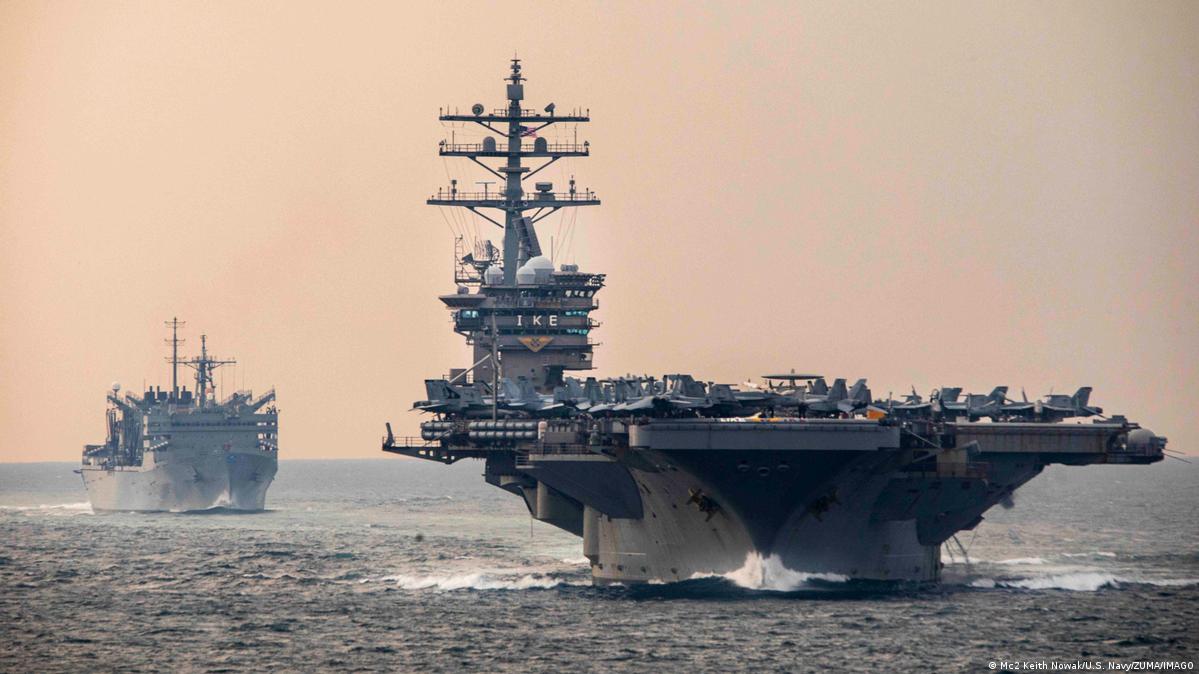
President Donald Trump said US forces seized an Iranian-flagged cargo ship on Sunday. The vessel was trying to evade a US naval blockade near the Strait of Hormuz, he wrote in a post on his Truth Social platform.
"Our Navy ship stopped them right in their tracks by blowing a hole in the engineroom," Trump wrote.
He added that US Marines had taken custody of the ship, named Touska, and were "seeing what’s on board!"
https://p.dw.com/p/5CSMsSkip next section Pakistani PM assures Iranian president of committment as mediator of peace04/19/2026April 19, 2026Pakistani PM assures Iranian president of committment as mediator of peace
Pakistani Prime Minister Shehbaz Sharif said he discussed the conflict in the Gulf with Iranian President Masoud Pezeshkian on Sunday.
Sharif wrote in a post on X that he "shared insights from my recent engagements with leaders of Saudi Arabia, Qatar and Türkiye."
"I appreciated Iran's engagement, including its high-level delegation to Islamabad for the historic talks, and recent discussions with Field Marshal Syed Asim Munir," Sharif said.
Sharif told Pezeshkian that Pakistan remains committed to its role as a facilitator of peace and regional stability.
https://p.dw.com/p/5CSBlSkip next section Unclear if Iran will join second round of Islamabad talks04/19/2026April 19, 2026Unclear if Iran will join second round of Islamabad talks
It is still unclear whether Iran will ultimately join the second round of talks in Islamabad with the United States.
State-run Iranian news agency Irna reported Sunday that "there is no clear prospect of fruitful negotiations."
Irna also pointed to Washington's "maximalism and unreasonable and unrealistic demands, frequent changes of positions, constant contradictions and the continuation of the so-called naval blockade."
Meanwhile, the Fars and Tasnim news agencies, quoting anonymous sources, said, "The overall atmosphere cannot be assessed as very positive."
Fars cited one source as saying that the lifting of a US blockade on Iranian ports was a precondition for continued talks.
https://p.dw.com/p/5CS5vSkip next section IN DEPTH: Mines in the Strait of Hormuz: How dangerous are they?04/19/2026April 19, 2026IN DEPTH: Mines in the Strait of Hormuz: How dangerous are they?
On Friday, German Chancellor Friedrich Merz said his country was prepared to supply mine clearance and maritime reconnaissance to help secure the Strait of Hormuz.
The same day, Iran's top diplomat Abbas Araghchi declared the critical waterway "completely open" for the duration of the Israel-Lebanon ceasefire, and US President Donald Trump likewise said it was "ready for full passage."
The following day, Iran reversed its decision, shutting the strait again.
Either way, maritime traffic might still be at risk, given that Iranian authorities had previously indicated there may be underwater mines in the strait.
How dangerous are naval mines, and what can be done to clear them? Find out here.
https://p.dw.com/p/5CS5KSkip next section Vance to return to Islamabad for new round of talks04/19/2026April 19, 2026Vance to return to Islamabad for new round of talks
US Vice President JD Vance, who led the first round of talks between the US and Iran last weekend, will return to Islamabad for the negotiations, according to a White House official.
Trump's envoy Steve Witkoff and son-in-law Jared Kushner will also be part of the delegation.
Earlier, Trump had said Vance would not go to the Pakistani capital. "It's only because of security," Trump told ABC News. "JD's great."
Last Sunday, Vance left Islamabad after 21 hours of talks with Iranian officials ended without a breakthrough.
Iran war: What's next after Islamabad talks fail?
To view this video please enable JavaScript, and consider upgrading to a web browser that supports HTML5 video
https://p.dw.com/p/5CRyrSkip next section Two cruise ships pass through Hormuz04/19/2026April 19, 2026Two cruise ships pass through Hormuz
Germany-based TUI Cruises said that its Mein Schiff 4 and Mein Schiff 5 ships passed through the Strait of Hormuz on Sunday.
According to the maritime data service MarineTraffic, only one other cruise ship, the Celestial Discovery, formerly known as the Aida aura, had been able to pass the strait since the start of the Iran war on February 28, when the US and Israel attacked Iran.
Tui said that all passengers had previously been brought home and both ships were operating with reduced crews, adding that it had obtained approvals from relevant authorities to cross the strait, under careful consideration of the security situation.
It said the ships would now continue on to the Mediterranean Sea.
https://p.dw.com/p/5CRvSSkip next section Macron to meet with Lebanese PM04/19/2026April 19, 2026Macron to meet with Lebanese PM
French President Emmanuel Macron is expected to meet with Lebanese Prime Minister Nawaf Salam in Paris this week, his office announced.
The meeting comes amid a fragile 10-day ceasefire between Israel and the Iran-backed militant group Hezbollah.
The visit was announced a day after France blamed Hezbollah for an ambush on UN peacekeepers that left one French soldier dead and three others wounded.
Macron is expected to urge Lebanese authorities to "shed full light on the incident" and "identify and prosecute those responsible without delay," his office added.
With the move, the French government will highlight Macron's commitment to seeing "full and complete respect for the ceasefire in Lebanon" as well as France's support for Lebanon's "territorial integrity," the president's office said on Sunday.
https://p.dw.com/p/5CRvRSkip next section Iran not sending negotiating delegation to Pakistan, Tasnim reports04/19/2026April 19, 2026Iran not sending negotiating delegation to Pakistan, Tasnim reports
Iran is not sending a negotiating delegation to Pakistan "as long as there is a naval blockade," Iran's Tasnim news agency reported on Sunday.
The development came after Pakistani Foreign Minister Ishaq Dar, who spoke by phone with his Iranian counterpart Abbas Araghchi on Sunday, had said his country was working to "bridge" differences between Washington and Tehran.
Earlier, US President Donald Trump had announced that US negotiators were due in Islamabad on Monday evening.
Late Saturday, Parliament Speaker Mohammed Bagher Ghalibaf, who has emerged as Iran's main negotiator, said in an interview on state television that "there will be no retreat in the field of diplomacy."
https://p.dw.com/p/5CRvESkip next section Trump accuses Iran of ceasefire violations04/19/2026April 19, 2026Trump accuses Iran of ceasefire violations
US President Donald Trump accused the Iranian regime of violating the current ceasefire agreement and threatened to "to knock out every single Power Plant, and every single Bridge," if Iran does not make a deal with the US.
Tehran said on Saturday it would keep the Strait of Hormuz closed. At least two ships reported they had been fired upon while approaching the strait on Saturday.
"Iran decided to fire bullets yesterday in the Strait of Hormuz — A Total Violation of our Ceasefire Agreement!" Trump wrote in a post Sunday on his Truth Social platform. "That wasn't nice, was it?"
https://p.dw.com/p/5CRlKSkip next section Iran accuses US of violating ceasefire via blockade04/19/2026April 19, 2026Iran accuses US of violating ceasefire via blockade
Iran has called the US blockade on its ports a "violation" of the ceasefire agreement mediated by Pakistan some 10-days ago, which paused over six weeks of fighting.
"The United States' so-called 'blockade' of Iran’s ports or coastline is not only a violation of Pakistani-mediated ceasefire but also both unlawful and criminal," Iranian Foreign Ministry spokesman Ismaeil Baqaei said Sunday on X.
He cited a United Nations General Assembly resolution to argue that the blockade was an "act of aggression" against Iran.
"Moreover, by deliberately inflicting collective punishment on the Iranian population, it amounts to war crime and crime against humanity," the Foreign Ministry spokesman went on to say.
Iran has reverted to shuttering the critical Strait of Hormuz after Trump refused to lift the blockade.
https://p.dw.com/p/5CRlfSkip next section US negotiators due in Pakistan early next week, Trump says04/19/2026April 19, 2026US negotiators due in Pakistan early next week, Trump says
US negotiators are due in the Pakistani capital on Monday evening, US President Donald Trump announced on Sunday, as Islamabad mediates efforts aimed at ending the US-Israeli war on Iran.
"My Representatives are going to Islamabad, Pakistan — They will be there tomorrow evening, for Negotiations," Trump said in a lengthy post on his Truth Social platform.
He then strayed into criticism and threats against Iran, which he accused of violating the ceasefire agreement by attacking ships attempting to pass through the strategic Strait of Hormuz on Saturday.
Iran had briefly reopened the critical waterway on Friday, only to announce closing it again less than 24 hours later after Trump refused to lift a blockade on its ports.
Questioning Iran's closure of the strait, Trump called it "strange" because "our BLOCKADE has already closed it."
Without mentioning any of the terms, he also said the US proposed a peace agreement.
"We're offering a very fair and reasonable DEAL, and I hope they take it because, if they don't, the United States is going to knock out every single Power Plant, and every single Bridge, in Iran. NO MORE MR. NICE GUY!" Trump went on to say.
https://p.dw.com/p/5CRiQSkip next section Houthis threaten to close key waterway04/19/2026April 19, 2026Houthis threaten to close key waterway
Yemen's Houthi rebels have threatened to close the Bab al-Mandab Strait off Yemen, amid escalating rhetoric between Tehran and Washington. The Yemeni militia is part of the so-called Axis of Resistance, a network of pro-Iran regional armed groups.
Late last month, the Houthis entered the US-Israeli war to support Iran, launching multiple attacks on Israel. But so far, the militia has stopped short of renewing its attacks on shipping in nearby trade waterways.
Iran war escalates as Houthis launch first strikes on Israel
To view this video please enable JavaScript, and consider upgrading to a web browser that supports HTML5 video
"If Sanaa decides to close the Bab al-Mandeb, then all of mankind and jinn will be too helpless to open it," Hussein al-Ezzi, a senior Houthi official, said in a post on X late on Saturday.
Sanaa is Yemen's capital and is controlled by the Houthi militant group alongside the most populous parts of the country, while the internationally recognized government is based in Aden.
The Strait of Hormuz is a crucial global shipping route located between Yemen in the Arabian peninsula and Djibouti in eastern Africa. It connects Europe with Asia via the Suez Canal, which one of the most important international maritime trade routes.
The Houthi's threat comes as Iran has doubled down on its pledge to restrict ships passing through the Strait of Hormuz and as mediators scrambled to extend the ceasefire, which is set to expire on Wednesday.
https://p.dw.com/p/5CRexSkip next section WATCH — How Iran's Navy still wields power in the Strait of Hormuz04/19/2026April 19, 2026WATCH — How Iran's Navy still wields power in the Strait of Hormuz
Even if the Strait of Hormuz is not fully blocked, Iran can still threaten global shipping. Security monitors report Iranian fire on commercial vessels, and the UN's maritime agency says at least 20 ships have been attacked. Analysts say the Islamic Revolutionary Guard Corps Navy deploys a "mosquito fleet" of fast boats, drones, missiles, torpedoes and sea mines to harass tankers, despite US claims Iran’s navy has been crippled.
How Iran's Navy wields power in the Strait of Hormuz
To view this video please enable JavaScript, and consider upgrading to a web browser that supports HTML5 video
https://p.dw.com/p/5CRWESkip next section Israelis near Lebanon border protest ceasefire04/19/2026April 19, 2026Israelis near Lebanon border protest ceasefire
Residents of Kiryat Shmona, the largest Israeli town on the country's northern border with Lebanon, went on strike on Sunday, to protest the ceasefire in the conflict with the Iran-backed Hezbollah militia there, Israeli media reported.
The protest affected the first work day, as the Israeli work week starts on Sunday.
City administration and schools were closed, Israeli public broadcaster Kan reported.
Kiryat Shmona has been repeatedly shelled by Hezbollah during the most recent war. Residents of the city are calling for Hezbollah to be fully disarmed and for better rocket protection in the border town, especially for schools and daycare centers.
Many of the 24,000 residents of Kiryat Shmona have left after the Gaza war began two and a half years ago.
Many remaining residents are angry at the Israeli government, accusing Israeli Prime Minister Benjamin Netanyahu of allowing a ceasefire in Lebanon to be imposed on him by US President Donald Trump.
"This is not a complete victory — it is a turning away from the residents of the north!" a statement from the town's mayor, Avichai Stern, read.
Stern spoke of a "dangerous ceasefire" that was sacrificing the security of Israel's northern residents.
Netanyahu, meanwhile, had repeatedly promised Israelis a decisive victory over Hezbollah.
Protests by representatives of Kiryat Shmona are also planned in Jerusalem.
https://p.dw.com/p/5CRSQShow more postsСхожі новини
Iran war: Trump says US seized Iranian-flagged cargo ship
Trump says US seized Iran-flagged ship trying to get past Hormuz blockade

Вигівський повідомив деталі біографії терориста, якого ліквідували у Києві