Iran war tensions, oil shocks dominate BRICS talks in India
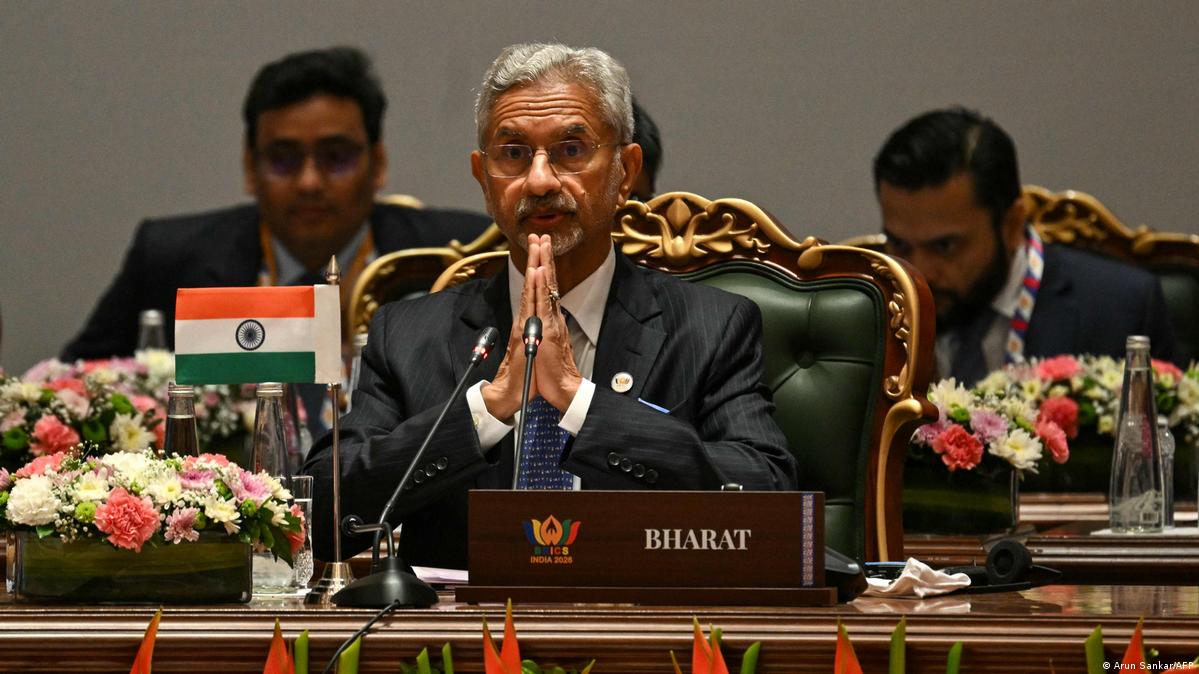
Indian Foreign Minister Subrahmanyam Jaishankar called for "safe, unimpeded maritime flows" through international waters, including the Strait of Hormuz, as the politically divided BRICS nations gathered in New Delhi on Thursday.
"We meet at a time of considerable flux in international relations," Jaishankar said in his opening remarks. "There is a growing expectation, particularly from emerging markets and developing countries, that BRICS will play a constructive and stabilizing role," he said.
Jaishankar's call for stability comes amid internal divisions within the grouping that has expanded over the course of the years.
BRICS now includes Egypt, Ethiopia, Iran, Indonesia and the United Arab Emirates (UAE), in addition to the original members, Brazil, Russia, India, China, and South Africa.
Not all BRICS nations see eye to eye
BRICS members Iran and UAE were especially at odds ahead of the meeting because of the Iran war.
Experts now fear that the grouping may struggle to agree on a common formulation to even describe US-Isarel war on Iran and the broader conflict in the Middle East.
Jaishankar also called on leaders to "address the increasing resort to unilateral coercive measures and sanctions inconsistent with international law and the UN Charter."
Why is BRICS foreign ministers' meeting so important?
The BRICS bloc of emerging economies has long sought to present itself as a counterweight to Western dominance.
South Africa joined in 2010, and the group expanded again in January 2024 to include Egypt, Ethiopia, Iran, Saudi Arabia, and the UAE. Indonesia became a full member in 2025.
Thursday's meeting also comes against the backdrop of the US-Israeli war with Iran that has disrupted critical global supplies of oil, gas, and raw materials.
Talks about energy security high on the table
India, the BRICS Chair for 2026, is also facing a shortage of foreign currency reserves. Indian Prime Minister Narendra Modi has urged citizens to avoid buying gold for a year and conserve fuel to help manage the crisis.
Talks are expected to focus on energy security, the Strait of Hormuz, and trade in local currencies.
Iran calls for unequivocal condemnation of US, Isarel
Iranian Foreign Minister Abbas Araghchi called on other BRICS members to unequivocally condemn the US and Israeli attacks against Iran — a demand likely to be rejected by several members, including the UAE and Saudi Arabia.
Araghchi's remarks came hours after Israeli Prime Minister Benjamin Netanyahu's office said that he had secretly visited the UAE during the US-Israel war with Iran to strengthen ties.
Netanyahu's secret trip to UAE
Netanyahu reportedly met with UAE President Sheikh Mohammed bin Zayed Al Nahyan at a gathering that "resulted in historic breakthrough in relations between" the two countries, according to an Israeli statement.
UAE swifty denied the visit and said its relations with Israel were "public" and "not based on non-transparent or unofficial arrangements."
Araghchi responded to Israel's claims in a thinly veiled post on social media, without naming the UAE.
"Enmity with the Great People of Iran is a foolish gamble. Collusion with Israel in doing so: unforgivable," he wrote, adding that "those colluding with Israel" would be "held to account."
The UAE and Israel normalized relations in 2020 under the Abraham Accords and appear to have strengthened ties during the Iran war. Tehran has criticized the accords and accused Israel of maintaining a military and intelligence presence in the UAE.
Iran targeted the UAE more than any other country during the conflict, which was sparked by US-Israeli strikes on the Islamic Republic at the end of February.
Edited by: Roshni Majumdar
AdvertisementСхожі новини
Forza Horizon 6 is all gas, no brakes in series’ first Japan pit stop
Takaichi plans to visit Britain and Italy before G7 summit in June