Iran denies deal with US is imminent despite some progress
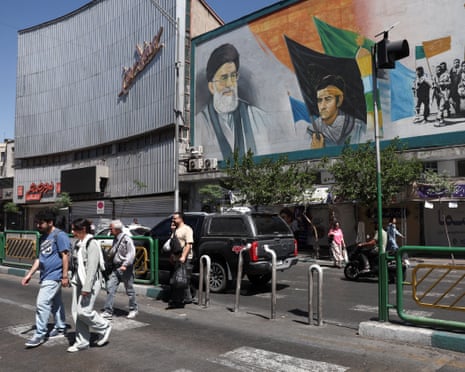
Tehran says ‘contradictory statements’ from US and Israeli interference hindering negotiations
Iran has poured cold water on suggestions that a deal with the US is imminent, pointing to the confusion in US positions and Israeli interference as key factors in why a complete agreement is proving difficult to secure.
Speaking at the weekly foreign ministry press briefing, Esmail Baghaei, the spokesperson for Iran’s negotiating team, also said future management of the strait of Hormuz was a matter for Oman and Iran to reach agreement on, and that it was not tolls that were being proposed but “fees for navigational services”.
Referring to the state of the talks, Baghaei said: “It is correct to say that we have reached a conclusion on a large portion of the issues under discussion. But to say that this means the signing of an agreement is imminent – no one can make such a claim.”
He also insisted that a ceasefire in Lebanon had to be included in the memorandum of understanding that would lead to Iran allowing commercial shipping through the strait, and the US lifting its blockade of Iran’s ports.
By contrast, the US secretary of state, Marco Rubio, still held out hope that a deal could be reached on Monday, but there appeared to be a mounting list of unresolved problems in what was intended to be a roadmap to reopening the nuclear talks that Trump abandoned in February in favour of war.
Rubio said it took time to receive an answer from the Iranian political system but he emphasised: “Either we will have a good deal or we will deal with this issue in another way, and we prefer to have a good deal.”
The US president, Donald Trump, said in a post on Truth Social on Monday that the deal would either be “great and meaningful, or there will be no deal at all”.
In the press briefing, Baghaei also said no nuclear issues, such as what to do with the Iranian stockpile of highly enriched uranium, would be tackled in the memorandum except for a commitment to negotiate in the next 60 days. Trump, under mounting pressure from critics inside the Republican party, wants the memorandum to contain a commitment by Iran to dispose of its stockpile of highly enriched uranium, even if the precise method is not detailed.
In previous rounds of talks with the US, Iran has said it is willing to down-blend the enriched uranium, but it will not permit the transfer of the stockpile to either the US or Russia. It has spoken of suspending domestic enrichment for as long as five years, but not the 20 years sought by the US.
Iranian officials also claimed the political outcry about the deal inside the US was placing pressure on Trump to backtrack on plans to release as much as $12bn (£9bb) in frozen Iranian assets held in Qatar. The governor of Iran’s central bank, Abdolnaser Hemmati, travelled to Qatar on Monday.
The release of the assets is a central Iranian demand, but has painful parallels for Trump, who lambasted Barack Obama for giving $1.7bn to Iran in cash at the time of the 2015 nuclear deal.
Baghaei, referring to the chaos in Washington, said: “You are faced with a wave of dismissals, contradictory statements, opposition from Congress and also opposition from parts of public opinion.”
Trump by contrast has dismissed his critics, saying he would not “listen to losers who are critical of something they know nothing about”.
The deal contains nothing on Iran’s ballistic missiles or support for its regional proxy groups; as such, it contrasts with Trump’s promise that the war would end with Iran’s complete surrender.
Baghaei accused Israel of trying to scupper the deal, saying nothing else should be expected of the Israelis.
On the strait of Hormuz, Baghaei said talks were held on Monday between Omani and Iranian officials. He claimed the reason Oman and Iran were trying to establish a reliable and effective mechanism to ensure safe passage in the strait was precisely because “we believe in the use of this international waterway for free trade and safe navigation”.
Rejecting claims the Iranian plan amounted to nationalisation of an open waterway, he said that if “navigation services are provided, plus necessary measures to protect the environment of the strait, these require the collection of fees. The term tolls should not be used. We do not charge tolls. I think we should be careful in the choice of words.”
European and Gulf states are likely to see this as a distinction without a differences, especially if commercial shipping is in effect required to seek Iran’s navigational services.
Inside Iran, many commentators saw the imminent deal as a roadmap to a hostile coexistence aimed at managing the tension, rather than ending it.
The sense that the war for now may be reaching its endgame was underlined by reports that Iran’s officials would reconnect Iran to the international internet within a week after a vote by the supreme national security council. Iranian officials, facing soaring inflation of food prices, are nervous about the public reaction once internet controls are lifted. The spate of executions inside Iran continues unabated.
Explore more on these topics- US-Israel war on Iran
- Iran
- US foreign policy
- Strait of Hormuz
- Trump administration
- Iran nuclear programme
- Oman
- news
Схожі новини

Can money buy happiness? Bill Gates offers a surprisingly honest answer
The Abraham Accord plus: Trump aims for grand bargain tying Islamic world with Israel
'For Brothers': Major international gang busted in Canada, 17 Indians charged for extortion targeting South Asians
