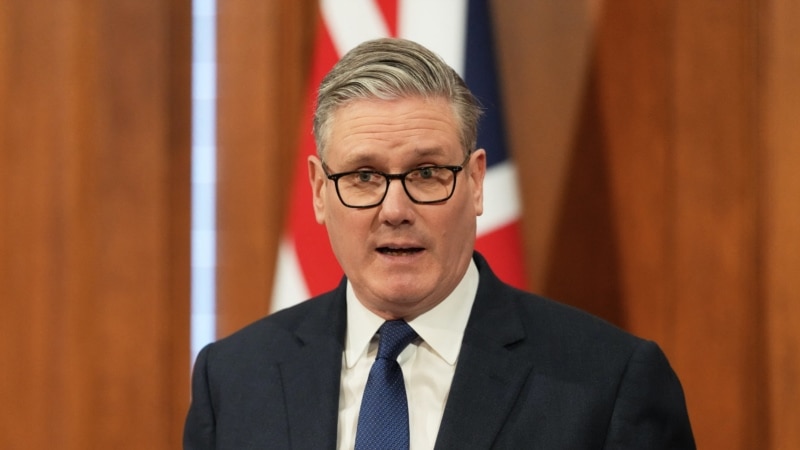
Iran closes Strait of Hormuz again over US blockade

What you need to know
- Iran has closed the Strait of Hormuz again
- It accused the US of violating the ceasefire agreement by its blockade
- Iran has meanwhile partially reopened its airspace
- US has renewed a sanctions waiver for Russian oil
Here is a round-up of the latest developments on the US-Israeli war with Iran and the wider Middle East on Saturday, April 18, 2026:
Skip next section Russia welcomes US decision to extend oil sanctions waiver04/18/2026April 18, 2026Russia welcomes US decision to extend oil sanctions waiver
Moscow on Saturday welcomed the Trump administration's decision to issue another temporary sanctions waiver for Russian oil, as the global oil market remains exceedingly turbulent.
"Many countries, including the US, understand the crucial and systemic importance of Russian oil and gas for the stability of world markets," Kirill Dmitriev, the Kremlin's envoy for foreign economic relations, wrote on Telegram.
Western countries have largely maintained sanctions imposed on Russia over three years ago over its invasion of Ukraine, with most countries seeking an alternative source for their energy supplies.
But Washington decided on the waiver after its joint attacks on Iran, carried out alongside Israel, prompted the Islamic republic to close the critical Strait of Hormuz, creating a massive global energy crisis.
How small waterways make big powers vulnerable
To view this video please enable JavaScript, and consider upgrading to a web browser that supports HTML5 video
https://p.dw.com/p/5CPvWSkip next section German minister says Iran war not causing migration wave to Europe04/18/2026April 18, 2026German minister says Iran war not causing migration wave to Europe
German Interior Minister Alexander Dobrindt said the United States and Israel's war with Tehran has so far not led to people fleeing to Europe despite internal displacement in Iran and Lebanon.
He stressed, however, that authorities in European countries were still taking precautionary measures.
Click here for more on Dobrindt's comments in our Germany news blog.
https://p.dw.com/p/5CPtFSkip next section Iran closes Strait of Hormuz again over US blockade after brief re-opening04/18/2026April 18, 2026Iran closes Strait of Hormuz again over US blockade after brief re-opening
Iran has reversed its decision of reopening the strategic Strait of Hormuz, as the US maintains a blockade on the Islamic republic's ports.
Iran's military announced the decision in a statement carried by Iranian media.
The strait, through which a fifth of crude oil and petroleum products pass, was reopened on Friday after remaining mostly closed amid the US-Israeli war on Iran, effectively creating among the worst energy crises in modern history.
https://p.dw.com/p/5CPpfSkip next section Iran partially reopens airspace04/18/2026April 18, 2026Iran partially reopens airspace
Iran has partially reopened its airspace to international flights crossing the eastern part of the country, its Civil Aviation Authority said on Saturday.
"Air routes in the eastern section of the country's airspace are open for international flights transiting through Iran," the French AFP news agency quoted the Iranian authority as saying.
Several airports reopened at 07:00 a.m. local time (0330 GMT) on Saturday, the semi-official Tasnim news agency reported.
However, flight tracking websites such as Flightradar24 continued to show no activity over any parts of Iranian airspace, even over three hours after the scheduled reopening.
https://p.dw.com/p/5CPiKSkip next section Pakistani PM concludes diplomatic tour amid efforts to end war04/18/2026April 18, 2026Pakistani PM concludes diplomatic tour amid efforts to end war
Saim Dušan Inayatullah EditorPakistani Prime Minister Shehbaz Sharif on Saturday concluded a trip to Turkey, the last leg of a three-country diplomatic tour aimed to end the US-Israeli war on Iran.
"I leave Antalya, with fond memories and a renewed commitment to further strengthening the enduring fraternal bonds between our two nations, and to continuing our close cooperation to advance dialogue and diplomacy for lasting peace and stability in the region," Sharif said in a post on X.
The Pakistani prime minister attended on Friday the Antalya forum and met Turkish President Recep Tayyip Erdogan on its sidelines.
Before that, Sharif was in Qatar and Saudi Arabia, where he met the Gulf countries' leaders amid a flurry of diplomacy aimed at mediating an end to the war.
Pakistan has emerged as a key mediator between Iran and the United States, and the two warring parties conducted talks in the Pakistani capital, Islamabad, on April 11 and 12.
The South Asian country borders Iran and has close defense ties with the United States, with Washington officially designating it a "major non-NATO ally."
The 8 countries that could swing the global power balance
To view this video please enable JavaScript, and consider upgrading to a web browser that supports HTML5 video
https://p.dw.com/p/5CPiJSkip next section Trump threatens to end Iran ceasefire if no deal reached by Wednesday04/18/2026April 18, 2026Trump threatens to end Iran ceasefire if no deal reached by Wednesday
US President Donald Trump said he may pull out of the ceasefire with Iran if a long-term deal to end the war is not agreed upon by Wednesday.
"Maybe I won't extend it, but the blockade (on Iranian ports) is going to remain," Trump told reporters Friday on Air Force One en route to Washington from Phoenix, Arizona.
"So you have a blockade, and unfortunately we have to start dropping bombs again," he added.
Trump also said, without elaborating, there had been some "pretty good news" regarding Iran.
"We had some pretty good news 20 minutes ago, but it seems to be going very well in the Middle East with Iran," Trump told reporters aboard Air Force One.
Cryptically, he also announced he would make a public statement on Saturday, saying only that it would not be about Iran.
https://p.dw.com/p/5CPWwSkip next section US renews sanctions waiver for Russian oil04/18/2026April 18, 2026US renews sanctions waiver for Russian oil
The United States renewed a waiver allowing countries to purchase sanctioned Russian oil and petroleum products at sea for approximately one month.
The Treasury Department posted the license on its website late Friday, allowing countries to purchase Russian oil loaded on vessels from Friday through May 16.
The license is part of the Trump administration's effort to control global energy prices, which shot higher during the US-Israeli war with Iran and recently slightly dropped on news of a temporary ceasefire for peace negotiations.
It replaces a 30-day waiver that expired on April 11. The license excludes transactions involving Iran, Cuba, and North Korea.
On Wednesday, Treasury Secretary Scott Bessent said Washington would not be renewing the waivers for Russian and Iranian oil. The Iranian waiver is set to expire on Sunday.
US lawmakers from both political parties slammed the administration, saying the sanctions waivers would help the economies of Iran and Russia while they are at war with the US and Ukraine, respectively.
https://p.dw.com/p/5CPWgSkip next section Tehran vows to close Strait of Hormuz unless US lifts blockade04/18/2026April 18, 2026Tehran vows to close Strait of Hormuz unless US lifts blockade
Iran will close the Hormuz Strait again if the United States maintains a blockade of Iranian ports, Iran's parliament speaker Mohammad Bagher Ghalibaf said Saturday.
"With the continuation of the blockade, the Strait of Hormuz will not remain open," Ghalibaf wrote on X, adding that passage through the waterway would be along routes determined by Tehran and depend on Iranian authorization.
The statement came hours after Iran announced ships would be allowed to transit the strait and after US President Donald Trump said his country would keep up its blockade until US and Iranian negotiators agreed to a long-term peace deal.
https://p.dw.com/p/5CPWeSkip next section Welcome to our coverage04/18/2026April 18, 2026Welcome to our coverage
Dmytro Hubenko | Sean Sinico EditorGood morning and welcome to DW's Saturday coverage of the situation in the Middle East.
Iranian Foreign Minister Abbas Araghchi said on Friday the Strait of Hormuz was open following a ceasefire agreement in Lebanon.
After Araghchi's statement, US President Donald Trump posted on Truth Social that "Iran has just announced that the Strait of Hormuz is fully open and ready for passage."
However, Trump stressed that the US naval blockade of Iranian ports would stay in force until Washington reaches a deal with Tehran.
Stay tuned for more news and analysis.
https://p.dw.com/p/5CPWSShow more postsСхожі новини
Українські військові змагаються з силами РФ на трьох напрямках – Сирський
Трамп заявляє, що Іран «повністю порушив» перемир’я. Тегеран відреагував
Папа Лев XIV засудив посилення обстрілів в Україні