Interview: VinFast CEO For ASEAN On The Current Oil Crisis & Electrification
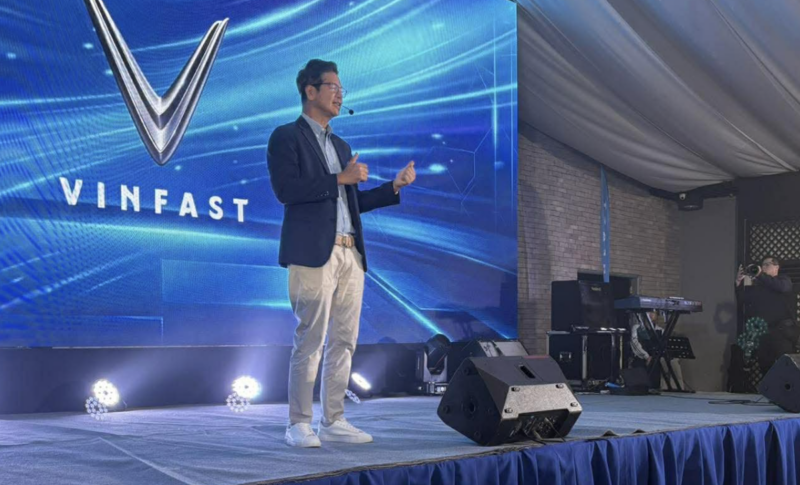 VinFast CEO for Southeast Asia Toti Zara at the launch of the VinFast MP7. (Photo for CleanTechnica by author)
May 7, 202641 seconds
Raymond Tribdino
0 Comments
Support CleanTechnica's work through a Substack subscription or on Stripe.
VinFast CEO for Southeast Asia Toti Zara at the launch of the VinFast MP7. (Photo for CleanTechnica by author)
May 7, 202641 seconds
Raymond Tribdino
0 Comments
Support CleanTechnica's work through a Substack subscription or on Stripe.
Fuel prices have begun to ease from the spike triggered by the Iran-linked supply shock, but the direction of travel is now widely understood. The peak may be behind us, yet a full return to pre-crisis fuel costs is increasingly unlikely. That shift, subtle but structural, is starting to reshape how Filipino consumers evaluate mobility.
For VinFast Philippines, the impact has been immediate and measurable at the showroom level. What initially appeared as a short-term reaction to higher pump prices is now evolving into a broader reassessment of ownership economics.
“We’ve seen a clear uptick in both inquiries and showroom visits following the recent hike in fuel prices,” said Toti Zara in an interview with CleanTechnica. “The inquiries are converting into actual sales. In fact, March is shaping up to be another record month for VinFast, contributing to a record-breaking quarter.”
Zara is careful to frame that growth not as a one-off spike but as part of a longer trend. According to him, VinFast has been building momentum for at least six months across both passenger and fleet segments, with fuel prices acting more as an accelerant than a root cause.
“It’s important to note that this momentum isn’t driven by fuel prices alone,” he said. “The oil price hike simply revealed the economic benefits of BEVs, boosting buyers’ confidence and simplifying their decision to switch.”
That distinction matters. Fuel prices may have triggered urgency, but the conversion to sales appears tied to something deeper: a growing awareness of total cost of ownership.
Conversations happening on showroom floors reflect that shift.
“Customers are particularly concerned about the rising fuel expenses,” Zara explained. “But they’re responding just as strongly to the solutions VinFast is offering.”
Those “solutions” form the backbone of VinFast’s strategy in the Philippines, where the company is not simply selling vehicles but attempting to redefine how electric vehicles are financed, valued, and used.
A central piece is the Battery Subscription Program. Instead of bundling the battery into the vehicle price, VinFast allows customers to purchase the car without it, then pay for battery use through a monthly subscription. The result is a significantly lower upfront cost, one of the biggest barriers to EV adoption in emerging markets.
Alongside that is the Residual Value Guarantee program, which directly addresses another major hesitation: depreciation.
“In November last year, we introduced our Residual Value Guarantee Program,” Zara said. “It guarantees up to 80 percent of the vehicle’s MSRP after 12 months, with a transparent depreciation curve.”
The company has also introduced a three-year free charging initiative, part of a broader push to reduce day-to-day operating costs while easing concerns about infrastructure availability.
Charging infrastructure remains one of the most persistent friction points in the Philippine EV market, and VinFast is leaning on its affiliate, V-Green, to address that gap. The company says expansion of charging networks is ongoing and designed to keep pace with vehicle adoption.
Even with these efforts, the transition from internal combustion engines to fully electric vehicles is not happening uniformly across all buyer segments.
“For buyers who are transitioning from ICE to electric vehicles, hybrids and plug-in hybrids remain a practical stepping stone,” Zara said. “They offer familiarity and reassurance against range anxiety.”
That places hybrids in a transitional role rather than a permanent endpoint. While they continue to dominate electrified vehicle sales today, VinFast expects battery-electric vehicles to expand rapidly as infrastructure improves and confidence grows.
“Industry data shows that hybrids dominate today,” Zara noted. “But the BEV market is projected to expand significantly in the coming years, with strong double-digit growth.”
One of the more revealing insights from the interview is where adoption is happening — and where it is not.
Contrary to expectations, first-time car buyers are not leading the shift toward EVs.
“Our data indicates that first-time car buyers are not necessarily more open to BEVs than existing car owners,” Zara said. “Most of our BEV sales are cash purchases, while first-time buyers tend to rely on financing and stick with ICE vehicles.”
The reason is practical rather than ideological.
“This is largely due to range anxiety,” he added. “First-time buyers often have only one car in the household, leaving them without a backup for long trips.”
This dynamic highlights a critical constraint for EV adoption in the Philippines: not just infrastructure, but also financing structures and household usage patterns.
Still, the direction of travel appears clear. VinFast reports that Filipino buyers are significantly more willing to consider electric vehicles today than they were a year ago, driven by a combination of market education, increased competition, and shifting economic conditions.
“The growing number of market players is playing a critical role in public education,” Zara said. “At the same time, current global conditions are underscoring the economic benefits of BEVs.”
That brings the discussion back to fuel prices. Even as pump prices soften from their recent highs, the psychological shift they triggered may persist.
“The current global market condition is an entry point to another new normal,” Zara said. “Similar to how the pandemic accelerated the use of e-wallets, the spike in fuel prices raises awareness of cost savings and efficiency with BEVs.”
In that framing, the Iran crisis may ultimately be remembered less for how high fuel prices went, and more for how it reset expectations. Prices may fluctuate, but the assumption of cheap, stable fuel has already been broken.
For automakers betting on electrification, that change in mindset could prove more important than any single price cycle.
COMPLETE INTERVIEW TEXT:
- Have you seen an increase in inquiries or showroom visits since fuel prices started rising? Are these inquiries converting into actual sales?
Yes. We’ve seen a clear uptick in both inquiries and showroom visits following the recent hike in fuel prices. The actual growth in traffic has increased significantly compared to the previous months. The inquiries are converting into actual sales. In fact, March is shaping up to be another record month for VinFast, contributing to a record-breaking quarter.
It’s important to note, however, that this momentum isn’t driven by fuel prices alone. VinFast has been consistently breaking records over the past six months, both in passenger car and fleet segments. The first-of-its-kind programs we’ve introduced to the market. The Battery Subscription Policy is projected to account for the lion’s share of our sales in March, and our Residual Value Guarantee (RVG) program has earned positive reception, making VinFast an attractive and practical choice for buyers.
This performance in our overall sales suggests that interest and demand for BEVs have been gaining momentum, and the oil price hike simply revealed their economic benefits, boosting buyers’ confidence in new-energy vehicles and simplifying their decision to make the switch. - What are customers telling your dealers—are they specifically concerned about fuel expenses?
Customers are particularly concerned about rising fuel expenses, but they’re responding just as strongly to the solutions VinFast is offering. Conversations on the ground are centered not only on reducing fuel costs but also on the value of the programs we brought to the Philippines, such as the Battery Subscription Policy, the Residual Value Guarantee (RVG) program, and the recently announced 3-year free charging initiative. These programs have disrupted the local EV market, resonating well because they address both cost and ownership concerns amid the oil price hike. - Right now, are Filipino buyers choosing hybrids or full EVs more often? Do you see buyers using hybrids as a stepping stone before going fully electric? What is stopping more customers from choosing full EVs today?
For buyers who are transitioning from ICE to electric vehicles, hybrids and Plug-in Hybrid Electric Vehicles (PHEVs) remain a practical stepping stone because they offer familiarity and reassurance against range anxiety. However, confidence in going fully electric is growing as more people realize the convenience of BEVs.
At VinFast, we are not just selling cars—we are offering a full ecosystem designed to boost confidence in BEVs and accelerate adoption.V-Green, our affiliate partner specializing in charging infrastructure operation and development, continues to make strides in expanding its charging networks to support the growing number of VinFast vehicles on Philippine roads. Our free charging program until 2029 significantly reduces day-to-day operating costs while easing concerns around charging.In November last year, we introduced our Residual Value Guarantee Program, a first-of-its-kind vehicle depreciation protection program in the Philippine BEV market, giving consumers guaranteed long-term value and eliminating the top barrier to BEV ownership: fears around poor resale value. The program guarantees up to 80% of the vehicle’s MSRP after 12 months, with a gradual, transparent depreciation curve that ensures buyers always know the future value of their vehicle.
And this year, we brought to the Philippines our Battery Subscription Program, which allows customers to purchase VinFast vehicles separately from the high-voltage battery, with the battery provided through a monthly subscription instead of an upfront purchase. By removing the battery from the vehicle’s purchase price, the program significantly lowers the vehicle’s MSRP, helping reduce the initial cost barrier to BEV ownership.
Together, these efforts exhibit VinFast’s capability to cater to the growing demand for BEVs in the market. More importantly, this also reflects our commitment to accelerating BEV adoption in the Philippines.
- Do you expect EVs to overtake hybrids in the Philippines soon?
Industry data show that hybrids dominate electrified vehicle sales today, but the overall BEV market is projected to expand significantly in the coming years, with strong double-digit growth driven by policy support, infrastructure improvements, and rising consumer interest. - Are buyers more willing to try EVs now compared to last year?
Filipino buyers are significantly more willing to consider BEVs, as evidenced by our sales growth over the last few months. This shift is driven by the growing number of market players, who play a critical role in public education on new-energy vehicles. While charging infrastructure remains a concern, market players like VinFast and V-Green are helping the Philippines accelerate BEV adoption through the strategic nationwide expansion of their charging networks. Additionally, the current unfavorable global market condition underscores the economic benefits of BEVs, prompting buyers to transition from ICE vehicles and making BEVs a practical choice. - Are first-time car buyers more open to EVs than existing car owners?
Our data indicate that first-time car buyers in the Philippines are not necessarily more open to BEVs than existing car owners. Most of our BEV sales are cash purchases, whereas industry financing ratios show that first-time buyers, who typically rely on loans, tend to stick with ICE vehicles. This is largely due to range anxiety: first-time buyers often have only one car in the household, leaving them without a backup for occasional long trips. Increasing BEV range and improving the BEV charging network are key to making BEVs more attractive to this segment.
- Do you think the current oil situation will have a lasting impact on EV adoption? If fuel prices remain high, how much faster could EV sales grow?
The current global market condition is an entry point to another new normal. Similar to how the pandemic accelerated the use of e-wallets, the spike in fuel prices raises awareness of cost savings and efficiency with BEVs. Even if prices stabilize, the heightened awareness of the advantages of BEVs has already resulted in a behavioral shift among consumers. This shift will continue to influence consumers’ buying decisions.
CleanTechnica's Comment Policy