India’s Electric Two-Wheeler Market Surpassed Targets in 1st Quarter
 April 22, 202620 minutes ago
Raymond Tribdino
0 Comments
Support CleanTechnica's work through a Substack subscription or on Stripe.
April 22, 202620 minutes ago
Raymond Tribdino
0 Comments
Support CleanTechnica's work through a Substack subscription or on Stripe.
The Indian electric two-wheeler market is entering a new phase of maturity in April 2026, defined not just by record sales but by a clear expansion in product ambition and consumer segmentation.
After a historic March that saw nearly 191,000 electric two-wheelers sold, up 45 percent year over year, manufacturers have opened the new fiscal year with models that push beyond earlier limits on range, performance, and price positioning.
What is emerging is no longer an experimental or subsidy-driven segment, but a competitive, innovation-led market where differentiation increasingly matters.
Unprecedented endurance and performance
The mid-April debut of the Simple Ultra marks a turning point for range expectations in India’s electric scooter segment. Developed by Simple Energy, the Ultra carries a 6.5 kWh battery and delivers a certified IDC range of 400 km, or roughly 248 miles. That figure alone places it in territory previously reserved for niche or conceptual models.
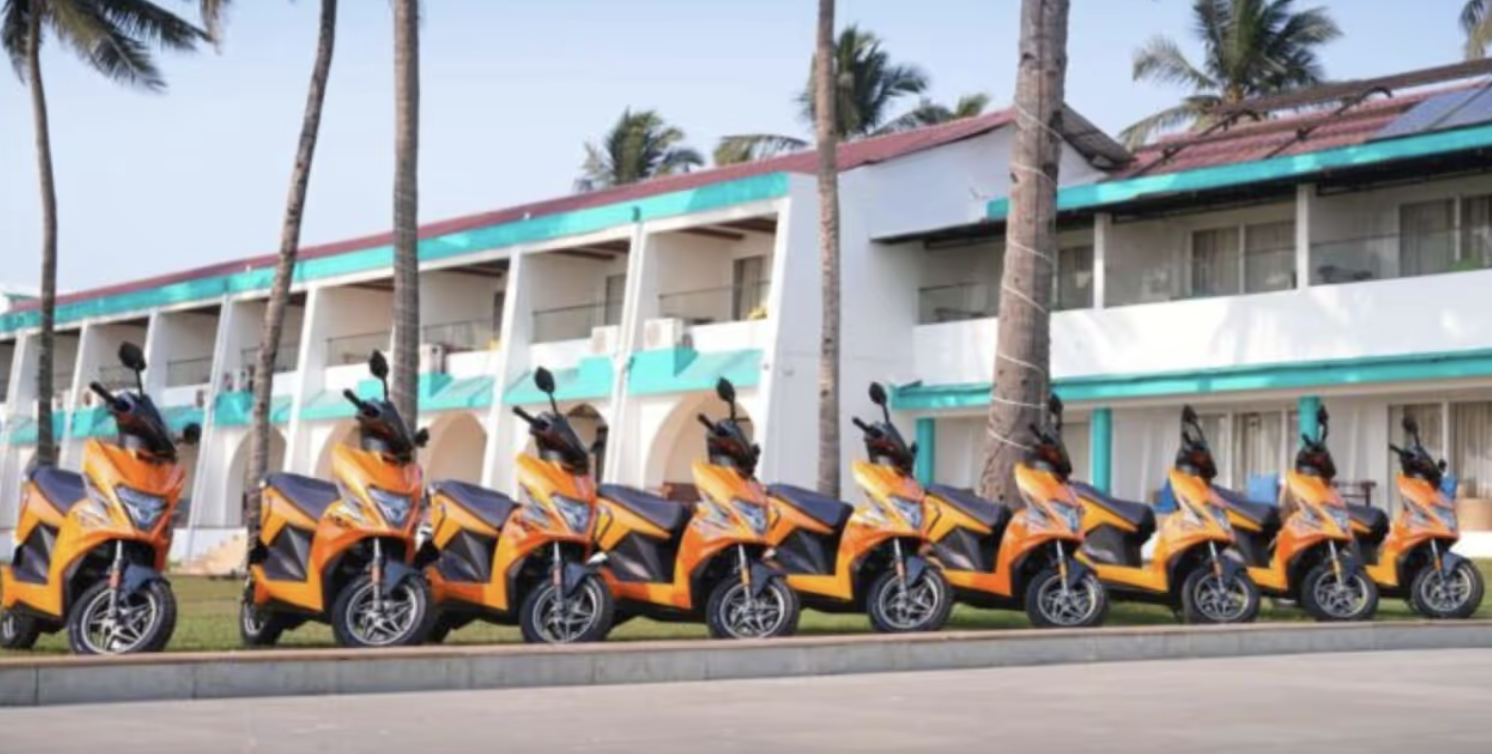
Priced at 235,000 rupees, or about $2,500, the Ultra is aimed squarely at riders who prioritize range security, particularly in regions where charging infrastructure remains uneven. Performance has not been sacrificed to achieve that range. The scooter reaches a top speed of 115 km/h and accelerates from 0 to 40 km/h in just 2.77 seconds. It also introduces features rarely seen in this category, including four-level traction control and the company’s Fleaware.OS interface displayed on a 7-inch touchscreen.
At the same time, Yamaha Motor Company has formally entered India’s electric two-wheeler race with the EC-06, signaling a broader strategic shift among legacy global manufacturers. Priced at around 167,000 rupees, the EC-06 uses an interior permanent magnet synchronous motor paired with a 4 kWh battery, delivering a certified range of 169 km.
Yamaha’s approach emphasizes durability and refinement over headline-grabbing specs. IP67 certification for both motor and battery, along with integration into its Yamaha Motor Connect R ecosystem, reflects a focus on reliability and connected functionality for urban riders. Its entry reinforces the idea that India’s EV transition is no longer confined to startups, but is now attracting sustained investment from established global players.
Diversification in the family and lifestyle segments
While premium models are stretching technical limits, the volume growth story remains rooted in affordability and practicality. Hero MotoCorp, through its Vida sub-brand, continues to expand its presence in this space with the VX2 series.
The VX2 Plus, priced just under 100,000 rupees in Delhi, is positioned as a dependable, low-cost commuter solution. Its removable twin-battery setup, with a combined capacity of 3.4 kWh, delivers a range of 142 km and a top speed of 80 km/h. This configuration addresses one of the key friction points in EV adoption in dense urban environments, where home charging access is not always guaranteed.
At the same time, branding and lifestyle positioning are becoming more visible. The limited “Knight Edition,” inspired by the Kolkata Knight Riders, underscores how electric two-wheelers are increasingly being marketed not just as transport, but as identity-driven consumer products.
Ather Energy is also recalibrating its strategy. Having established itself as a premium brand, the company is now moving toward the mass market with its upcoming EL platform. The first model, the EL01, is expected later this year at a price point closer to 100,000 rupees. The challenge will be maintaining the software-driven experience and build quality that defined its earlier 450 and Rizta models while competing in a far more price-sensitive segment.
Industry dynamics and sales performance
Sales data from the close of the 2025–2026 fiscal year highlights a significant reshuffling of market leadership. TVS Motor Company and Bajaj Auto have emerged as the top two players, driven by consistent demand for the iQube and Chetak lines. TVS, in particular, recorded a monthly high of 49,453 units in March 2026, underscoring the advantage of established distribution and service networks.
In contrast, Ola Electric has seen its market share erode, dropping to fifth place in monthly rankings. The shift reflects growing consumer sensitivity to after-sales support and reliability, areas where legacy manufacturers continue to hold an edge.
At a structural level, the market is also beginning to move beyond heavy dependence on government incentives. New flagship models such as the Simple Ultra exceed eligibility thresholds for programs like PM E-Drive, yet still find buyers. This suggests a critical inflection point: consumers are increasingly willing to pay a premium for performance, range, and brand confidence.
Taken together, these developments indicate that India’s electric two-wheeler sector is no longer defined by early adoption dynamics. It is becoming a fully competitive market, where technology, pricing strategy, and execution will determine long-term winners.
Sign up for CleanTechnica's Weekly Substack for Zach and Scott's in-depth analyses and high level summaries, sign up for our daily newsletter, and follow us on Google News! Advertisement Have a tip for CleanTechnica? Want to advertise? Want to suggest a guest for our CleanTech Talk podcast? Contact us here. Sign up for our daily newsletter for 15 new cleantech stories a day. Or sign up for our weekly one on top stories of the week if daily is too frequent. CleanTechnica uses affiliate links. See our policy here.CleanTechnica's Comment Policy