Indian model's understated Met Gala debut revives debate on cultural representation

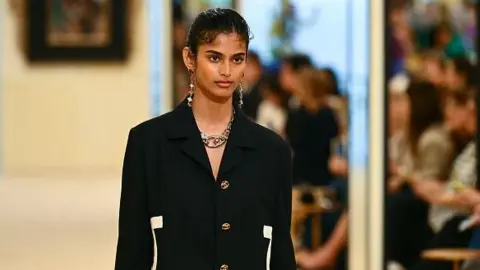 AFP via Getty Images
When Indian model Bhavitha Mandava arrived at this year's Met Gala, the reaction to her look was unusually divided.
From a distance, her Chanel outfit looked disarmingly simple: a sheer zip-up jacket and what appeared to be a pair of low-slung jeans. Around her, the usual theatre unfolded - sculpted gowns and silhouettes, outfits that declared themselves before their wearers could.
In comparison, Mandava's look seemed to hold back. Except it didn't. The "denim" was not denim at all, but silk muslin, printed and constructed to mimic it - a detail later noted by fashion websites. The simplicity, in other words, was carefully engineered.
That contrast shaped much of the reaction. Some saw it as a quiet twist on the Met Gala's excess, even a subtle challenge to it, while others felt it didn't quite match the scale of the event.
Indian media coverage mirrored the divide - some praised the minimalism, others questioned whether the moment had been undersold. On social media, the debate turned sharper, touching on how Indian representation is received, framed and sometimes flattened on global stages.
The conversation once again put the spotlight on Mandava herself - a 26-year-old who, in less than two years, has gone from relative obscurity to one of global fashion's most watched new faces.
In India, every milestone in her career - major runway shows, luxury campaigns and now a Met Gala debut - has fed into a broader conversation around representation, beauty and, as Mandava herself put it, "culture renegotiating itself".
Alongside that, she has come to embody something quieter: an understated ease that makes even high fashion seem incidental. It feels less carefully constructed than slowly formed - shaped long before the runways and fashion campaigns, in a life far removed from the one she inhabits now.
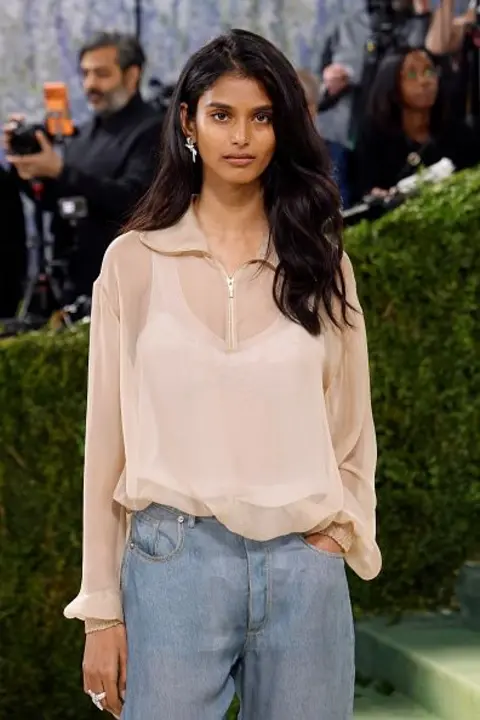 Getty Images
Raised in Hyderabad in southern India, Mandava was discovered in a New York subway station in 2024.
At the time, she was a graduate student at New York University studying architecture. In interviews, she has said she was on her way to get biryani with a friend when she was approached by a scout from 28Models - an encounter she has described as entirely incidental.
Over time, though, the moment has taken on the shape of a familiar fashion myth: the chance meeting that changes everything.
Within months, Mandava was swept into the world of luxury fashion, appearing on major runways for Bottega Veneta, Dior and Courrèges, before becoming closely associated with Chanel.
Yet the way she presented herself stayed largely unchanged - restrained, unshowy, and less interested in spectacle.
"My agent still roasts me about the fact that I used to go to castings dressed in jeans and NYU T-shirts that I'd got for free," she told British Vogue in February. "I just showed up in whatever was clean."
In December, she opened Chanel's Métiers d'Art show in New York - the first Indian model to do so - in a setting that echoed her origin story: a subway platform, reconstructed with precise attention to detail.
Her opening look - a white T-shirt, a half-zipped knit, loose jeans - set a template that has now followed her to the Met Gala. It appeared ordinary. It was not.
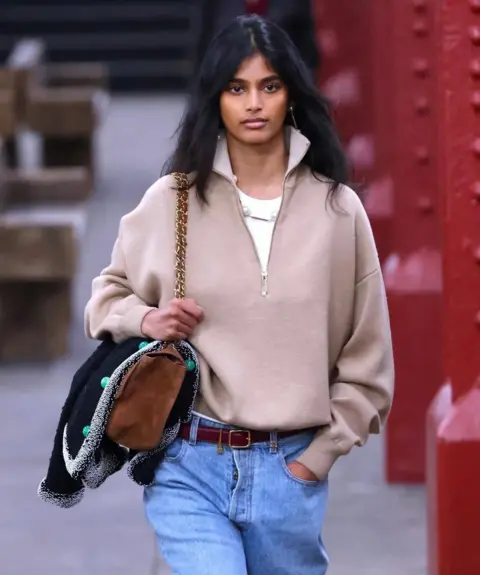 Bhavitha Mandava/Instagram
Part of what makes Mandava's story compelling is also how familiar it feels.
Before the runways and luxury campaigns, there is a version of her that is instantly recognisable: a student far from home, piecing together a life in New York - learning subway lines, hunting for cheap meals, building routines around classes, deadlines and distance.
Even now, as her career accelerates, she seems to have carried something of that earlier self with her - in the simplicity of her clothes, the lack of heavy styling, the way she does interviews, usually speaking about her studies, family and the pace of work rather than turning herself into a bigger myth.
In an interview with People magazine, Mandava described modelling as "this magical, whimsical and nurturing thing".
And despite the speed of her rise, she still sounds slightly surprised by it all. "Life has become so strange, there are so many plot twists and weird turns that I genuinely don't know what the future holds," she told British Vogue.
When she opened the Chanel show, she shared a short video of her parents watching from home in India - her mother repeating her name in disbelief as her father sat beside her, quietly beaming with pride, a small, unguarded moment that was adored by millions online.
Her social media persona generally follows the same restraint. In her bio, she calls herself "a Brooklyn lab rat", a description that feels at odds for someone now fronting some of the world's biggest fashion houses.
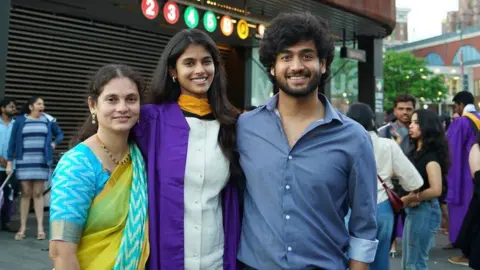 Bhavitha Mandava/Instagram
But neither Mandava, nor the brands she represents, seems to want to dramatically reinvent her to fit that story.
If anything, she still seems shaped by the life she began with - a regular girl who is, as she once put it on Instagram, "somewhere between publishing research papers, walking fashion shows and living that transatlantic life". She once joked that she studied couture history with the same intensity she used to reserve for her NYU research papers.
It is an image that fits neatly into fashion's current preference for effortlessness - where not trying too hard has become its own kind of aesthetic.
At the Met Gala, though, that idea met a more complicated set of expectations.
Mandava has not responded publicly to the debate over her outfit. As social media users raged over whether the look was too understated - and what it signalled about India's global image - she simply posted photos from the evening on Instagram without addressing the criticism.
She later told British Vogue that the outfit was a way of "carrying that memory forward" - transforming the clothes tied to her discovery into something more elevated, but still recognisably hers.
Fashion is fickle. The current obsession with understatement may not last, and it is probably unfair to expect Mandava - or any young model - to remain frozen in this version of herself forever.
But part of her appeal, for now, is that she offers a bit of breathing space - a feeling that in between all the performance and construction, something unforced still survives.
AsiaMet GalaIndiaFashion