'In China we have now dropped to zero': CEO Jensen Huang bemoans Nvidia's market share and calls for US to export AI 'like crazy'
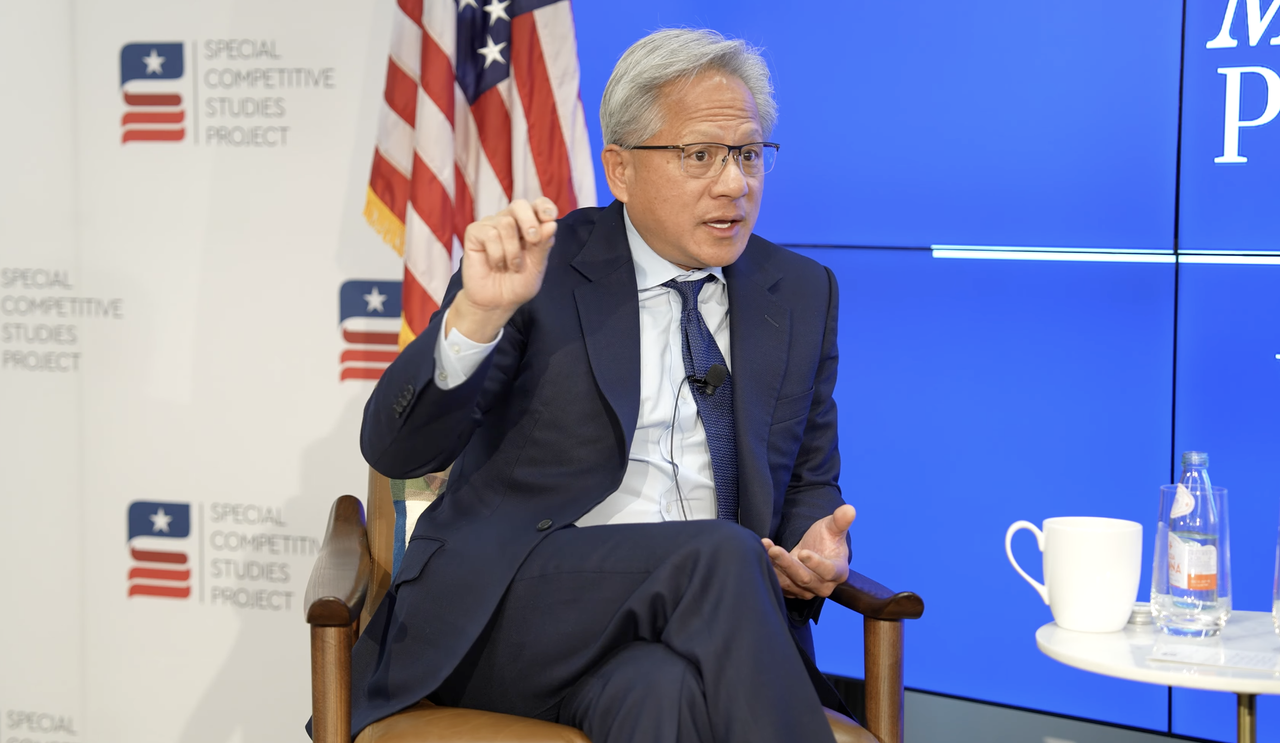
"We have now dropped to zero." So, says Nvidia CEO Jensen Huang of the company's market share in China's AI hardware market. Needless to say, Huang thinks this is a big mistake and Nvidia should be allowed to sell as many AI chips to China as the country wants to buy.
Speaking to the Special Competitive Studies Project podcast, Huang is clear that he thinks the upside to selling AI chips to China clearly outweighs any concerns over allowing China access to America's most advanced technology.
“Conceding an entire market the size of China probably doesn’t make a lot of strategic sense,” Huang says. “And so I think that that has already largely backfired.”
“Maybe it made sense at the time, but I think the policy really needs to be dynamic, and it needs to stay with the times,” he concludes.
His broader pitch involves the idea that the current AI revolution is akin to the industrial revolution and the US needs to be at the forefront of it all. "We were the front runners in applying technology in the last industrial revolution, we need to be careful not to be the last in this industrial revolution," he explains.
To get the full benefits of that, the US needs to "export like crazy" Huang says, resulting in an "incredible trade imbalance" in the US's favour. If this all makes immediate sense, Huang doesn't explain how the US will stay ahead with this strategy.
As Huang himself explains, the AI industry is like a layer cake with five levels: energy production, AI chips, infrastructure like data centers, AI models and finally AI applications.
By Huang's estimations, the US is behind in at least some of those categories, most obviously energy production. And he doesn't explain how supplying China with the best available chips in the short term means China won't catch up or surpass the US in all areas in the medium term.
In short, his argument seems to boil down to something ironically unsophisticated given the complexity of all this AI tech. Make hay while the sun shines, seems to be his main point. Which would be great for Nvidia, no doubt. But it's less obvious that it's a sustainable long term strategy for the US as a whole.
Схожі новини

'A single 732-byte Python script can be used to obtain root on essentially all Linux distributions shipped since 2017': Time to update your kernel

Росія вдарила КАБами по підприємствах Запоріжжя: кількість загиблих зросла до 12

The Star Wars: Fate Of The Old Republic Team Is Full Of Mass Effect Veterans