I tried the UK's 'saltiest' sandwich - here's what I learned

 Emma Lynch/BBC
I couldn't resist.
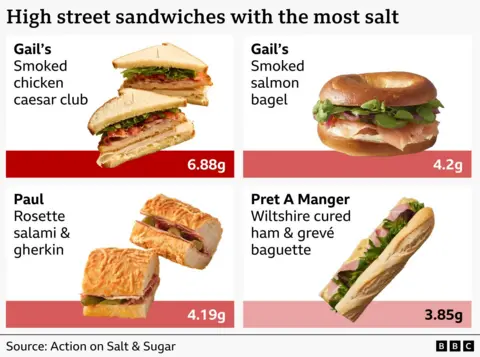
This week it was revealed a chicken sandwich is packing as much salt as five McDonald's cheeseburgers - putting it top of a naughty list of more than 500 sandwiches analysed.
The sarnie, sold by bakery chain Gail's, contains 6.88g of salt.
That's more than the UK's recommended daily limit of 6g, or the World Health Organization's 5g cap. So, it's clearly not the healthiest choice.
But succumbing to the siren song of salt, I left my packed lunch at home to give it a whirl and find out what regularly eating too much salt is doing to our health.
I nipped out before the lunchtime rush and my first impression was "it's massive" followed swiftly by "how much?" - £8.90 is one pricey sandwich.
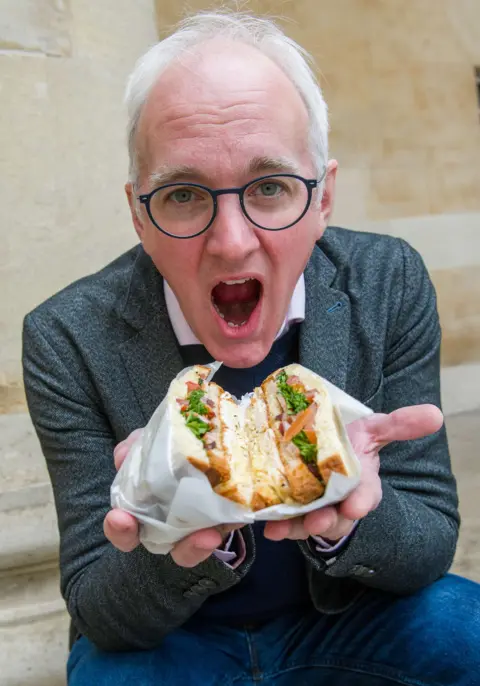
Peeling back the wrapping I'm holding a 1,000 calorie triple decker – three slices of bread with two layers of filling. One is a thick cut of bacon with salad, the other smoked chicken and coleslaw.
 Emma Lynch/BBC
A bit of me wanted to hate it, to be overwhelmed by its salt content and find it unpalatable.
But it was fantastic. You certainly know the salt is there - but taste-wise it hit the spot and you realise why salt is added to our food.
I didn't finish it though, but there was no shortage of volunteers back in the newsroom to help me out.
However, this week's latest on salt by the World Health Organization did not make the best lunchtime reading. Director of nutrition, Dr Luz Maria De Regil, said "excess salt consumption remains among the top preventable drivers of death globally" and put the figure at 1.7m deaths a year. Gulp.
So as my body absorbs all that salt from one meal, what is it doing to me and why are we all eating so much?
 Emma Lynch/BBC
Chemically, table salt is sodium chloride. The human body needs some sodium to function and you can find the element in nearly every cell of the body.
It's needed for our nerves to communicate with each other and for the body to maintain the right balance of water.
"But the amount we need is actually very, very small in the grand scheme of things," Sonia Pombo, a researcher at Queen Mary University of London and head of research at Action on Salt and & Sugar, tells me, "especially in comparison to the amount of salt we're actually eating."
Too much salt has many effects on the body, but the clearest evidence is on how it impacts blood pressure.
The salt we eat ends up in the bloodstream where it draws in extra water and increases the volume of our blood.
This gives the heart a bigger job of pumping it around the body and it copes by dialling up the blood pressure - a bit like cranking the tap on a garden hose pipe.
The problem with high blood pressure is it's known as "the silent killer". You may not know you have high blood pressure until something goes wrong and that extra pressure ruptures a blood vessel - like a burst pipe – causing a stroke or a heart attack.
Salt also alters the blood vessels themselves to make them stiffer and increase the risk.
But elsewhere in the body excess salt damages the kidneys which filter our blood, leaches calcium out of our bones making them more frail, and has been linked to vascular dementia, stomach cancer and emerging evidence that it alters the immune system.
Posh sandwich has more salt than nearly five cheeseburgers
Suddenly my lunch isn't sitting quite so well, but a single sandwich isn't going to kill me.
"Having a one-off, high-salt meal isn't going to impact your long-term health," says Pombo, "because what salt does is it very gradually and silently raises your blood pressure over the course of your lifetime."
I'd like to think I eat a healthy diet most of the time, but the data on how much salt we eat is not reassuring, so I'm probably still taking on more than 6g a day.
The UK National Diet and Nutrition Survey monitors people's urine for 24 hours to work out how much salt we've been eating.
The latest data, from 2019, suggests men are having 9.2g a day and women 7.6g. The difference between the sexes is in part down to men eating more food.
And those numbers have not improved since 2008.
Pombo dismisses many of my thoughts on balancing out my salt intake. You can't sweat it all out "unless you're a super athlete" training all the time, or flush it out by drinking plenty of water, she says.
A diet packed with fruit and vegetables, rather than going all in on ultra-processed foods, will contain potassium, which can counteract some of the impact of salt.
"But that doesn't make it OK," Pombo says, "one doesn't cancel out the other."
So if what matters is the salt we're eating every day, where is that coming from?
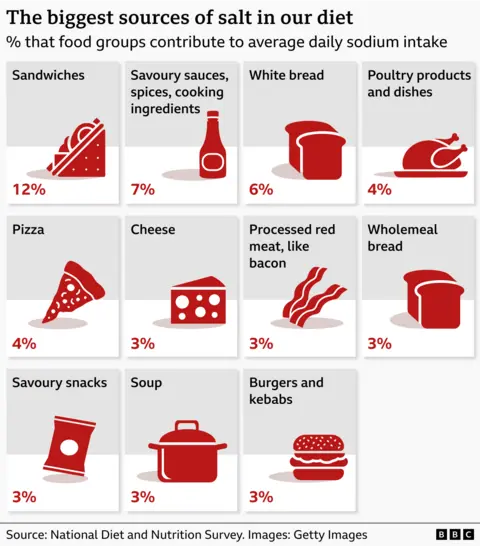
Salt is mostly already in the foods we eat, rather than something we sprinkle on top (although I retain it is a crime not to put a bit of salt on your fish and chips).
"It's in pretty much everything," says Pombo, and it is not always the foods that taste super-salty. Bread in all its forms features so prominently in the list above because we eat so much of it.
We can all make healthier choices and seek out foods with less salt in them if we're prepared to read the labels. But salt being so prevalent in our food means campaigners think the responsibility for cutting it out has to lie with the people making it.
Small amounts of salt in food can help preserve it by preventing bacteria from growing.
"The rest is all to maintain the cycle of profit," says Prof Francesco Cappuccio, from the University of Warwick, who insists "salt can be taken out" but manufacturers don't want to because it is "so cheap".
"When you go to a pub and you get your salted peanuts on the counter, it's not by chance," he says, "you buy an extra pint later.
"Salt is the flavouring which masks bad food - so you can market terrible food, by just putting a little salt in it."
We asked Gail's about the salt content in its products but the bakery did not respond.
A spokesperson for the Food and Drink Federation said its members products had "nearly a third less salt" than in 2015 and the industry had made "significant investment in innovation to develop healthier products".
Kate Nicholls, chair of UKHospitality, said: "Hospitality venues invest significantly in nutrition and healthy eating to give customers the best possible choices when going out for a meal.
"The range and choice of food we offer is why customers choose to eat out of home and building healthy choices into that has been a priority."
So am I heading back to the bakery next week for another chicken caesar sarnie? I think that it is, at most, an occasional treat, and I'll be back to packed lunches.
 Emma Lynch/BBC
I inhaled traffic fumes to find out where air pollution goes in my body
I'm watching brain surgery to see if Alzheimer's can ever be cured
I found a bacteria-eating virus in my loo - could it save your life?
Vitamin pills and icy swims: Can you really boost your immune system?
Diet & nutritionHealthСхожі новини
Trump says IS second in command killed in Nigeria

Смертельний вірус Ебола повертається: де зафіксовано новий спалах

Чому ракета Х-101 "складає" будинки: аналіз експертів щодо удару по Києву