Hundreds of children die within months as measles cases soar in Bangladesh

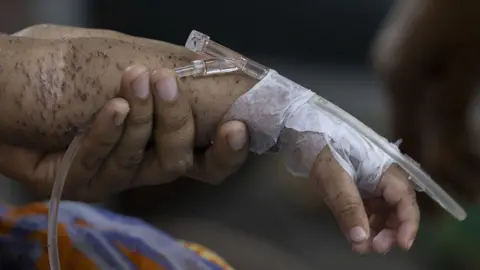 Getty Images
Akira was always a fast learner, her father Al Amin says with pride.
At 6 months she was already saying her first words. At just over 4 years old, she had started to say some words in English.
He stops, his voice catching.
"She was never short of love from both families. She was the crown of all."
Al Amin, who lives with with his family in the Bangladeshi capital of Dhaka, says his daughter had all her vaccines, apart from measles.
They took her four times to get it; twice she was turned away because she had a cold. "Don't stress," he says the health care worker told them, "the vaccine can be administered up until she reaches 5." The third and fourth time, he says, they were told the vaccine was unavailable.
On 8 March Al Amin took Akira to hospital, suffering with what he thought was a normal fever. She improved, went home, then started developing a rash, a high fever and sores in her mouth. She was discharged and readmitted to hospital a total of five times, Al Amin says; only on the fifth occasion did a doctor tell him she was suffering from measles.
Akira was put on life support. She died 27 days after she was first admitted.
Over 500 children with suspected and confirmed cases of measles have died in Bangladesh since March, according to the country's health ministry.
The health minister said last week that doctors and nurses treating those with the virus have had their Eid holiday leave cancelled and the government has been running a mass vaccination campaign to slow the spread and save lives.
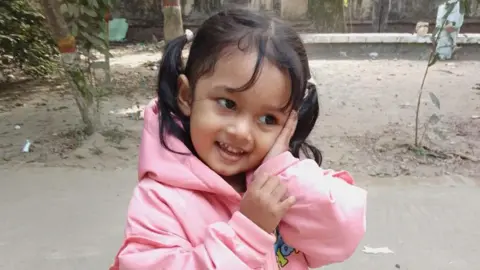 Supplied: Al Amin
Al Amin says he and his wife still torture themselves, thinking that their daughter may have picked up the virus in the hospital.
"From the ticket counter line to the x-ray room, there was a measles patient everywhere," he says.
He is angry; that his child couldn't get a vaccine, that her symptoms were missed, that he feels the hospitals failed to keep patients with measles apart from others.
In just over two months, the number of suspected cases of measles have reached over 60,000 in Bangladesh, according to the health ministry. The exact number has not been confirmed, as many are waiting for results from the laboratory.
Highly contagious, measles spreads quickly through coughs and sneezes and is particularly dangerous for unvaccinated young children under the age of 5.
There are multiple reports of parents struggling to find space for their sick children in Bangladesh's hospitals.
UNICEF told the BBC that during field visits the hospitals they went to were overwhelmed. They say that their staff are helping to isolate and triage children arriving at hospitals where such measures are lacking.
Where local health clinics can't help, many people are travelling to the cities, hoping the hospitals there will be able to.
"Poor people do not usually come to government hospitals until the last moment, as they have to buy medicine and tests," Dr Mushtaq Husain, former Principal Scientific Officer at the Institute of Epidemiology Disease Control and Research says.
If healthcare were better resourced at a local level, he adds, fewer would need emergency hospitalisation.
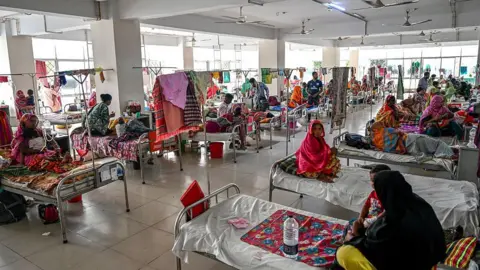 Getty Images
"It feels like a bit of a perfect storm," Rana Flowers, Bangladesh country head for UNICEF said during a press conference.
Flowers explained that the agency had identified several factors which increased the risk of infection, including pockets of cases since 2023 where children were missing out on routine vaccination, high population density in certain areas - especially Dhaka or Cox's Bazar - and big population movements for holidays.
But one element in particular has stood out: delays ordering vaccines.
In 2024 Bangladesh's long-term ruler, Sheikh Hassina, fled from the country after mass protests against her rule. An interim government was appointed, and elections were held in February 2026.
UNICEF says that the interim government decided to change the way Bangladesh bought vaccines, which led to delays in placing orders. Flowers said they had 10 separate meetings with the interim government where UNICEF flagged risks associated with delays to vaccine procurement.
"I can tell you I sat with the interim advisor and staff on at least ten occasions," she said. "Saying we are worried, look at my face, I am worried you are going to face an outage."
In a post on social media, Md Sayedur Rahman, former Special Assistant to interim chief advisor for the health ministry, said that "no change was implemented in the vaccine procurement process during the tenure of the interim government".
"A regular and consistent collaborative relationship regarding vaccine matters was maintained with UNICEF," he added.
Others also say that gaps in vaccination which opened during the Covid pandemic were never closed.
"Previously health workers went from door to door to convince parents to get their children vaccinated," Husain says. "But during Covid they were discouraged from doing that to avoid transmission. Some parents were afraid that they could contract Covid if they took their child to hospital to receive the vaccine too."
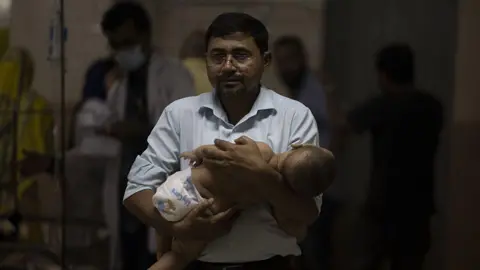 Getty Images
Bangladesh launched an emergency vaccination campaign at the start of April, assisted by international aid agencies. UNICEF says this has helped numbers start to plateau in some badly affected areas - which were the first to be the focus of the vaccination campaign - and that the number of new infections has declined.
Building immunity from the jab is not immediate, so it will take time for the impact of the vaccine to start to take full effect nationwide.
Bangladesh's Minister of Health and Family Welfare, Sardar Sakhawat Hossain, tells the BBC he is expecting the number of infections to start dropping soon.
"It takes three to four weeks after the vaccination to create antibodies in the babies. We expect by next week, Inshallah, it will come down."
Others are concerned about the potential spread during this Eid holiday, as families travel to see friends and relatives.
"Thousands of children will travel with their parents from town to village, village to town," Husain warns. "There will be mixing of children with a fever, with the virus."
Hossain dismissed calls for Bangladesh to declare an emergency, saying district level hospitals are "ready" and are helping to supply ICUs in more remote areas.
"I don't think at all about the emergency," he says. "Bangladesh is able to handle."
Meanwhile, Al Amin still counts the number of days since Akira passed away.
"Today I cried for over an hour beside her graveyard," he says, and points out that he has been prescribed sleeping pills by his doctor.
"I have so many questions inside me."
Additional reporting by Sardar Ronie
MeaslesAsiaHealthBangladeshСхожі новини
Більшість регіонів накриють дощі, грози та шквальний вітер: прогноз погоди на 27 травня
Мінус тисяча окупантів, РСЗВ та танк: які втрати ворога на 27 травня

Яке церковне свято у середу, 27 травня: хто сьогодні має іменини