How Reform won votes from Swansea to Sunderland

 PA Media
"We're taking a chance."
At the Caerphilly social club in Wales on Friday night, Bernard and Linda explained the gamble they were taking.
"With Labour I think you get nowhere," Linda told BBC Radio 4's Today programme. "They're not the working class now," Bernard added.
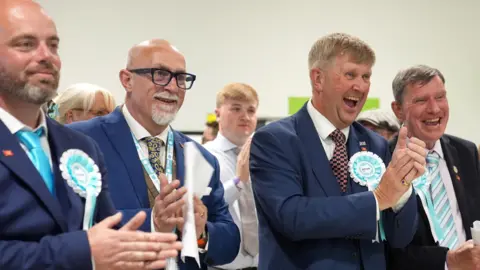
Like thousands of voters from Sunderland to Swansea, Bernard and Linda have turned to Reform UK with devastating consequences for the main two parties.
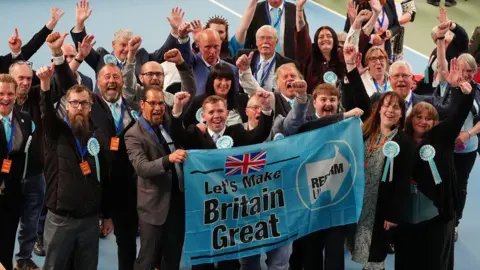
In Wales, where Labour have dominated for a century, the party now has just nine of 96 Senedd seats. From having virtually no presence, Reform has 34 Senedd seats, and in Scotland, Reform UK gained 17 MSPs.
In north-east England, if the local election results went better than Reform's wildest dreams, they were the stuff of nightmares for Labour.
What Labour and Reform agree on is that national factors were critical. Both parties found voters on the doorsteps who disliked the government and detested the prime minister. Reform's tactic of framing the polls as a referendum on Sir Keir Starmer certainly paid off, drowning out any positive local messages Labour tried to sell. Anger about small boat crossings also played a part.
But is this as simple as a rejection of the current PM or something deeper?
Even if what is happening at Westminster played its part, there were some distinctive local factors at play.
Incumbency is proving difficult for governments, but it also poses problems for councils. Labour believed its local authorities were beginning to deliver positive change after the damage austerity caused in the region.
But people have experienced 15 years of local services being cut while council tax rises. The North East has some of the highest rates in the country. With the exception of Hartlepool, the Labour councils in the region added almost another 5% to bills again this year.
Labour councils could turn their fire on Conservative or coalition governments in the past, but now there was nobody else left to blame.
Voters in Sunderland acknowledged regeneration has been happening in the last two years but felt that didn't forgive the previous 50.
Too little, too late some said.
 PA Media
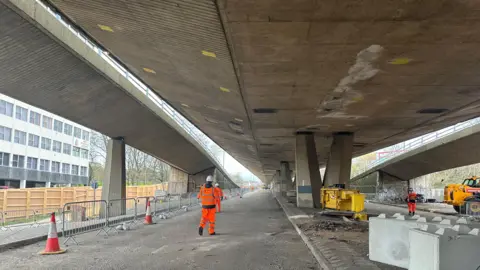
In Gateshead, the closure of a crumbling motorway flyover linking the town to Newcastle symbolised a sense of neglect. It was shut overnight in December 2024 when it was proved to be unsafe, but demolition only began in the middle of the election campaign.
The Labour council might not have been entirely to blame for the state it was in, but they seem to have carried the can. Many voters in the town said they had no faith the council could deliver the regeneration they promised would follow its destruction.
But the warning signs for Labour date back further. The 2024 general election looked like a return to the North East's natural order with Labour winning all but one of the region's constituencies.
The majorities for the MPs though were shallow and Reform came a strong second in many seats. And that with largely low profile if not invisible candidates, and without much of a ground campaign.
The door was ajar to a more concerted push.
Since the 2008 credit crunch no government has been able to provide a sustained solution to the biggest problem – how to return to a time when people on modest and low incomes felt they were gradually getting wealthier and happier instead of worrying about the rising cost of living.
When Labour talked about the risks of handing councils over to Reform candidates with little or no experience of local government, voters responded by asking: what was there to lose?
There were echoes of the 2016 Brexit referendum when North East voters, asked about the risks of leaving the EU, would respond by saying that things could not get any worse.
When you feel the established parties and politicians are not doing much for you and your community, where is the risk in rolling the dice?
North East voters in this election said they felt someone different deserved a chance to move the dial.
There is a risk then for Labour that these are not short-term losses but the tipping point in a longer decline in a region they have relied on.
And Nigel Farage's party has built an operation that is not just capable of hoovering up former Labour voters.
In Essex, Suffolk and Havering, Reform UK mopped up in former Conservative areas as well.
The scale of that operation is partly thanks to the extremely deep pockets of their donors. Last year, for example, Reform UK received more than £5.4m in large donations in the final three months of the year, more than any other political party, new figures from the Electoral Commission show.
This included another big donation of £3m from cryptocurrency investor and aviation entrepreneur Christopher Harborne.
That has allowed Farage the freedom to spend vast amounts on social media advertising, targeting messages to particular voters in particular areas.
Reform UK is also benefiting from a wider resentment at politics in general; a sense that from the NHS to the economy to border control, the state isn't working as it should.
And so, as Bernard and Linda said, and as voters on the doorstep in the North East of England and elsewhere have said, more and more people are willing to "take a chance" on a party untested over long periods in government.
A big barrier to Reform is thought to have been that there is a significant proportion of people so vehemently opposed to Farage they are willing to vote for whichever party is best placed to defeat them.
But there are some early signs there might be limits to the 'Stop Reform' strategy. In Wigan, for example, ward-by-ward results suggest the combined votes for Labour, Greens and the Lib Dems was often not enough to overtake Reform UK.
That provides Reform UK with enormous opportunities, as it has demonstrated with these results.
From Basildon to Barnsley; Walsall to Wakefield; Thurrock to Tamworth they issued a devastating rebuke to the traditionally dominant Labour and Conservative parties.
That gives Farage an even larger army of councillors, volunteers and activists to draw on come the general election.
But it also has challenges. As Labour have found to their cost, promising change in opposition is one thing. Standing on a record in government is another.
And in more places than ever, Reform are no longer the insurgency. They are now the incumbents.
Follow updates and reaction live
Reform election gains show historic shift in British politics, says Farage
We welcome scrutiny, Reform UK says after major election gains
England local elections 2026Welsh Parliament election 2026Scottish Parliament election 2026Reform UKUK elections 2026Схожі новини

Стрілянина в Києві: з’ясування стосунків криваво закінчилося — соціальні мережі

У Кремлі намагаються зірвати обіцяний Трампу обмін полоненими — джерело

Вони стежать за нами, навіть коли сплять: дослідники розкрили великий секрет домашніх котів