How is Keir Starmer getting on with his pledges to deliver change?

 BBC
BBCKeir Starmer has said he will prove his doubters wrong in a speech designed to head off a leadership challenge following his party's heavy election losses.
The prime minister said he took "responsibility for the change we promised for a stronger and fairer Britain".
In December 2024, he set out a number of "measurable milestones" which included targets on building houses, hospital waiting times and living standards.
So how is his government getting on with meeting them?
Building houses
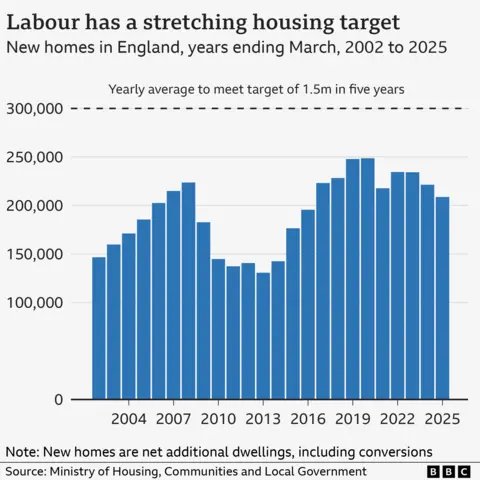
Starmer's plan is to build 1.5 million "safe and decent homes" in England.
This is to be delivered by the end of this Parliament - so by 2029.
The government is measuring progress by looking at net additional dwellings - the difference between houses and flats built (or converted) and those demolished.
There is no annual target but getting this many homes would average out at 300,000 a year.
Labour is only currently managing to add just over 200,000 a year.
Ministers say they were always going to ramp up to the 1.5 million target in the later years of the Parliament.
However, it is worth noting that, so far, the delivery rate is actually down on the final years of the last Conservative government.
And the rising cost of building materials and higher energy costs as a result of the Iran war will make the target harder to achieve.
When will we know? Figures for the year to the end of March come out in November.
BBC Verify's housebuilding tracker uses a more timely indicator: the number of new homes receiving their first Energy Performance Certificate (EPC). These figures come out roughly a month after the end of each quarter.
Hospital waiting times
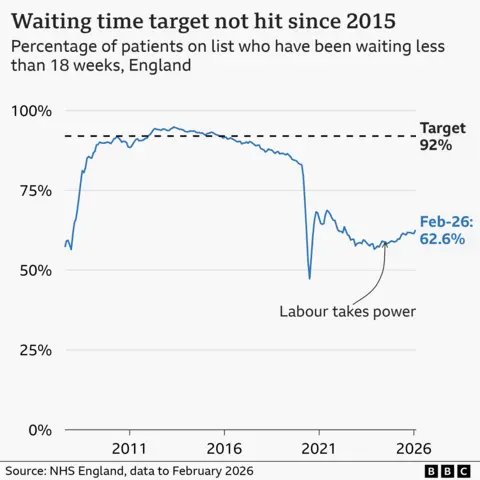
On health, the pledge is 92% of patients in England seen within 18 weeks by the end of the Parliament.
There have been some signs of progress.
The latest NHS data for England show that in February 2026, 62.6% of patients due for procedures were seen within 18 weeks.
When Labour took power in July 2024, the share was 58.8%.
The government has set an interim target of 65% by March 2026 and we'll get that figure on Thursday 14 May.
The last time the 92% target was hit was in 2015.
When will we know? Waiting list figures come out about six weeks after the end of a month. You can check waiting times in your area with this tracker.
Track UK's latest migration numbers - including asylum, visas and small boats
Living standards
Starmer's plan commits to "raising living standards in every part of the United Kingdom".
The government says real household disposable income (RHDI) per person - which roughly measures what is left after taxes and benefits and the effects of inflation - will grow over this Parliament.
This measure did not grow in the Parliament between 2019 and 2024 - that was the first time this had happened since the 1950-51 Parliament, according to analysis from the Resolution Foundation.
In the first year of this government, 2024-25, RHDI per person went up strongly by 3.1%.
But the forecasts from the Office for Budget Responsibility (OBR) for this measure are much lower, with 0.1% expected for 2025-26 and about 0.5% a year for the following five years. The forecasts were published in March 2026, a few days after the start of the Iran war.
Another measure of living standards which the government is using to track its target is GDP per head - the size of the economy divided by the population.
The Office for National Statistics says that grew by 1.1% in 2025 having shown no growth at all in 2024.
When will we know? RHDI figures come out about three months after the end of each quarter of the year. GDP per capita figures are published about six weeks after the end of each quarter.
Police numbers
 Getty Images
The pledge is "putting police back on the beat" with 13,000 additional officers, police community support officers (PCSOs) and volunteer special constables in neighbourhood policing roles in England and Wales by the end of the Parliament.
The Home Office has not given a breakdown of this figure but has said it will "work with police forces on the mix of roles".
The Home Office published neighbourhood policing figures in April measuring growth from 31 March 2025. It found that the first year target of 2972 extra full-time equivalent (FTE) officers and PCSOs was surpassed in January 2026 and on 28 February it was 3,123.
But the overall number of officers has been falling. On 30 September 2025, there were 145,550 FTE police officers in England and Wales, down 2195 from 31 March 2024 (shortly before Labour came to power).
When will we know? The figures for neighbourhood police numbers on 31 March 2026 will be published in July 2026.
Education
 PA
PAThe pledge is to have "75% of five-year-olds in England ready to learn when they start school".
The government defines this as having a "good level of development" in the Early Years Foundation Stage assessment, which is based on teachers' assessments in areas such as language, personal, social and emotional development, and maths and literacy.
Official data from the Department for Education suggests that in the 2024-25 school year, 68.3% of children in England had a good level of development.
This was up slightly from 67.7% the previous year.
When will we know? The figures for the school year 2025-26 will come out in November 2026.
Clean power
The pledge is for "at least 95% clean power by 2030".
This is slightly down on an election manifesto pledge to have "zero-carbon electricity by 2030".
In November 2024, the National Energy System Operator (NESO) - the government's independent system planner and operator for the energy transition - concluded that it was "possible to build, connect and operate a clean power system for Great Britain by 2030, while maintaining security of supply".
However, it added that achieving this would be "at the limit of what is feasible".
In 2025, clean sources accounted for 73.3% of electricity generation in Great Britain, according to government figures, slightly lower than the previous year.
When will we know? Figures for the proportion of UK-wide electricity coming from low carbon sources are in the Energy Trends publication on the last Thursday of each quarter of the year, giving figures for the previous quarter.
Additional reporting by Daniel Wainwright, William Dahlgreen, Mark Poynting, Gerry Georgieva and Tamara Kovacevic

What do you want BBC Verify to investigate?

Sign up for our Politics Essential newsletter to read top political analysis, gain insight from across the UK and stay up to speed with the big moments. It’ll be delivered straight to your inbox every weekday.
Keir StarmerCrimeUK economyNHSRenewable energy