How controversial VAR calls have defined two title battles
To play this video you need to enable JavaScript in your browser.
This video can not be played
Late VAR penalty decision boosts Celtic
- Published21 minutes ago
Two games, two potentially title-defining stoppage time video assistant referee moments.
On Sunday in the Premier League, West Ham saw their equalising goal against Arsenal ruled out for a foul by Pablo on David Raya.
It gave the Gunners a 1-0 win to keep the title in their own hands, while also deepening West Ham's relegation worries.
Then on Wednesday night, the VAR intervened to give a penalty for handball against Motherwell's Sam Nicholson with just eight seconds remaining in added time.
Kelechi Iheanacho converted from he spot to snatch a 3-2 win for Celtic in the Scottish Premiership. It was the last kick of the game.
This led to a similar kind of impact and reaction as both decisions went in favour of the bigger club, the one fighting for the title who does not have the weight of public support on their side.
But it showed differences, too, in how the VAR decisions were reached, and what is considered conclusive.
Many fans feel that VAR was sold as the solution
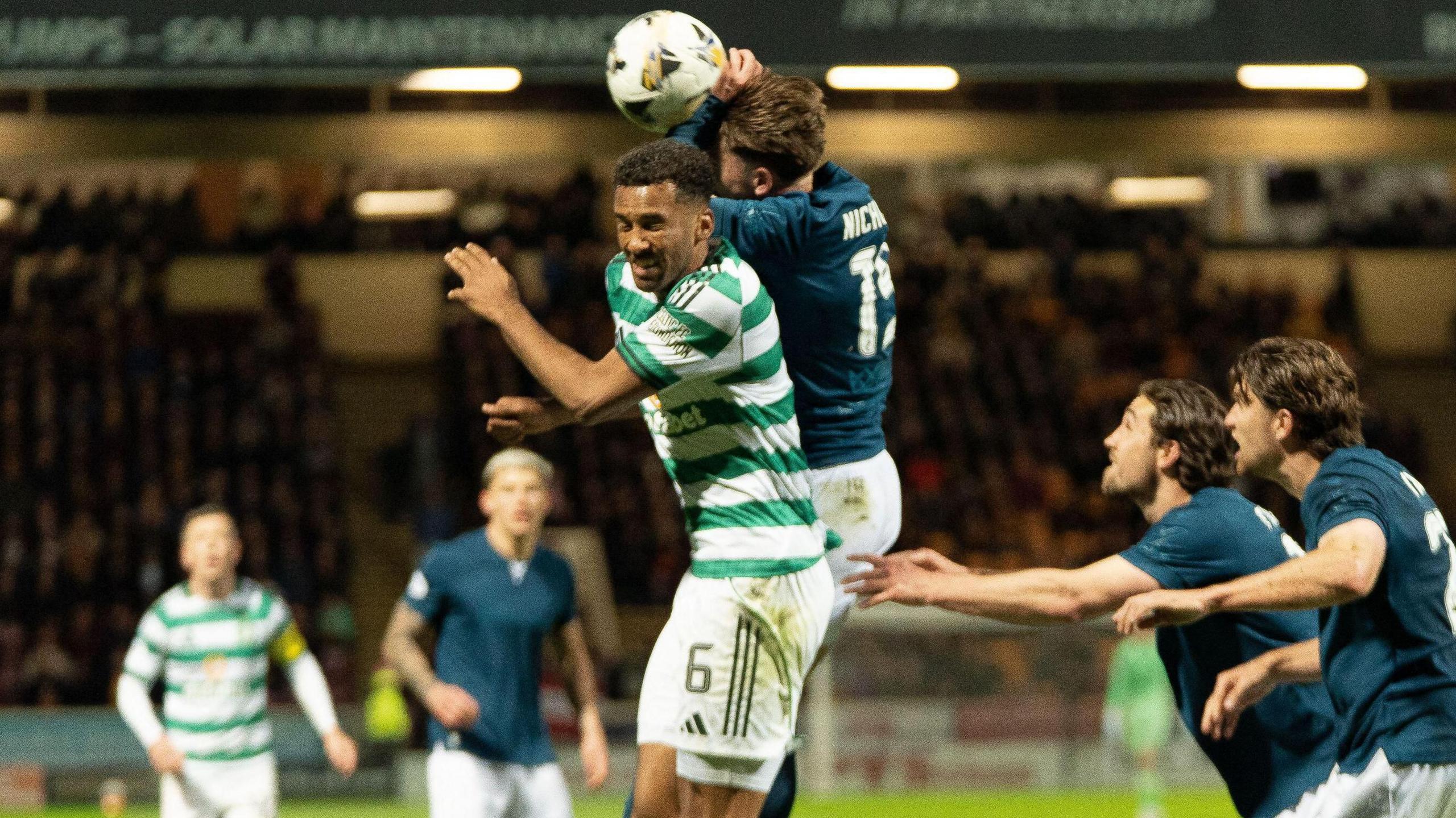 Image source, Alamy Stock Photo
Celtic scored a match-winning penalty with the last kick of the game after Motherwell's Sam Nicholson conceded a penalty for handball after a VAR review
"The controversy and discontent around West Ham not being given the goal is because it's Arsenal," Danny Murphy said on MOTD.
Murphy was suggesting that lots of neutral fans might not want the Gunners to win the title.
This is largely due to their style of play, the perception that there is an over-reliance on set-pieces and that they have got away with bullying the opposition on corners.
"They can't be held accountable for decisions in the past," Murphy added. "Just because it's Arsenal we shouldn't get it distorted."
In Scotland, meanwhile, if you are not of a green-and-white persuasion (and that includes Hibernian) you probably want Hearts to win the title - and end the Celtic-Rangers duopoly.
Not since Sir Alex Ferguson's Aberdeen in 1984-85 has a team other than one of the Old Firm been crowned Scottish champions.
The VAR intervention means that rather than needing a victory by at least three goals in Saturday's title decider between Celtic and Hearts at Parkhead, any win will now be sufficient for Martin O'Neill's men.
Both VAR decisions caused a huge controversy - among pundits, supporters and in the media.
Penalty for this? Celtic and Hearts face title decider as McInnes slams 'disgusting' call
- Published15 hours ago
Five 'fouls' in one move - breaking down Premier League corner chaos
- Published2 days ago
Biggest VAR call ever? Four chaotic minutes that may define the season
- Published3 days ago
It raises a question about whether the game is any better with VAR - and if the reaction would be any different without it.
Many fans feel that VAR was sold as the solution, that all arguments about decisions would be ended by video review.
If anything, the noise has been amplified with supporters able to find fault not only with the on-field call, but with the video referee too.
But we should not pretend that before VAR there was a utopian world where shoulders were shrugged and decisions accepted. We have video review because of anger about referees.
Take the image of Pablo holding onto the arm of goalkeeper Raya. This would certainly have been circulated across social media, held up by boss Mikel Arteta as proof of an error.
There was, though, near-universal agreement among pundits and refereeing experts that disallowing the West Ham goal was the right decision.
It was largely fan sentiment that was against it.
The opposite is true in Scotland, where there is pretty much universal agreement that the VAR should not have stepped in to give the penalty to Celtic.
Furious Hearts head coach Derek McInnes said it was a "disgusting" decision.
Why Dallas had just one camera angle to use
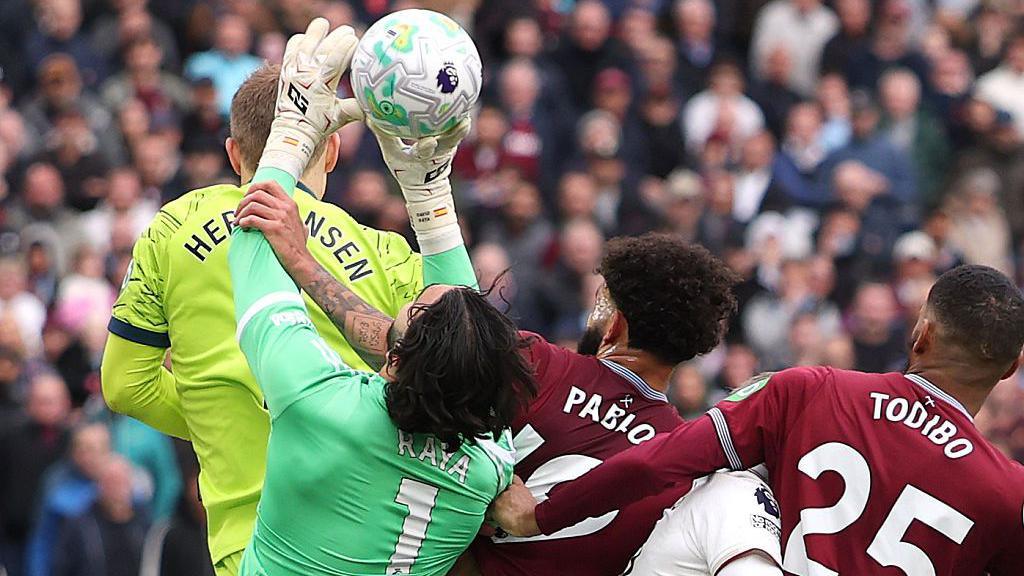 Image source, Getty Images
There is a certain irony, given that Arsenal have been the kings of the dark arts on set-pieces this season, that they beat West Ham thanks to VAR ruling out Pablo's effort for a foul on Gunners keeper David Raya
There were some clear differences in approach.
Darren England, the VAR for the Arsenal game, spent two minutes 41 seconds poring over every angle of the footage, checking the possible foul, and potential penalties.
That length of time made sense, as there were multiple incidents to check.
Once at the monitor, referee Chris Kavanagh was there for one minute 15 seconds and watched 17 different replays.
In total, the review lasted four minutes 11 seconds.
It was markedly quicker at Fir Park, though there was only one thing to review.
The Celtic game was stopped for one minute 25 seconds while the VAR, Andrew Dallas, carried out a penalty check.
But once referee John Beaton went to the pitchside monitor, he was there for only 20 seconds and watched just two replays.
Dallas also rocked-and-rolled the frames, presenting this as clear proof that the ball had hit the Motherwell midfielder's hand.
It was two minutes four seconds from the potential handball to the spot-kick being awarded - half the time of the contentious decision at the London Stadium.
VARs in Scottish football are hindered by one key factor: resources.
In England, a minimum of 28 cameras, though often more, are available to the VAR at each ground.
But up in Scotland, most games have a minimum of just six cameras, going up to 12 for the fixtures selected for live television broadcast.
That the VAR was only able to present one camera angle to the referee highlighted the limitations. Beaton was only shown what everybody at home had watched on television.
It should be remembered that referees must have a level of trust that in the VAR, that when they get to the screen it is only because they have made a clear error.
It is why, at all levels, there are only a handful of times each season that a referee sticks with their own decision.
It is why the VAR is the real arbiter.
So regardless of whether the ball does actually touch Nicholson's hand, it was a bold move for the VAR to determine he had definitive evidence.
"VAR was introduced to, in Fifa's terminology, not to look for pebbles but look for boulders," former Scottish Premiership referee Bobby Madden told 5 Live.
"Last night isn't a pebble, it is not even a grain of sand. It goes against the whole ethos of why VAR was introduced."
Perhaps it says a lot that fans found it necessary to create and share fake images on social media as supposed definitive proof.
The VAR should must have evidence which is 'absolutely categorical'
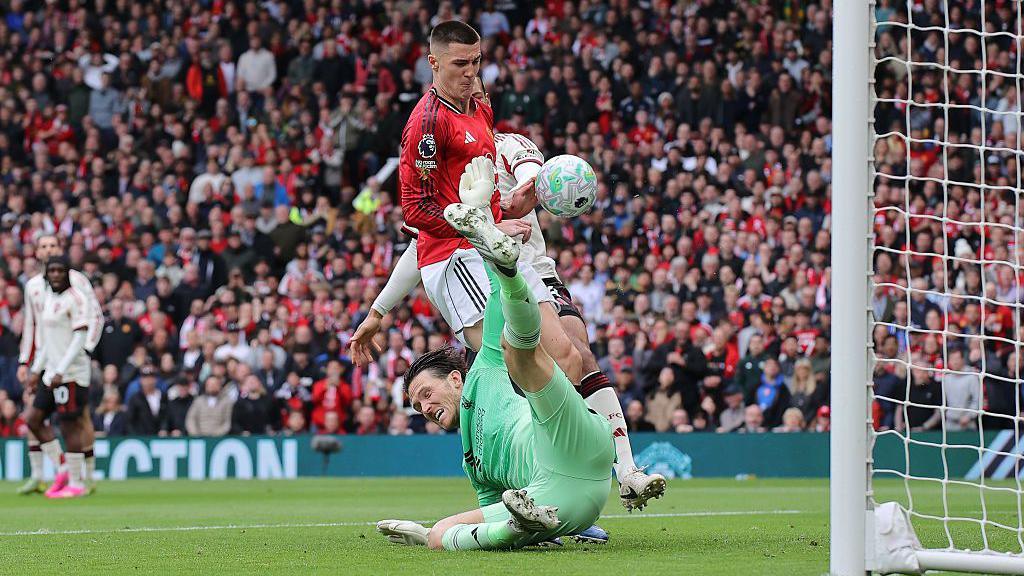 Image source, Getty Images
The VAR felt there was no conclusive proof to rule out a goal by Manchester United's Benjamin Sesko against Liverpool in the Premier League
Only on Tuesday, Premier League referees' chief Howard Webb discussed a handball decision which was not given.
When Benjamin Sesko scored Manchester United's second goal against Liverpool earlier this month, there was a chance the ball might have touched his fingers before it went into the net.
Under the handball law that should automatically lead to the goal being disallowed but, as Webb explained, the VAR did not feel he could be "absolutely categorical" about it.
The VAR, Stuart Attwell, had multiple different camera angles and still could not be certain.
Peering through the gloom of the Fir Park floodlights with one camera angle, it is difficult to understand how Dallas could be so sure.
While there might be a feeling justice was served at the London Stadium, that does not appear to be the case in Scotland.
Did the ball actually touch Nicholson's hand? Or just his head?
The only person who truly knows is the player himself.
And that should never be enough for the VAR to get involved.
The one thing VAR has not done, which some believed it would, is stop arguments about the game.
But in a sport which is drawn on such partisan line, that was never really going to be possible.
What does this say about how VAR is working?
VAR continues to be divisive regardless of whether the final decision is correct, and it continues to frustrate the fans.
BBC Sport Celtic fan writer Martin Callaghan:
"Maybe the biggest debate about the late penalty that Celtic got at Fir Park last night is just how sure (or not!) referee John Beaton could have been that a handball did indeed occur when he was called to the VAR monitor in the dying minutes of the game.
"So although I'd say that he did get it right, are he and his colleagues truly working with the suitable technology, resources and tools to consistently nail what could be decisions with multi million pound consequences?
"I'm not so sure.
"The product here in Scotland has been described in places as 'VAR Lite' and I'd say that's as accurate a way as any to describe what our officials are working with - and also what our supporters are having to endure.
"It's quite clear (pardon the pun) that there's simply not enough cameras to ensure that with any contentious decisions such as this one the referee is given enough data to make a truly informed decision – and that can't be right.
"So while the decision went Celtic's way last night – and some sort of myth has since been peddled that it was ever thus – the reality is that everyone is suffering with our below par product.
"Players, fans, clubs, coaches – and perhaps most of all, those in the middle who are ultimately tasked with making the big calls."
Gerry Mallon, the chairman of the Foundation of Hearts, external:
"All of us at the Foundation of Hearts congratulate our magnificent team and manager, Derek McInnes, on their outstanding achievements in this momentous season.
"We have, however, been extremely concerned by a number of refereeing and VAR decisions across the last two rounds of fixtures, which have had a significant impact on outcomes for Hearts and others.
"That this has occurred at such a crucial stage of the season is particularly disappointing. We understand that the club shares these concerns and has made representations to the football authorities seeking clarification on recent decisions.
"At a time when Scottish football is subject to heightened scrutiny, both nationally and internationally, it is important that confidence in officiating standards is maintained.
"We therefore call on those responsible for the officiating of Saturday's match to ensure that the highest standards of decision-making are applied, so that the game is decided by the players on the pitch and the team is given the fair opportunity it has earned."
Related topics
Follow your club with BBC Sport
- Published12 March

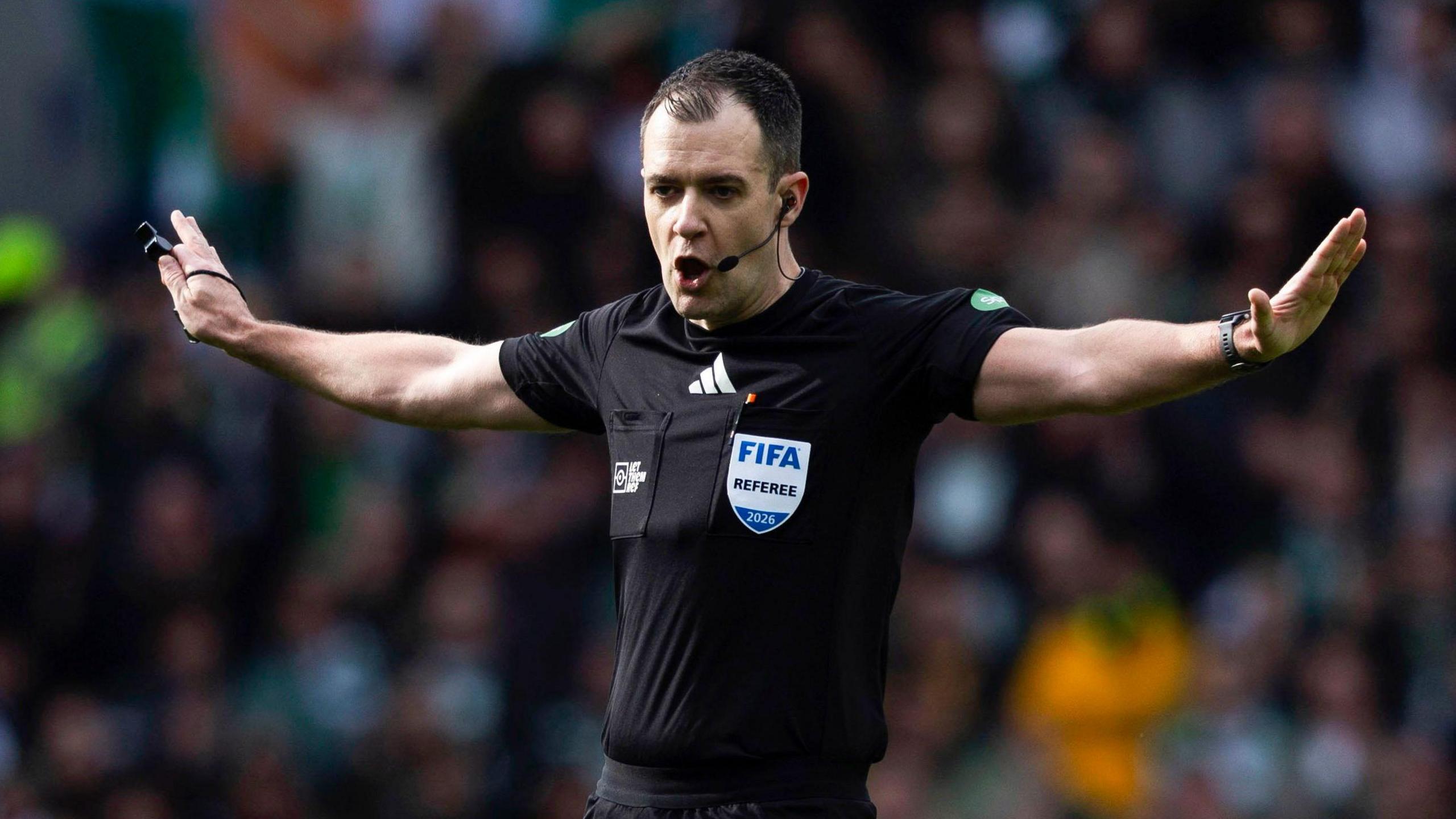
Robertson to referee decider amid Hearts concerns
- Published1 hour ago
Penalty pandemonium sets up Hearts & Celtic showdown for the ages
- Published14 hours ago

Схожі новини
World Cup final halftime show will feature Madonna, Shakira and BTS
World Cup final halftime show will feature Madonna, Shakira and BTS

«Воробей поменялся, как хамелеон». Экс-футболист сборной Украины вспомнил экстремальное приземление на Фарерах