How China became the new master of Russia's economy
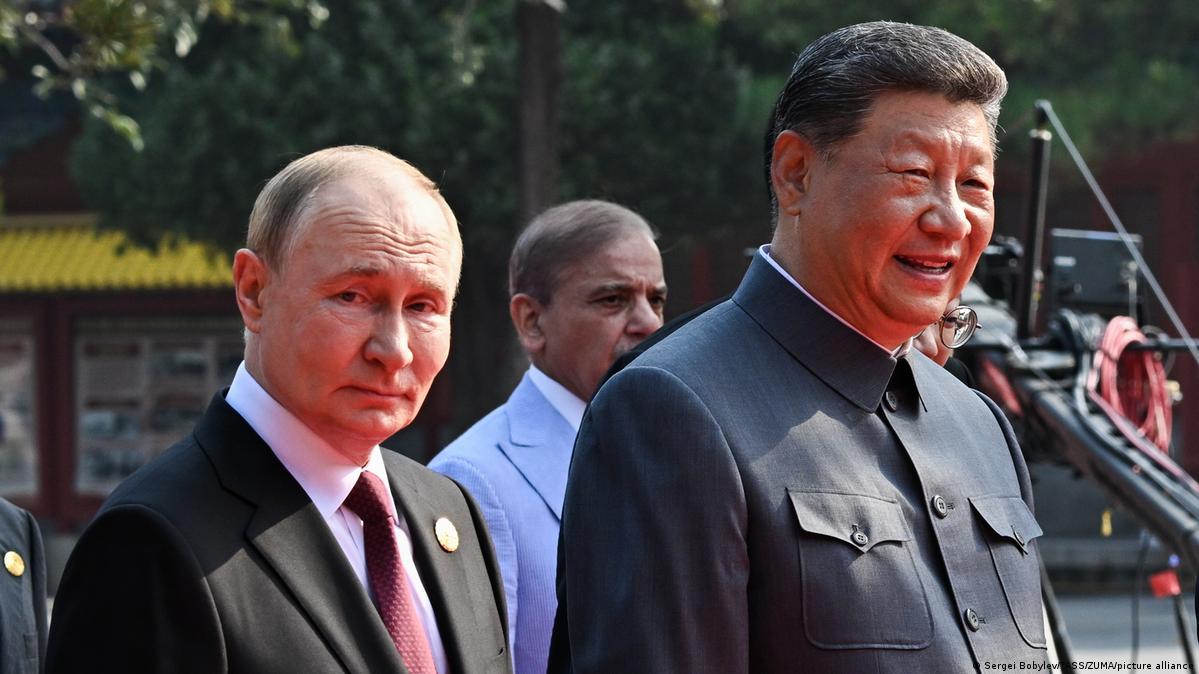
Russia may celebrate its "no-limits" partnership with China — a phrase coined when President Vladimir Putin and Xi Jinping met just before the Ukraine war — yet those relations are increasingly one-sided.
Although bilateral trade softened last year as a result of lower oil prices, Russia’s goods exports to China have nearly doubled since February 2022, when Moscow's full-scale invasion began.
In 2024, Russia shipped roughly $129 billion (€111 billion) worth of goods to China — the overwhelming majority in crude oil, coal and natural gas sold at steep discounts.
The Centre for Research on Energy and Clean Air calculated that China has bought more than €319 billion ($372 billion) of Russian fossil fuels since the conflict began, giving Moscow vital hard currency to fund its military amid Western sanctions.
In return, China exported nearly $116 billion worth of goods to Russia in 2024, supplying machinery, electronics and vehicles that replaced Western suppliers who exited the Russian market.
Although Beijing has stopped short of direct exports to Russia of finished military hardware, China has supplied billions of dollars' worth of dual-use goods — civilian products and technologies that also have military applications. These have also helped sustain Russia’s defense industry.
As Putin and Xi prepare to meet in Beijing this week for high-level talks — timed to mark the 25th anniversary of the two countries' cooperation treaty— this growing imbalance leaves Moscow increasingly vulnerable to Beijing’s priorities.
China and Russia: A partnership of equals?
To view this video please enable JavaScript, and consider upgrading to a web browser that supports HTML5 video
Why is Russia increasingly reliant on Chinese technology?
Western sanctions, imposed since 2022 and repeatedly tightened, have severed Russia’s access to advanced Western technology.
The United States, European Union, United Kingdom and allies banned exports of semiconductors, microelectronics, precision machine tools and other dual-use goods critical for weapons production. These moves created acute shortages in Russia.
In response, Moscow turned to China, which, according to Bloomberg, supplied roughly 90% of Russia’s sanctioned technology imports in 2025 — up from 80% the previous year.
Obtaining goods like machine tools for missile and drone assembly is far more difficult and expensive than before the war. Russia must utilize complex evasion networks through third countries and often ends up paying premiums of nearly 90% above pre-war prices.
Beijing has also provided Russia with earth observation intelligence, satellite imagery for military purposes and drones, Bloomberg reported last year.
Chinese technology has enabled Russia to sustain and even expand its production of missiles, drones and other weapons, keeping the war economy running.
Why are Russia, China conducting more trade in yuan?
As the Ukraine war unfolded, the US, EU, and allies expelled major Russian banks from the SWIFT payment system and froze approximately $300 billion of Russia’s central bank reserves held abroad.
This effectively weaponized the dollar-dominated financial system against the Kremlin, making dollar or euro transactions risky or impossible. The move also exposed foreign banks, individuals and entities worldwide to secondary sanctions if they continued to work with sanctioned Russian entities.
In response, Moscow and Beijing accelerated so-called de-dollarization, the shift away from using the US dollar toward their own national currencies. According to Russian Finance Minister Anton Siluanov, by late last year, the two countries were settling over 99% of their bilateral trade in rubles and yuan.
This trend has been reinforced by the BRICS group of emerging economies, which promotes local-currency settlements between its nearly dozen members and has even floated plans for a single BRICS currency.
Yuanization, as it's known, has created new dependencies, however. Russia now faces occasional yuan shortages, higher borrowing costs and must tolerate Beijing’s upper hand in all bilateral negotiations.
China isn't trying to replace the dollar overnight, but a more widely used yuan increases Beijing's global economic influence. Countries that hold or borrow in yuan become more tied to China’s economy and policies.
Is China likely to increase its economic dominance over Russia?
Many top Russia-China analysts believe that Beijing’s leverage over Moscow is likely to grow further in the coming years.
During his visit this week, Putin is expected to push for progress on new and expanded pipelines that will further strengthen Russia's export revenues and China's energy security.
Boosting Russian pipeline capacity to China "would significantly enhance Beijing's oil security in a Taiwan contingency," Joseph Webster, a senior fellow at the Atlantic Council, wrote in a post on Substack on Sunday.
Webster was referring to China's repeated threats to invade Taiwan, a move that could draw Western sanctions on Beijing or even a US naval blockade that disrupts China's sea-borne oil imports.
The Kremlin is particularly keen to finalize construction of the long-delayed Power of Siberia 2 gas pipeline, which could deliver up to 50 billion cubic meters of gas annually to China via Mongolia. The project remains stalled over pricing disputes and technical details.
Beijing's desire for reliable overland energy supplies has grown since the disruptions in the Strait of Hormuz during the Iran war. But any breakthrough in those plans would further tie Russia’s energy future to China, reinforcing Beijing’s leverage over Moscow.
The Putin-Xi summit also comes just days after US President Donald Trump’s high-profile visit to Beijing, which saw Washington and Beijing attempt to stabilize their ties on trade, technology and global issues after a rocky few years.
A thaw in US-China relations, however, would not help Putin. It reduces China's incentive to fully align with Russia against the West, as Beijing prioritizes protecting its massive economic interests with the US and Europe.
Conflicts remain after Trump-Xi summit ends
To view this video please enable JavaScript, and consider upgrading to a web browser that supports HTML5 video
Edited by: Srinivas Mazumdaru
AdvertisementСхожі новини
Taiwan & Thucydides Trap: How close have the US and China come to conflict before?

НБУ на рік відклав вимогу про формування банками буферів капіталу

НБУ відтермінував на рік формування банками буферів капіталу