How child soldiers in Sudan become influencers on TikTok
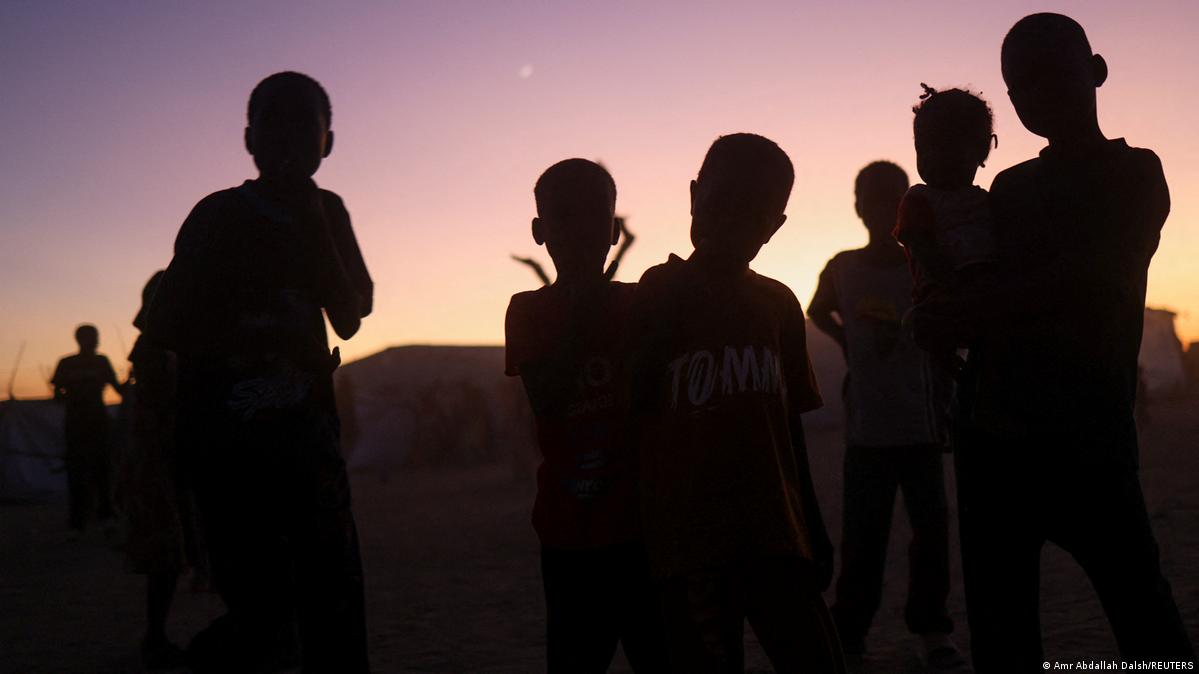
In a TikTok video, a boy of around 12 years old walks through dusty streets, carrying a Kalashnikov weapon, and shouts "God is great!" in Arabic. Behind him, numerous bodies can be seen lying on the ground. Gunshots ring out.
The video was published in early December, shortly after rebels from the RSF (Rapid Support Forces) militia captured the southern Sudanese city of Babanusa, apparently with the involvement of child soldiers. The investigative research network Bellingcat verified that some of the videos were filmed directly in Babanusa.
Numerous videos of child soldiers in Sudan are going viral on social media these days, especially on TikTok. Most are filmed by the children themselves using mobile phone cameras and are viewed millions of times, according to Bellingcat reporter Sebastian Vandermeersch.
He stumbled upon the videos while researching war crimes in Sudan.
"I was able to find an entire network of accounts on TikTok sharing content about child soldiers," he said.
"Child soldiers as influencers are an entirely new phenomenon," Vandermeersch added.
Sudan's children hit hardest by war
The war in Sudan, which began three years ago, is one of the world's largest humanitarian catastrophes. Nearly 14 million people have been displaced, with more than four million seeking refuge in neighboring countries. Approximately 34 million Sudanese rely on humanitarian aid, according to the United Nations, which accounts for around 65% of the population.
Children are the most severely affected, according to Kamal Eldin Bashir from the aid organization Save the Children in Sudan.
"They suffer from displacement, separation from their families, lack of education, and above all, a lack of health care, in addition to the malnutrition affecting a very large number of children," Bashir said.
The most vulnerable are the countless unaccompanied children living without parents in displacement camps. According to the UN children's agency UNICEF, around 42,000 such children have been registered.
Most lost their parents during the fighting, or while fleeing, Bashir said, adding: "They are at risk of being recruited for the war."
The RSF in particular maintains large numbers of child soldiers, according to Mohamed Othman, head of the UN fact-finding team on Sudan.
"They are deployed in various roles, for example, at roadblocks, but also for espionage," Othman reported. He emphasized that the use of children under 15 constitutes a war crime under the Rome Statute, on which the jurisdiction of the International Criminal Court in The Hague is based.
"Lion cubs" carry severe trauma from Sudan's civil war
These children are referred to online as "lion cubs" or "lion babies." The term has been used in previous wars in Sudan and in the region. In South Sudan and Uganda, thousands of children were deployed on the front lines in the past.
These child soldiers end up severely traumatized and scarred for life, Save the Children's Bashir warned.
"According to statistics, up to 50% of children in Sudan suffer from post-traumatic stress disorder," Bashir said. "These are truly alarming numbers."
Among those children recruited to actively participate in the war, the figures are even higher.
Trauma manifests through a range of symptoms, including nightmares and declining school performance.
"But to treat all these children, we simply lack the specialized health facilities equipped to deal with this problem," Bashir said.
Severe consequences for Sudan's future
If these children are not treated, it will ultimately have very negative consequences for society, according to Ugandan doctor Victor Ochen. He is the director of the organization AYINET, which specializes in treating former child soldiers.
It is one of the few such organizations on the continent. Ochen recently trained psychologists from Sudan. He finds it alarming that child soldiers are now being glorified as war heroes.
"They can be exploited as propaganda tools by the warring parties," he said.
Ochen grew up in Uganda during the civil war. His brother was forcibly recruited by the Ugandan rebels of the Lord's Resistance Army (LRA). He knows from personal experience that these war experiences typically shape future generations.
In a regional study commissioned by the African Union, AYINET found the entire region, including Sudan, experiences brutal civil wars in regular cycles.
The reason, according to Ochen: "Many experience war as children and see their parents killed. And once they are ten to 15 years older and grown up, they are ready to strike back." This means trauma perpetuates itself across generations.
Investigative journalist Vandermeersch confronted TikTok with the videos. But the platform's response was muted.
"After 48 hours, the accounts were still available," he said. Only after the publication of his article were all the reported accounts taken down. However, the journalist said new accounts immediately surfaced afterward.
This article was adapted from German.
AdvertisementСхожі новини
Russia offers Ukraine May 8-9 ceasefire amid WWII anniversary, but threatens major reprisals in same breath
РФ атакує великий обласний центр: перші деталі від влади про наслідки
Чому Путін хоче перемир’я на 9 травня: Жорін назвав справжню причину