Housing and climate resilience dominate Latin American agenda at WUF13

 Facebook
 Twitter
 Flipboard
 Send
Send
 Reddit
 Linkedin
 Messenger
 Telegram
 VK
VK
 Bluesky
 Threads
 Whatsapp
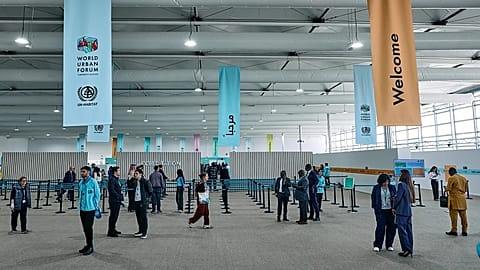
Latin American leaders at World Urban Forum 13 called for new housing finance models, stronger private investment and climate-resilient urban development.
At the World Urban Forum in Baku, delegations from Colombia, Mexico and Ecuador pushed for new housing finance models capable of supporting affordable, climate-resilient cities.
 ADVERTISEMENT
ADVERTISEMENT
ADVERTISEMENT
As urban populations continue to grow across Latin America, policymakers warned that traditional state-led housing systems are struggling to keep pace with rising demand, climate risks and widening inequality.
Among the leading voices was Aydeé Marsiglia Bello, Colombia's housing minister, who said governments can no longer rely solely on public spending to address the scale of the housing crisis.
"Public investment continues to play a fundamental role, especially to guarantee equity and protect vulnerable communities," Bello told Euronews Business. "But housing challenges today are too large to be addressed by governments alone."
Colombia is combining public subsidies, territorial investment and multilateral cooperation to expand affordable housing while integrating climate resilience into urban planning, she said.
"Through initiatives such as the Resilient and Inclusive Housing Project, we are integrating housing with climate adaptation, public space and social inclusion," she added.
Reforming global finance for an urban world
Delegates repeatedly highlighted how climate-related disasters are placing growing pressure on fragile urban systems, particularly in lower-income communities vulnerable to displacement and informal housing.
Former Quito mayor Mauricio Rodas said the future of urban development will depend heavily on reforming global finance systems to give cities better access to long-term capital.
"It is in cities where more than half of the world's population lives, and very soon it will be close to 70%," Rodas told Euronews Business. "Cities produce 80% of global GDP, but also generate more than 70% of CO2 emissions."
Rodas argued that the current international financial architecture, largely designed around national governments, is no longer suited to an increasingly urbanised global economy.
"We need to reform the international finance system, deploying new direct financial facilities for cities," he said, warning that municipalities often struggle to secure financing for affordable housing and climate adaptation projects.
Attracting private investment into affordable housing will become increasingly important as governments face growing fiscal pressure, he added.
Related"Housing is fundamentally a matter of dignity, but also a matter of providing opportunities to prosper," Rodas said.
One of the main barriers, he argued, remains the lack of regulatory frameworks capable of giving investors long-term confidence in urban housing projects.
Bello echoed that view, identifying limited financing capacity in vulnerable municipalities as one of Colombia's biggest obstacles.
"One of the main bottlenecks remains the fiscal ceiling and the limited long-term financing capacity for vulnerable territories," she said.
Private capital and the affordability challenge
Discussions in Baku also focused on the growing role of private capital in urban development, with governments looking for ways to attract institutional investment into affordable housing without weakening social protections.
"Private capital is essential to scale resilient infrastructure, sustainable urban development and climate-adaptive housing solutions," Bello said.
Governments, she added, need to create "stable regulatory frameworks", improve territorial planning and reduce uncertainty through clearer risk-management systems to draw in institutional investors.
Mexico City looks ahead to 2030
Mexico City mayor Clara Brugada said the forum was helping shape the next phase of the global urban agenda ahead of the 2030 sustainable development targets.
"This forum means construction of the bases for 2030," she said, describing Baku as a key moment for reviewing how cities can realistically meet future urban development goals.
Brugada also confirmed that the next World Urban Forum will take place in Mexico City, positioning the Mexican capital at the centre of upcoming international urban policy discussions.
On housing, Brugada said Mexico City is increasing public investment to tackle both housing shortages and deteriorating living conditions. She doubled the housing budget upon taking office, she said, describing it as one of the city's top priorities.
Brugada also warned about the growing impact of gentrification in the Mexican capital, describing it as part of a broader global trend displacing lower-income residents from central districts. The city is preparing new legislation on "fair, affordable and reasonable rents" while expanding social housing programmes and tenant protections.
Mexico City has committed to delivering 200,000 housing actions by 2030 as part of broader efforts to strengthen housing access and affordability.
The discussions at WUF13 underlined how Latin American countries are increasingly positioning cities not only as engines of economic growth, but as testing grounds for new urban finance models that could shape housing policy worldwide
Go to accessibility shortcuts Share CommentsRead more
MENA leaders push for reimagined housing policy at Baku urban forum
Схожі новини

Tim Hortons says it will hire 10,000 locals in Canada amid boycott call, 'Singh Hortons' nickname
DGCA issues Ebola SOP for airlines, tightens screening at Indian airports

Ruud survives five-set epic at French Open, Shelton also advances as Wawrinka bows out