Horrified Wagga residents call for proper sanitation at homeless camp where baby was found dead

Tent where twins were born up to a 15-minute walk away from nearest public toilets or running water
-
Get our breaking news email, free app or daily news podcast
The tent where a newborn baby was found dead at Wagga beach at the weekend was part of a homeless encampment up to a 15-minute walk away from the nearest public toilets or running water, with residents in a nearby apartment block saying conditions were “worse than a Syrian war camp”.
The tragedy has prompted fury in the community, with residents of Wagga Wagga calling on authorities to take urgent action to make the encampments safe and sanitary.
The 37-year-old mother had been living on the Murrumbidgee riverbank with her partner when she went into labour. On Saturday police were called to the camp where they found one of her newborns had died.
The woman and the other twin were taken to hospital. The woman has been discharged from hospital while the infant – who was in a critical condition on Monday – has been transferred to a hospital in Sydney.
It is unclear why the newborn died.
One resident, who lives along the riverbank encampment but did not want to be named, said the woman, who is Indigenous, had not returned to the camp.
It’s understood that the woman had other children who were not present during the birth and had not been living with the couple in the tent. Her partner was there during the birth.
Homelessness is a growing problem in Wagga, with multiple encampments in the area. Several people working in local social services said the river camp – which includes about 10 tents – was seen as a safer, quieter spot compared with other encampments, with single women, some under 25, living there.
A city councillor, Amelia Parkins, said the larger encampment in town, Wilks Park campground, was well managed, with waste collection and access to bathrooms. At a community meeting on Tuesday night there were calls for the council to offer the same level of amenities to those living in other encampments.
“Council can do that,” Parkins said. “But that would have to be a short-term option, just to assist people with hygiene and sanitation right now.”
The closest public toilets are about a 10- to 15-minute walk away from most of the tents, and are closed overnight. People in the river encampment had been using water from a much closer apartment building until access was restricted.
Parkins said she was investigating whether the council had asked for the water to be restricted after complaints from apartment residents about people from the camp using water.
“Access to clean water is a fundamental human right,” Parkins said. “And something that council should be able to provide.
“That goes for the waste collection as well. You know, council runs all of the waste management.”
When asked if it had asked for the water to be restricted, Wagga Wagga city council said it had been contacted by apartment residents who complained about people “camping on private property, bathing and washing under the taps at that property, and intimidating residents”.
“General advice was given by compliance officers in response to that specific request to secure the public areas of the complex, per the resident’s request,” a spokesperson said. “Council does not manage infrastructure on private property.”
The council said the public amenities at Wagga beach “remain accessible in line with normal operating hours” and it had not been informed about concerns that a woman living on the riverbank was pregnant.
A broader problem
Residents and councillors are calling for more permanent housing solutions, asking the New South Wales government to invest in social housing and to provide more funding for support services.
Homes NSW has worked with the woman’s family for many years and she has had help with both short- and long-term property. The assistance had been relinquished.
“People [living rough] may be offered housing on a short-term basis and that’s a really tricky thing,” Parkins said. “If you’ve set up camp, say, down at the river, to then relocate for one or two weeks, only to then have to go back to the river.”
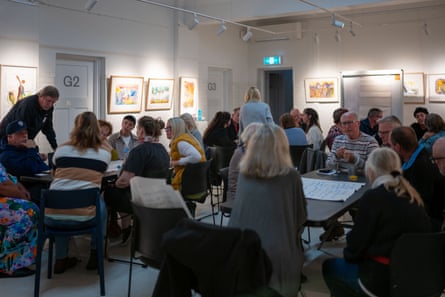
At a local meeting on Tuesday night, residents were visibly shaken by the tragedy, and outraged that the housing crisis had become so bad that a woman had given birth in a tent.
“Everyone’s pretty distraught that something like this has happened in Wagga,” Parkins said. “There’s a general feeling of hopelessness and helplessness, and a lot of people desperately want to do something but don’t know what to do.”
The NSW housing minister, Rose Jackson, the local state MP, Joe McGirr, and the mayor of Wagga, Dallas Tout, will meet on Thursday to discuss the baby’s death.
The president of Wagga Women’s Health Centre, Vickie Burkinshaw, backed calls for immediate “practical solutions” such as access to clean drinking water.
“There is no sanitation down there,” Burkinshaw said. “So a lot of the camps do gravitate towards where there is sanitation but there’s clearly not enough of it for the number of people that are using it.”
In the long term, she said, the community needed more social homes. The waitlist for social housing in the area was about 700 people, Burkinshaw said, and it could take up to four years for even the most vulnerable to find a place. She said all tiers of government were failing the community.
“Bureaucracy has tried to deal with this for a very long time, and we are just not getting the results,” she said. “We are not getting people off the streets. We are putting more people on to them.”
– Additional reporting by Caitlin Cassidy
Explore more on these topics- Inequality
- Homelessness
- New South Wales
- Rural and regional Australia
- Indigenous Australians
- Housing
- Water
- news