Help scientists find spacetime warps in these Euclid Space Telescope images
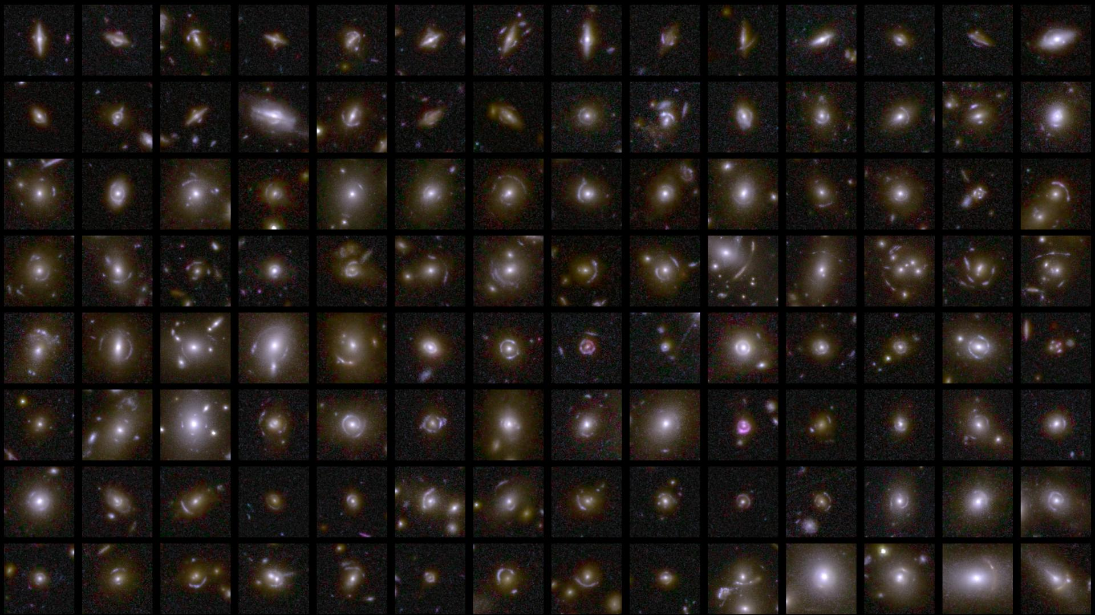
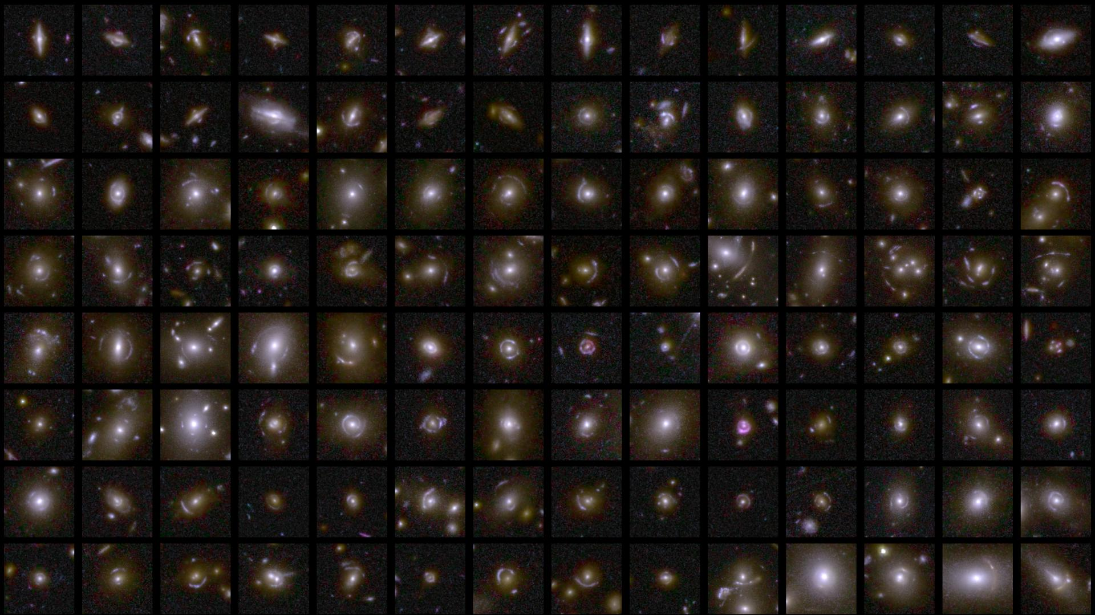
A new citizen science project invites the public to scan never-before-seen images from the Euclid Space Telescope in search of galaxies bending spacetime.
Led by the European Space Agency (ESA), the initiative, called Space Warps, uses data from Euclid to crowdsource the search for rare cosmic distortions known as gravitational lenses. These occur when massive foreground objects such as galaxies or galaxy clusters warp spacetime, bending and magnifying the light from more distant background objects. As Euclid continues its survey, sending around 100 GB of data to Earth each day, citizen scientists are being asked to help identify strong gravitational lenses in the dataset, according to a statement from the space agency.
Gravitational lensing can produce striking visual signatures: stretched arcs of light, duplicated galaxy images or near-perfect rings known as Einstein rings. Beyond their visual appeal, these "space warps" are powerful scientific tools. By magnifying extremely distant galaxies, gravitational lenses allow astronomers to study objects that would otherwise be too faint to detect, while also offering clues about the distribution of dark matter throughout the universe.
Finding these lenses, however, is far from straightforward. Even with modern machine learning tools, the subtle distortions can be difficult to reliably identify in large imaging surveys. Citizen scientists, by contrast, are often adept at picking out unusual patterns that algorithms miss.
Through the Space Warps project, hosted on the Zooniverse platform, participants are shown real Euclid images and asked to flag potential lensing features. Roughly 300,000 AI-selected images — refined using results from the initial Euclid citizen science strong lens search — will be shown, representing the top candidates drawn from 72 million galaxies in the mission's first data release.
No scientific background is required to participate. Volunteers are guided through examples, along with an explanation of what gravitational lenses are and how to recognize them before classifying data from the mission's growing archive. Participants also get an early look at images not yet released publicly, ahead of Euclid Data Release 1.
Over 2,500 volunteers have already joined Space Warps to identify rare strong lenses. Participants are asked to place a marker on features that suggest there is gravitational lensing in an image. A marker can simply be added to an image by clicking on the lens feature — or easily deleted — and users can then move on to the next image by clicking done.
The Zooniverse platform makes it easy to comb through the images, allowing users to pan/zoom each image, or change to a flip-book view of the different colored images. The platform also has a built-in Field Guide to help distinguish real signals from imposters, as well as training images and real-time feedback to help sharpen classifications.
The scale of the task reflects Euclid's ambition. Since its launch in 2023, the mission has begun mapping the large-scale structure of the universe in unprecedented detail, capturing vast numbers of galaxies across a wide swath of the sky. Its high-resolution, wide-field imaging makes it especially well suited for spotting strong gravitational lenses, which are rare but scientifically valuable.
Researchers estimate that citizen scientists could help identify more than 10,000 new lens candidates over the course of the project — a major expansion of the current catalog. Those discoveries would help improve measurements of how matter, both visible and invisible, is distributed across cosmic scales.
The effort builds on earlier successes in citizen science, where volunteers working through the Zooniverse have already contributed to the discovery of hundreds of gravitational lens candidates. In fact, in March 2025, 500 galaxy-galaxy strong lenses were found nestled in just the first 0.04% of Euclid data, most of them previously unknown. Those classifications not only add to scientific databases but also help refine the artificial intelligence systems increasingly used to process astronomical data, according to the statement.
As Euclid continues to survey the cosmos, Space Warps highlights a growing reality in modern astronomy: the biggest datasets in history are increasingly being explored not just by scientists and supercomputers, but by anyone with an internet connection and a willingness to help uncover the universe's hidden distortions.
Registration on the Zooniverse platform is required to participate in the research and save possible classifications for further investigation. By exploring and interacting with Euclid images, volunteers have a unique chance to contribute directly to discoveries that could reshape our understanding of the universe.
View MoreYou must confirm your public display name before commenting
Please logout and then login again, you will then be prompted to enter your display name.
Logout
Samantha Mathewson joined Space.com as an intern in the summer of 2016. She received a B.A. in Journalism and Environmental Science at the University of New Haven, in Connecticut. Previously, her work has been published in Nature World News. When not writing or reading about science, Samantha enjoys traveling to new places and taking photos! You can follow her on Twitter @Sam_Ashley13.
Схожі новини