‘Hazardous’ heat could put World Cup players’ health and performance at risk, report warns

 Facebook
 Twitter
 Flipboard
 Send
Send
 Reddit
 Linkedin
 Messenger
 Telegram
 VK
VK
 Bluesky
 Threads
 Whatsapp
Climate scientists are calling on FIFA and fans “to realise that there is no aspect of society not affected by climate change”.
This summer, the World Cup will return to North America for the first time since 1994.
 ADVERTISEMENT
ADVERTISEMENT
ADVERTISEMENT
A lot has changed in the last 32 years as extreme weather has become more frequent and intense, fuelled by human-caused climate change.
“The 1994 World Cup may not feel particularly distant to many adults today, yet half of human-induced climate change has happened since then,” says Dr Friederike Otto, professor of climate science at Imperial College London and co-founder of World Weather Attribution (WWA), an international effort to analyse and communicate the possible influence of climate change on extreme weather events.
The US has just experienced its hottest 12-month period on NOAA’s record, raising fears for player and spectator safety during the tournament, which will take place in 16 cities across Canada, the US and Mexico.
The wide spread of the games could make it especially difficult for players to cope as they will be faced with highly variable climate conditions, according to analysts at WWA.
A new report by the organisation warns that the risk of extreme heat during the matches has doubled in some venues since 1994.
This has forced organisers to introduce safety measures like later match times and mandatory cooling breaks – but both fans and players could still endure hazardous temperatures at a significant number of matches, the report warns.
Heat stress could hit a quarter of World Cup games
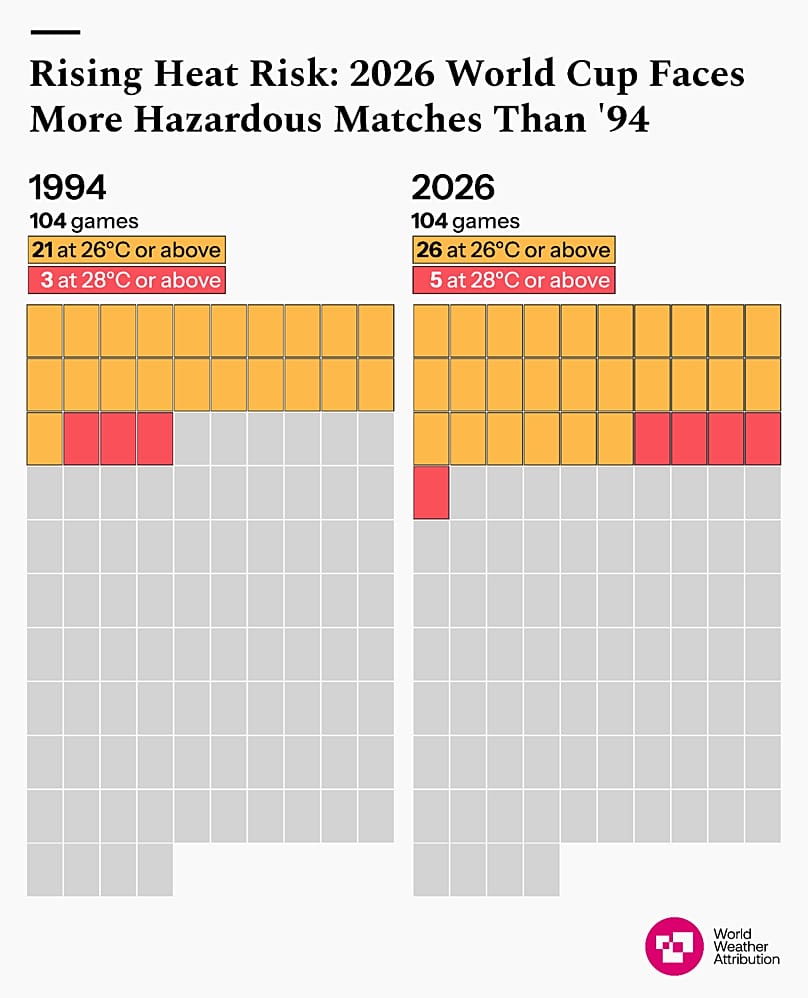
Temperatures are expected to be above 26°C Wet Bulb Globe Temperature (WBGT) for around a quarter of the games, creating significant levels of heat stress, according to WWA.
WBGT takes air temperature, humidity, wind speed and sunlight into account to assess how heat affects the human body.
“A 30°C day in dry, breezy conditions is very different from a 30°C day with high humidity, strong sun and little wind,” explains Dr Chris Mullington, a consultant anaesthetist and honorary clinical senior lecturer at ICL. “High humidity reduces the evaporation of sweat, limiting the body’s primary cooling mechanism.”
Heat stress risk at 26°C WBGT is considered moderate to high, particularly during strenuous activity like professional sports, warranting precautions to prevent heat-related illness. In these conditions, “player performance can suffer”, says Dr Mullington.
RelatedIn an attempt to reduce risks, World Cup 2026 organisers will enforce mandatory three-minute “hydration breaks” midway through each half of games, splitting the matches into quarters.
Around five games are expected to be played in 28°C heat, a level that the global union for professional football players, FIFPRO, considers to be unsafe and postponement is advised. However, official FIFA regulations only consider postponement at WBGT levels above 32°C.
“Above 28°C, the risk of serious heat illness becomes more concerning – not only for players, but also for the hundreds of thousands of fans in stadiums and outdoor fan festivals,” says Dr Mullington.
“Heat stroke, the most severe form of heat illness, is life-threatening, and older people and those with pre-existing medical conditions are particularly vulnerable.”
Which World Cup games are most at risk of extreme heat?
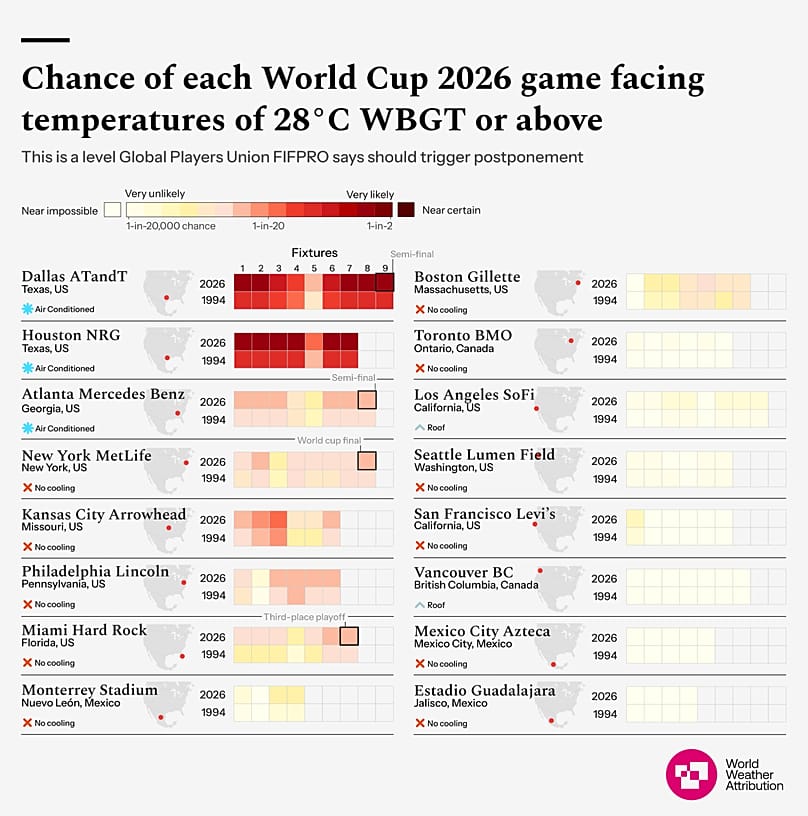
A number of at-risk stadiums do not have air conditioning, including New York’s open-air MetLife Stadium, where the World Cup Final will be played. The venue has seen its risk of heat-related disruption increase by up to 50 per cent since the 1994 World Cup, according to WWA.
“There’s a very real risk that we’ll be faced with games taking place in conditions that are unsafe for players and fans,” warns Dr Joyce Kimutai, a research associate in extreme weather and climate change at ICL.
One of the most exposed venues is the open-air Miami Stadium, which faces a “near certainty” of exceeding 26°C, according to WWA, and is set to host one quarter-final game and the bronze final.
RelatedDespite attempts to mitigate the risk of heat with later kickoff times, Kansas City Stadium also remains dangerously exposed. The Netherlands versus Tunisia match, for example, faces a 7 per cent chance of exceeding the 28°C threshold and a 25 per cent chance of exceeding 26°C – despite kicking off at 6pm. The stadium will also host one quarter-final game.
Philadelphia Stadium, which will host a knockout-stage fixture on American Independence Day as well as five group-phase games, has also been flagged as at-risk.
Dallas, Texas, has a near-certain probability of exceeding 28°C WBGT. Fans celebrating outside the air-conditioned AT&T Stadium, which will host multiple games including both semi-finals, could therefore be at high risk of heat stress.
‘Cancellation-level’ heat is a wake-up call on climate change
If global temperatures continue to rise, WWA climate models show that hazardous heat in potential World Cup host locations will continue to worsen.
The organisation warns that, without substantial adaptation measures such as widespread access to air conditioning, staging football matches during the northern hemisphere summer will become increasingly dangerous for both players and spectators.
“Our research shows that climate change is having a real and measurable impact on the viability of holding World Cups during the northern hemisphere summer,” says Dr Otto.
“That the World Cup Final itself – one of the biggest sporting occasions on the planet – faces a non-insignificant risk of being played in ‘cancellation-level’ heat should be a wake-up call for FIFA and fans, highlighting the urgent need to realise that there is no aspect of society not affected by climate change.”
With football fans participating at outdoor gatherings, adaptation measures are not enough to ensure safety, WWA warns. The organisation urges a rapid transition away from burning fossil fuels to mitigate the dangers of climate change.
Go to accessibility shortcuts Share CommentsRead more
The strongest El Niño on record is brewing. Here's what could happen
Схожі новини
Japanese researchers identify scientific mechanism behind crows' black color

Вчені виявили новий засіб проти комарів: що відлякує шкідників
Вчені наблизилися до розгадки сигналу з космосу, який десятиліттями не можуть пояснити