Hantavirus-hit cruise ship leaves Cape Verde after three evacuated

 Reuters
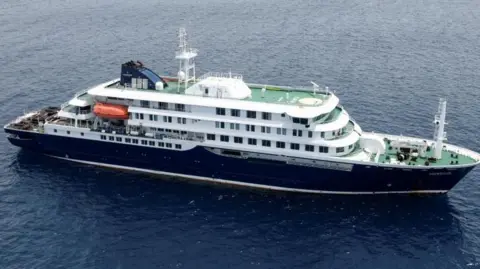
A Dutch cruise ship hit with a hantavirus outbreak has left Cape Verde, after three people on board were medically evacuated.
A British man, 56, a Dutch crew member, 41, and a German national, 65, were sent from the MV Hondius to the Netherlands for treatment, officials said.
The ship, which has 146 people on board, has begun a three-day journey to the Canary Islands.
Three people who were aboard the ship have died since it set sail from Argentina a month ago. Officials have said that one of the deceased had the virus, while the other two deaths are under investigation.
None of the three evacuees have tested positive for hantavirus so far, but two are showing symptoms. Spain's health minister earlier said the British man was a doctor but the BBC later understood that was not correct.
The cruise ship's operator, Oceanwide Expeditions, said the third evacuee, a German passenger, was "closely associated" with a German woman who died on board the ship on 2 May.
It comes as the UK's Health Security Agency said two British people were self-isolating at home in the UK after potential exposure to the virus on the ship. They left the vessel earlier in its journey and did not have symptoms.
In its latest update, the World Health Organization (WHO) said eight cases of hantavirus - three confirmed and five suspected - have so far been identified in people who were on the ship.
Hantavirus typically spreads from rodents, but health experts believe that in this case, it may have passed between humans that were in close contact.
Testing to confirm whether other people on the ship have contracted the virus is ongoing. Health officials have stressed that the risk of transmission to the wider public is low.
What is the cruise ship hantavirus and how does it spread?
The vessel had been anchored near Cape Verde, off Africa's west coast, before it set off towards the Canary Islands on Wednesday.
Spanish authorities agreed to the move, but the Canary Islands' president has opposed the plan and demanded an urgent meeting with Spain's prime minister.
"I cannot allow [the boat] to enter the Canaries," Fernando Clavijo told Spain's Onda Cero radio. "This decision is not based on any technical criteria and nor have we been given enough information."
South African health authorities have said the Andes strain - prominent in Latin America, where the cruise originated - was found in two of the confirmed patients after tests were carried out by the country's National Institute for Communicable Diseases.
Experts have observed the Andes strain spreading between human patients in previous outbreaks. South Africa says efforts to trace all contacts remain underway.
One of the deaths include a Dutch woman who left the MV Hondius when it stopped at the island of St Helena on 24 April. Her husband died on board on 11 April, but is not a confirmed case.
The Dutch woman travelled to South Africa, where she died on 26 April. WHO official Dr Maria Van Kerkhove told the BBC that health experts were carrying out contact tracing on the flight she took.
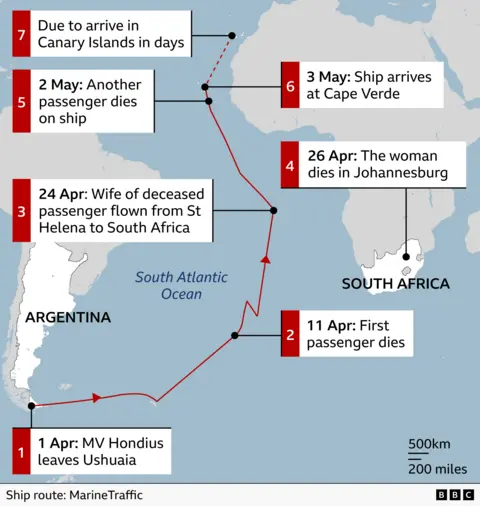
KLM Airlines on Wednesday issued an advisory saying the woman had also briefly been aboard one of their flights from Johannesburg to Amsterdam on 25 April before the crew decided not to let her fly due to her medical condition.
The third fatality - a German woman - is not a confirmed case either. Her body remains on the ship.
Dr Van Kerkhove said the way hantavirus is transmitted "is very different than COVID and flu".
"We're not talking about casual contact from very far away from one another," she said, but "really physical contact".
A total of 146 people from 23 different countries remain aboard the MV Hondius under "strict precautionary measures", Oceanwide Expeditions said.
They have been joined by infectious disease experts and WHO staff, who will travel with them to the Canary Islands.
All those who remain on the ship have no symptoms, Spain's health minister Mónica García said.
She added that everyone on board will undergo a medical assessment when they arrive in Tenerife and, if fit to travel, those from abroad will be repatriated to their home countries.
Spaniards, meanwhile, will be sent to a defence hospital in Madrid to quarantine.
The evacuation would "avoid contact" with Canary Island citizens and that there would be "no risk" to them when it arrives in Tenerife in the coming days, Garcia said.
Hantavirus strain that spreads between humans found in cruise ship passengers
SpainHealthCruise shipsCanary IslandsCape VerdeСхожі новини

Кіровоградська обласна лікарня отримала сучасне обладнання для перинатального центру