Gotion Unveils Sodium Battery Products With 261 Wh/kg Energy Density And 20,000 Charge Cycles
 Credit: Gotion
May 22, 202641 minutes
Steve Hanley
0 Comments
Support CleanTechnica's work through a Substack subscription or on Stripe.
Credit: Gotion
May 22, 202641 minutes
Steve Hanley
0 Comments
Support CleanTechnica's work through a Substack subscription or on Stripe.
Yesterday, we published a story about the new Mercedes AMG GT Coupe, a car that features a lot of high-tech advances like its aluminum-jacketed, laser-welded, silicone-anode NMCA cells that are unusually tall and narrow at 10.5 cm high and 2.6 cm wide. Put all that latest battery tech together and you get a battery rated at 298 Wh/kg. That’s at the high end of what is possible in lithium-ion batteries for mass production today.
In the past few months, news about sodium batteries, which use no lithium at all, has been everywhere. Last week, Alsym announced it has created grid-scale sodium-ion battery storage systems that require no heating or cooling. Yes, its sodium-ion batteries are less energy dense than the LFP batteries now used by most new BESS systems, but by eliminating the need for thermal management systems, it can pack more cells inside a conventional container to deliver the same total energy storage capacity. Alsym says its battery cells have an energy density of 160 Wh/kg — about half as much as those high-tech NMCA cells Mercedes uses.
Sodium-ion batteries have a number of benefits — lower cost of materials, greatly reduced risk of fires, less need for thermal management systems, faster charging, and better cold weather performance — but they suffer from one significant disadvantage. They have a relatively low energy-to-weight ratio. So, what to make of the announcement this week that Gotion, a Chinese company backed by Volkswagen Group, said it is ready to start production of sodium-ion batteries that are rated at up to 261 Wh/kg?
Three New Sodium-Ion Batteries
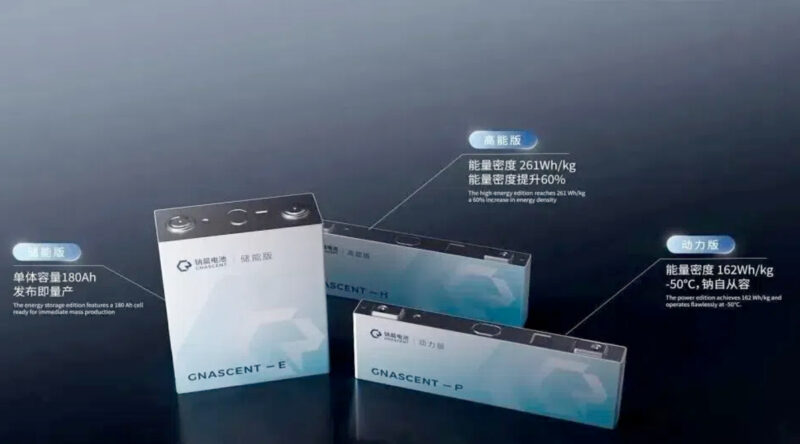
According to CarNewsChina, this week at the 15th Global Technology conference, Gotion introduced three specialized versions of its sodium battery and said it already has gigawatt-hour scale production lines set up and ready to go in Tangshan and Hefei. The three iterations of the new Gnascent (the “g” is silent as in “gnat”) batteries are:
- High-Energy Version: This cell achieves an energy density of 261 Wh/kg, a 60 percent increase over traditional sodium-ion batteries. This battery is specifically aimed at weight sensitive applications such as light electric vehicles and drones within the “low-altitude economy.”
- Power Version: With an energy density of 162 Wh/kg, this version supports ultra-low temperature discharge down to -50°C. It is engineered to solve winter performance challenges for commercial vehicles and outdoor equipment in extremely cold regions.
- Energy Storage Version: Featuring a single-cell capacity of 180 Ah, this version boasts a cycle life exceeding 20,000 cycles. It maintains 88 percent capacity at -40° C and has passed rigorous safety protocols, including an 8 mm steel nail penetration test and 400° C high temperature heating without ignition.
Not Intended For EV Applications — Yet
Okay, these batteries are not scheduled for use in electric automobiles yet, but with the rapid development of sodium-ion batteries — which were just a laboratory curiosity a few short years ago — is there any doubt they soon will be? And what will the EV naysayers have to complain about then?
The technology that is the basis of the Gnascent sodium-ion batteries is supported by over 90 patents covering cathode materials (layered oxides, polyanions, and sodium manganese iron pyrophosphate), hard carbon anodes, and electrolyte additives. The “anode-free” design helps reduce material costs while boosting energy density.
Founded in 2006 and headquartered in Hefei, Gotion High-Tech has grown into a vertically integrated global energy solution provider, with Volkswagen Group as its largest shareholder. By the end of 2025, the company’s energy storage capacity reached 400 GWh, supported by 20 manufacturing bases worldwide. In China, Gotion High-Tech is the leading battery manufacturer after CATL and BYD. In April, its installed battery capacity reached 4.05 GWh, which represents a 6.6 percent market share.
A Gotion battery factory was proposed in Michigan, but locals there were petrified of having a Chinese owned company next door and managed to kill the factory before it got built. Fear and loathing in the heartland is strong — amplified by the lies parroted by the current administration, which prides itself on arresting foreign workers and humiliating them on TV as it frog marches them onto armored buses to be hauled off to jail. Gotion may be a major battery manufacturer globally, but it is not welcome in America.
One presumes that if Volkswagen is backing the company, it is doing so because it expects to use its batteries in some of its electric vehicles in the future. When that happens, sodium batteries may come to dominate the transportation sector. We can’t wait!
Sign up for CleanTechnica's Weekly Substack for Zach and Scott's in-depth analyses and high level summaries, sign up for our daily newsletter, and follow us on Google News! Advertisement Have a tip for CleanTechnica? Want to advertise? Want to suggest a guest for our CleanTech Talk podcast? Contact us here. Sign up for our daily newsletter for 15 new cleantech stories a day. Or sign up for our weekly one on top stories of the week if daily is too frequent. CleanTechnica uses affiliate links. See our policy here.CleanTechnica's Comment Policy
Share this story!
Схожі новини

RCB's 255 chase approach against SRH split fans over intent
GTA 6: по данным утечки, третий трейлер выйдет 26 мая — и у этой даты есть логика
Lenovo Yoga Pro 7i 15 G11: один из первых мультимедийных ноутбуков с обновленной видеокартой RTX 5070
