Germany's 'rapid militarization' threatens basic rights
In an era of populism and authoritarian regimes worldwide, fundamental rights are coming under increasing pressure even in Germany, a country governed by the rule of law.
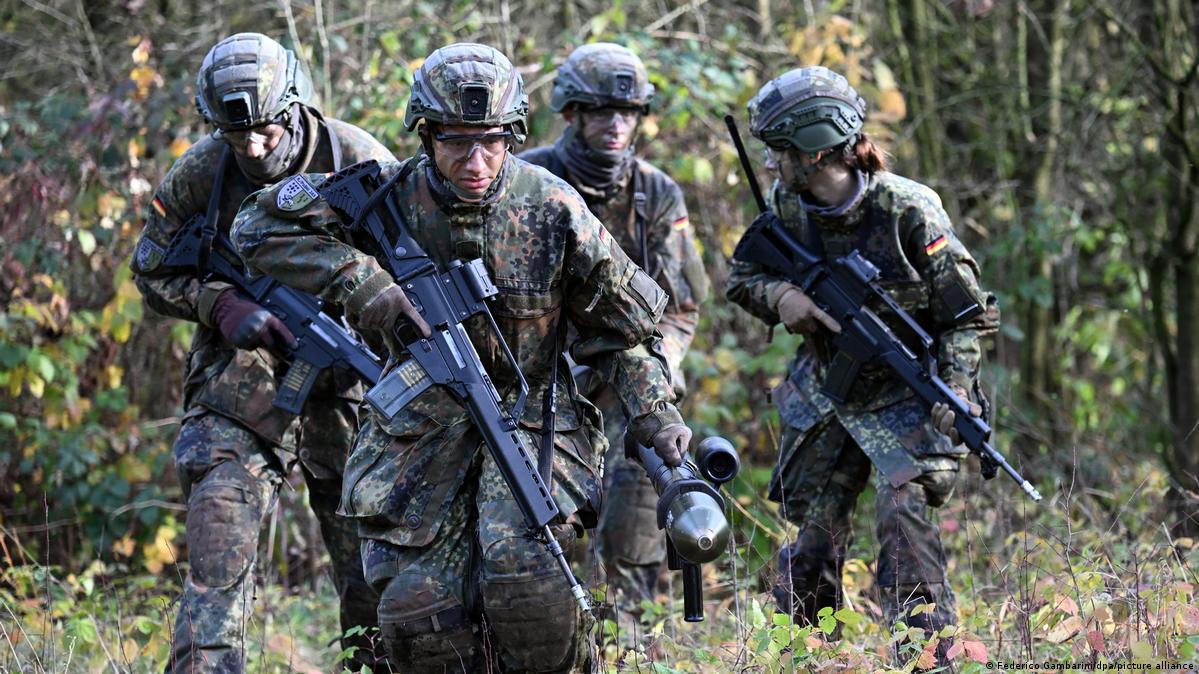
The 240-page-long "2026 Fundamental Rights Report," presented in Karlsruheon Thursday, says fundamental rights are threatened, for example, when efforts to combat climate change wane, when affordable housing becomes scarce and when technical standards on social media violate informal self-determination. But the greatest danger comes when security concerns dominate domestic policy, and lead to a military buildup.
Fundamental rights are the basic rights to freedom and equality guaranteed by law to every person. In Germany, they are enshrined in the first 19 articles of the constitution, the Basic Law, and protect individuals from state overreach.
Germany agrees on conscription framework
To view this video please enable JavaScript, and consider upgrading to a web browser that supports HTML5 video
The annual report has been published since 1997, sponsored by human rights organizations including Pro Asyl, the Humanist Union and the League for Human Rights. And this year, the organizers found a well-known advocate: former Federal Justice Minister Herta Däubler-Gmelin, who served from 1998 to 2002 under then-Chancellor Gerhard Schröder of the center-left Social Democratic Party (SPD).
At Thursday's press conference, Däubler-Gmelin said the main current triggers for the threat to fundamental rights are Russia's war of aggression against Ukraine, the war in Gaza and the war in Iran. "What are wars of aggression if not the worst possible violations of fundamental and human rights?" she asked.
Germany sees 'rapid militarization'
Through a broad consensus between the Conservative bloc, Social Democrats and the environmentalist Greens in 2025, €500 billion ($580 billion) in new debt was agreed on to modernize the Bundeswehr, Germany's armed forces.
The Fundamental Rights Report highlights this "rapid militarization of Germany," unprecedented since the end of World War II. At the same time, government development aid is being slashed. The budget of the Ministry for Economic Cooperation and Development was cut by €910 million to €10.31 billion in 2025.
"This means that healthcare systems in other countries can no longer be maintained. It means that people in Africa are dying because they have no way to escape conflicts," Däubler-Gmelin warned.
An increasing number of SPD government officials share this view. Coinciding with the release of Thursday's report was a paper from the conservative-leaning wing of the Social Democrats, the Seeheim Circle, deploring the fact that the value of development aid is currently being "questioned more than ever before."
German deportations to Afghanistan spark rebuke
To view this video please enable JavaScript, and consider upgrading to a web browser that supports HTML5 video
Government spending cuts have also affected refugee programs. Taking part in Thursday's press conference was Ahmad Mosamem Rahimi, a refugee from Afghanistan and a critic of the Taliban regime who has been living in Germany since December. He spoke of how he was forced to wait two years to be allowed entry into the country, despite previous promises to that effect.
The reason for the delay: The German government terminated resettlement programs established by previous administrations following the Islamist Taliban's seizure of power in 2021.
"Although I had all my documents and had been promised that I would be allowed to come to Germany, I waited in Pakistan for nearly two years for my visa," said Rahimi. In the end, he was able to secure his departure with the help of lawyers.
Could Germany bring back conscription?
The authors of the report were particularly concerned about the possible reintroduction of conscription in Germany.
Athena Möller, a member of the executive board of the International League for Human Rights, said it was presumptuous to expect complete loyalty to the German state, "especially from the younger generation," while the state fails to adequately uphold fundamental rights.
The government is currently trying to recruit more young people for military service on a voluntary basis. Should this effort fail, a return to conscription — which was suspended in 2011 — is also up for discussion.
This article was originally written in German.
AdvertisementСхожі новини

Ціни на молочку в Україні зростуть вже цього літа: скільки доведеться платити

Як зупинити ріст бур’янів на патіо за 5 хвилин: садівники радять зробити це до червня
Терехов: Нова житлова політика має стати ключовим напрямком повоєнного відновлення України