Germany prepares for mission in the Strait of Hormuz
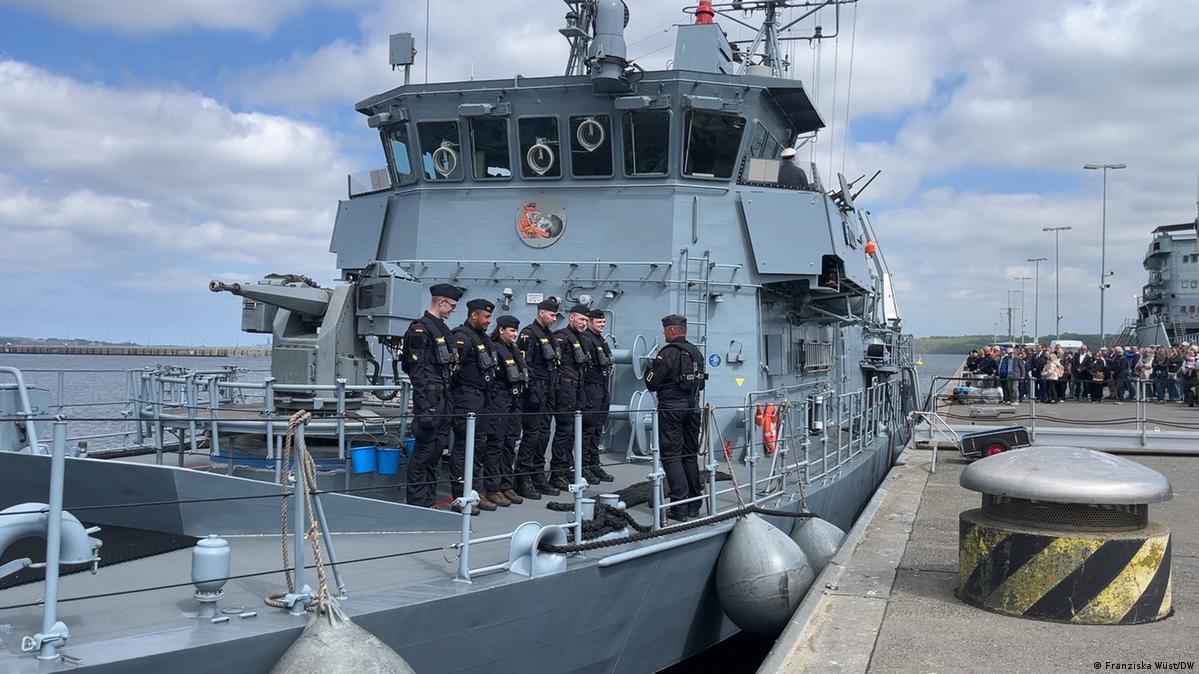
The minesweeper Fulda set sail from the Kiel-Wik naval base on the Baltic Sea bound for the Mediterranean. Its highly specialized equipment for tracking down and destroying sea mines would lend significant support to NATO's anti-mining operations. Should Germany's conditions for participating in an international operation in the Strait of Hormuz be met, this would put the ship in a better position.
Since the start of the war on Iran on February 28, the regime in Tehran has used mines to keep commercial ships from passing through one of the world's most important trade routes. The blockade has sent oil and liquefied natural gas prices soaring on the global market.
The blockade of the Hormuz Strait is hitting the German economy hard
On several occasions, German Chancellor Friedrich Merz has stated that Germany would be prepared to help secure a peace agreement — but only after the Iran war has ended. On Sunday evening, Merz reiterated this on the ARD program "Caren Miosga," stating that he had personally assured US President Donald Trump of this: "During my last visit and also in our phone calls, I repeatedly told him that this war is now having a significant impact on us, that we would like to see it ended — and that we are also offering assistance."
The German Navy has extensive experience in clearing mines. Since the end of World War II, it has continued to remove old munitions, especially from the Baltic Sea. Ten minesweeper ships, equipped with modern drones and specially trained mine divers, have established Germany's reputation as an international leader in a field where few others operate. Within NATO, expertise in mine clearance is seen as a rare and valuable skill.
The German parliament will make the final decision
As with any armed deployment of the German Armed Forces abroad, a naval mission in the Strait of Hormuz would only take place under the circumstances outlined in Germany's Basic Law and by the rulings of its highest court, the Federal Constitutional Court. First, the mission must be part of a "system of collective security," such as the United Nations, the NATO defense alliance, or the European Union.
Secondly, the German parliament must be informed about the overseas deployment, hold discussions on it and ultimately approve the deployment mandate. This mandate specifies the exact mission of the German Armed Forces, the Bundeswehr, as well as the military assets that will be deployed, the theatre of operations, the total number of troops and the duration of the mission.
How Iran exposed the limits of the US Navy
To view this video please enable JavaScript, and consider upgrading to a web browser that supports HTML5 video
German Navy already stretched to capacity
Authorization of a mission by the German parliament could take days or even weeks. That is why the German Navy is already making preparations. To do so, it must reallocate its assets. "Everything we have is already deployed. This is particularly true for the minesweeper squadron," said Commander Inka von Puttkamer, commander of the 3rd Minesweeper Squadron, during a recent press conference at the Kiel Naval Base. "A new mission always comes at the expense of a previous one."
According to Defense Minister Boris Pistorius, the German Navy — already "the smallest navy in the history of the Federal Republic" — is currently involved in multiple missions for the European Union, NATO and the United Nations.
Commander von Puttkamer made it clear that the dangerous work in a minefield can only be carried out if aequate protection is provided. "Mine clearance units can only be deployed if threats from land and air can be ruled out. Just as a frigate cannot detect mines, a minesweeper cannot engage in aerial combat. That is why you will always see us operating alongside warships, such as frigates and corvettes." The new P-8 Poseidon maritime patrol aircraft could also play a role in such operations.
German rearmament sparks controversy, again
To view this video please enable JavaScript, and consider upgrading to a web browser that supports HTML5 video
Pistorius says there will be no operation without the US
Defense Minister Pistorius emphasized that such a mission would only be possible in cooperation with partners — and specifically with the United States. They have "the best situational awareness in the region," said the defense minister. On the ARD program "Bericht aus Berlin," the politician from the center-left Social Democratic Party (SPD) stated in April that, "the Americans are the ones who — together with the Israelis — are waging this war, and that is why they are the ones with whom we must operate jointly when it comes to addressing its consequences."
It is unclear to what extent the Strait of Hormuz has been mined. It is also unclear when the most important requirement for a German military deployment will be met, namely a permanent end to the war with Iran. At the moment, however, an end to the war does not appear likely as tensions surrounding the Strait of Hormuz have recently escalated once again.
This article was originally written in German.
AdvertisementСхожі новини

Арсенал — Атлетико: обзор полуфинала Лиги чемпионов — видео

«Позиция — я в домике». Никто не вызывал Умерова в оборонный комитет из-за «пленок Миндича» — Фриз

Частина українських біженців в Ірландії втратить право на безкоштовне житло
