Germany news: US Ebola patient's family to join him
What you need to know
- US Ebola patient admitted to Berlin's Charite hospital
- The Health Ministry later said his immediate family, who were also in the DRC with him, would be allowed to join him at the clinic
- Police arrest married couple in Munich accused of spying for China
- Search for missing people continues after Görlitz house collapse
- SC Freiburg preparing for Europa League final tonight in Istanbul
Tired of missing our real-time updates? Click here to add us as a Preferred Source on Google, then tap "Star" or "Preferred" to keep DW news at the top of your feed.
Below is DW's coverage of what Germany is talking about on Wednesday, May 20:
Skip next section US Ebola patient's family to fly in to join him in Germany05/20/2026May 20, 2026US Ebola patient's family to fly in to join him in Germany
Family members will be allowed entry to Germany to join the doctor from the US infected with Ebola in the Democratic Republic of Congo (DRC) who is now receiving treatment in Berlin.
Germany's Health Ministry announced the decision on Wednesday, saying it was a response to a request from US authorities.
The man's wife and three children will be brought to the special isolation ward at Berlin's Charite university hospital.
The doctor became infected while working in the east of the DRC, the epicenter of the latest outbreak.
It's not clear whether his relatives, who were also in the DRC, were showing symptoms.
The special isolation ward at the Charite hospital is a bespoke contained area that's isolated from the rest of the university clinic and is experienced at handling dangerous cases like Ebola patients.
Ebola is transmitted primarily via direct contact or exposure to bodily fluids of the infected or deceased.
Ebola: What to know after WHO declares health emergency
To view this video please enable JavaScript, and consider upgrading to a web browser that supports HTML5 video
https://p.dw.com/p/5E3weSkip next section German Cabinet approves driving test reforms, seeking to allow practice with parents and reduce costs05/20/2026May 20, 2026German Cabinet approves driving test reforms, seeking to allow practice with parents and reduce costs
The Cabinet has signed off on a new reform package for acquiring a driving license in Germany, trying to simplify a process that has long been one of the most expensive and slowest in the world.
According to the Transport Ministry, the entire process to secure a German driving license costs around €3,400 (roughly $3,950) on average. In comparison, a driving license in neighboring Belgium costs around €2,000 on average and in Luxembourg just €1,500.
"These are miles away from the average cost in Germany," said Transport Minister Patrick Schnieder (CDU). "That's why we're reforming driving lessons."
How do they plan to cut costs?
Among the planned changes, which still need to be finalized and to clear the Bundestag or parliament, three in particular are aimed at reducing the expense and the duration of the learning process:
- People studying for their theory test will no longer be obliged to attend in-person lessons at instruction centers. Instead, they will be allowed to learn online, via an app or using books, with the only requirement being that they pass their theory test.
- The number of obligatory special driving lessons — night driving, highway driving, and main road driving outside build-up areas — will be reduced. Currently set at 12 lessons, Transport Minister Patrick Schnieder said he thought there should be at least one drive in each category, or possibly more depending on the individual students.
- Germany will join many countries like Austria, Switzerland, the UK and the US in permitting what other German-speaking countries call 'layperson instruction.' In the future, parents or another person who is 'close' to the learner will be allowed to accompany learner drivers on the roads as they practice in a private capacity.
The challenges of obtaining a driver's license in Germany
To view this video please enable JavaScript, and consider upgrading to a web browser that supports HTML5 video
The German Automobile Association (ADAC) has welcomed the plans to allow learners to practice privately, telling the Rheinische Post newspaper that more practice reduces the risk of accident.
But the nationwide association of driving instructors (BVF), which has an interest in creating as much work for its members as possible, has warned about a lapse in traffic safety, saying: "We expect Minister Schnieder to listen to the expertise of driving instructors and scientists."
Schnieder insisted that "no shortcuts will be taken when it comes to traffic safety" and that safety standards would remain at the "highest level."
The reforms are expected to come into effect from January 2027.
https://p.dw.com/p/5E3KpSkip next section Europa League final: SC Freiburg face Aston Villa in Istanbul05/20/2026May 20, 2026Europa League final: SC Freiburg face Aston Villa in Istanbul
Wesley Dockery EditorExcitement is building in Istanbul ahead of Bundesliga side SC Freiburg's UEFA Europa League final against Aston Villa.
For Freiburg, it's only the club's second ever major cup final (after the German Cup final in 2022) and their first ever European final. And though they go into the showpiece as underdogs, head coach Julian Schuster is counting on his team's spirit and togetherness to pull off an upset against English Premier League side Villa.
"It's one of our greatest strengths," he said pre-match. "We all know each other perfectly and we have a fantastic mentality in the squad. We're all very close to one another."
In the semi-final second leg against Portuguese side Braga, five of Freiburg's starting XI had come through the club's academy and another five were sat on the bench. Meanwhile, veterans such as Vincenzo Grifo, Philipp Lienhart, Maximilian Eggestein and Matthias Ginter have all gathered substantial experience elsewhere before joining – or returning to – Freiburg.
"We've grown to the point where many of the lads who develop at Freiburg no longer leave; they stay here at their peak," explained captain Christian Günter. "If I think back ten years ago, we had three or four players who were extremely good but then they would leave and we'd be back to square one."
Now, however, as a result of sustainable economic growth, Freiburg have the financial means to keep them. "Many of the lads feel really at home here and they identify with the city and our football," said Günter.
Read more about SC Freiburg's unique approach here on DW.
Setback for Freiburg fans as organizers ban flags
Despite selling out their 34,000-capacity home stadium in the Bundesliga every two weeks, Freiburg (and Villa) were only allocated 11,000 tickets for the final in Istanbul — and all were quickly sold out.
Like many German fan groups, Freiburg supporters are well known for creating a spectacular atmosphere and for their colorful pre-match choreographies – but there will no such display at the Besiktas Stadium on Wednesday after local authorities imposed restrictions on flags, banners, drums and other fan materials.
"Today's conditions are worlds apart from our idea of a vibrant and loud fan culture," the Freiburg fans lamented in a statement.
https://p.dw.com/p/5E2urSkip next section Two German nationals arrested on suspicion of spying for China05/20/2026May 20, 2026Two German nationals arrested on suspicion of spying for China
Authorities in the southern German city of Munich have arrested two German nationals on suspicion of engaging in espionage on behalf of Chinese intelligence, federal prosecutors said on Wednesday.
The married couple, identified in line with German privacy rules only as Xuejun C. and Hua S., are suspected of attempting to make contact with scientists at German universities to procure "scientific information on high-tech technologies with military applications."
While the Munich residences and workplaces of the suspects were searched, further operations in connection with the arrests also took place across the states of Bavaria, Baden-Württemberg, Berlin, Brandenburg, Lower Saxony and North Rhine-Westphalia aimed at establishing contact with witnesses who are not under suspicion.
Prosecutors said the suspected spies posed as interpreters or employees of automobile manufacturers to make contact in particular with "university professors in the areas of aerospace and space travel, IT and artificial intelligence."
Some of the scientists were reportedly even encouraged to travel to China where they received payment to hold presentations to civilian audiences "which actually took place in front of employees of state armaments companies."
https://p.dw.com/p/5E2YzSkip next section Berlin Airport: Eurowings looking to fill Ryanair gap05/20/2026May 20, 2026Berlin Airport: Eurowings looking to fill Ryanair gap
German budget airline Eurowings is expanding its operations to and from Berlin Airport (BER) with the addition of two new airplanes and a range of new destinations, including Bologna in Italy, plus additional flights to popular holiday destinations such as the Canary Islands.
"With two additional planes, new routes and greater frequencies, Eurowings is responding to recent market changes at BER," read a statement from the Lufthansa subsidiary.
Those market changes include, in particular, the recent withdrawal from BER of leading European budget airline Ryanair, which is set to halve its operations to Berlin citing high taxes and airport fees in Germany.
With British budget airline EasyJet also reducing services, Eurowings and other Lufthansa subsidiaries, including Swiss, Austrian Airlines, Brussels Airlines and SunExpress, are set to account for around 30% of all flights to and from Berlin.
"We believe in Berlin and see — despite all the crises — good perspectives for the location," said Eurowings CEO Max Kownatzki, before adding that he shares concerns about operating conditions at German airports.
"Taxes and fees have almost doubled since 2019, leading many airlines to fly in an arc around Germany," he said. "Combined with the rapid increase in the cost of kerosene, this acts as a stop sign for investments in Germany."
He insisted that "Berlin has great potential," but he insisted, "For sustainable growth, airlines need competitive conditions."
High costs render German airports uncompetitive
To view this video please enable JavaScript, and consider upgrading to a web browser that supports HTML5 video
https://p.dw.com/p/5E2QOSkip next section Görlitz: Search continues after house collapse05/20/2026May 20, 2026Görlitz: Search continues after house collapse
More than 36 hours after a house collapsed in the center of the eastern German city of Görlitz, emergency services are still searching for three missing people — but hope is dwindling.
"We are certain that we will find the missing people — but in what state I cannot say," said local fire brigade chief Anja Weigel. "We're now into day two of the operation, which has been going on since 5:30 p.m. on Monday. The chances are obviously sinking but, if we're lucky, someone might be trapped in a cavity in the rubble. Maybe there'll be a miracle."
The 19th-century building collapsed on Monday evening for reasons that are still unclear, although police suspect a potential gas explosion. Gas, water and electricity in neighboring houses have also been turned off as a precaution while the search continues.
According to local media, the three missing people include two female Romanian tourists aged 25 and 26, and a 48-year-old man with both German and Bulgarian citizenship who had been in Görlitz for work. There is still no sign of any of them.
"Pedestrians could have been buried on the pavement in front of the building," cautioned fire brigade chief Weigel. "We have to assume the worst and that we may even only find body parts."
#DailyDrone: Lower Market Görlitz
To view this video please enable JavaScript, and consider upgrading to a web browser that supports HTML5 video
https://p.dw.com/p/5E207Skip next section Ebola patient admitted to Berlin hospital05/20/2026May 20, 2026Ebola patient admitted to Berlin hospital
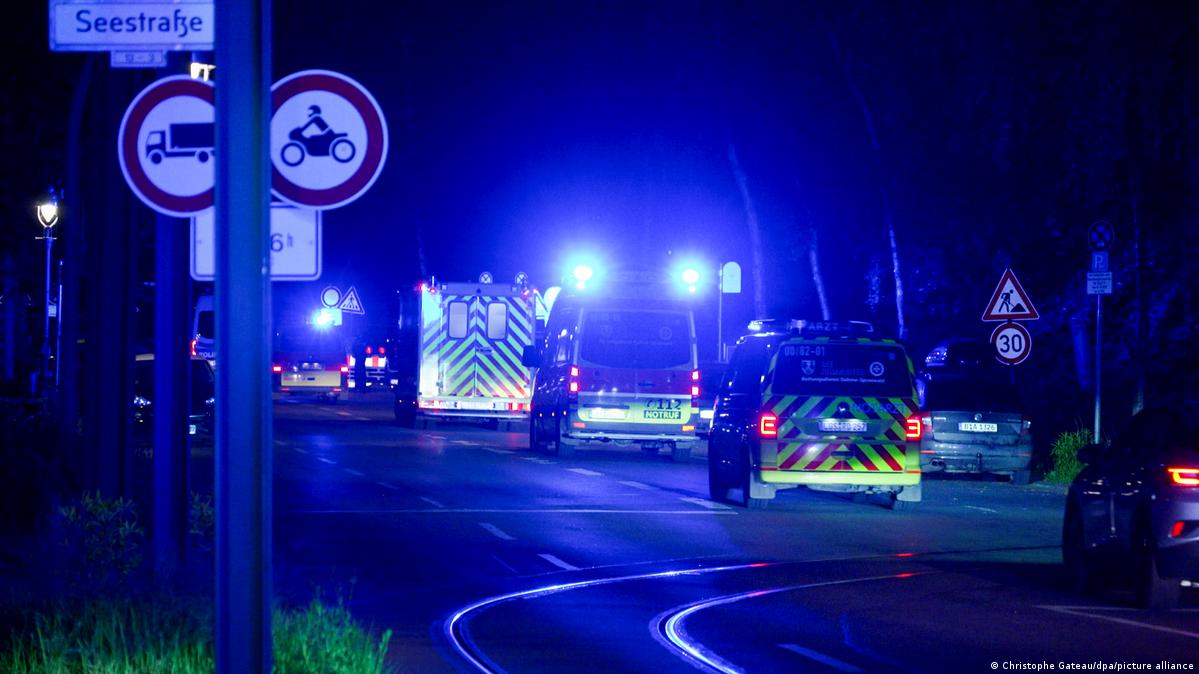
A US doctor infected with the Ebola virus in Congo was admitted to Berlin's Charité hospital in the early hours of Wednesday.
The German Health Ministry acquiesced to a request from the United States for the patient to be treated in Germany rather than the United States due to the shorter travel time from Uganda and the Charité's experience in dealing with Ebola.
The patient was flown to Berlin on a special medical aircraft and was then driven to the hospital in a specially designed vehicle escorted by police.
Six people with whom the infected man had contact have also been flown to Germany.
The German Health Ministry has reassured the public that there is no danger of the deadly virus spreading to the general population.
The Charité hospital specializes in the treatment of such cases and the patient is being housed in a completely isolated ward, separate from the rest of the clinic.
Ebola spreads through direct contact with infected people or their bodily fluids and generally begins with symptoms comparable to flu or diarrhea before worsening. The ultimate cause of death is usually multiple organ failure.
According to the German Health Ministry, however, the mortality rate following modern treatment and specialist monitoring at a clinic like Berlin's Charité drops from around 60% to 20%-30%.
What makes this Ebola outbreak different from others?
To view this video please enable JavaScript, and consider upgrading to a web browser that supports HTML5 video
https://p.dw.com/p/5E1qhSkip next section Welcome to our coverage05/20/2026May 20, 2026Welcome to our coverage
Matt Ford | Sean Sinico EditorGuten Morgen! Welcome to DW's coverage of what Germany is talking about on Wednesday, May 20, 2026.
An American doctor who became infected with the Ebola virus in Congo has been flown to Berlin for isolated treatment in the city's famous Charitße hospital.
Meanwhile, in the eastern German city of Görlitz, the search continues for three missing people 36 hours after a house collapsed.
And in sport, Bundesliga side SC Freiburg are preparing for the biggest game in the club's history: the Europa League final against Aston Villa in Istanbul tonight.
You can catch up on yesterday's news here.
https://p.dw.com/p/5E1qxShow more postsСхожі новини

У регіони доставили понад 42 тисячі доз вакцини проти сказу

Кайлі Міноуг відверто поділилася деталями боротьби з раком: лікування, операція та новий етап життя
Люди несуть 80% відповідальності за проблеми зі своїм здоров’ям у старості, - дослідження