Germany news: Surf's up again in Munich!
What you need to know
- Surfing has resumed in Munich's English Garden after the city's new mayor lifted a ban with a new city decree.
- Only experienced surfers are allowed on the wave until 10 p.m. with new safety rules introduced following a fatal accident last year.
- Germany reaches its 2026 Earth Overshoot Day on May 10
- Environmental group BUND blames a heavy reliance on fossil fuels and energy-intensive sectors
Here are the latest developments from and about Germany on Saturday May 9, 2026.
Skip next section German football bosses in talks over World Cup player bonuses05/09/2026May 9, 2026German football bosses in talks over World Cup player bonuses
The German Football Association (DFB) has been negotiating bonus payments with the national team ahead of the FIFA World Cup.
DFB President Bernd Neuendorf said no agreement had yet been reached, though discussions with the players' council were ongoing and constructive.
Talks come weeks before the tournament kicks off across Canada, Mexico and the US, with the German Football Association aiming to finalize terms in time.
Germany’s 2014 World Cup winners each received €300,000 ($354,000), while a title at Euro 2024 would have earned €400,000 per player. More recently, players took home €100,000 each after reaching the quarterfinals at Euro 2024.
Former Germany captain Philipp Lahm has said reaching at least the semifinals should remain the benchmark, with coach Julian Nagelsmann expected to lead a renewed push after recent World Cup disappointments.
Neuendorf has said Germany belongs among the wider group of contenders, alongside teams such as England, France, Brazil and Argentina.
How Germany won back the nation at Euro 2024
To view this video please enable JavaScript, and consider upgrading to a web browser that supports HTML5 video
https://p.dw.com/p/5DWOnSkip next section Germany hits 2026 resource limit05/09/2026May 9, 2026Germany hits 2026 resource limit
Germany has already used up all of the natural resources that should last for the entire year.
The date, known as Earth Overshoot Day, is calculated annually by the Global Footprint Network for individual countries and for the planet as a whole.
If everyone on Earth consumed as many natural resources and produced as much carbon dioxide as people in Germany, the planet's annual biocapacity would already be exhausted within the first third of the year.
According to the German Federation for the Environment and Nature (BUND), Germany consumes far too many resources, mainly because of its heavy reliance on fossil fuels. The main contributors are energy-intensive industries, the building sector, road transport and industrial livestock farming.
As a result, the consequences are already being felt through droughts, heavy rainfall and increasing heat in cities.
"Our current way of living and doing business is not sustainable," BUND chairman Olaf Bandt said. "Instead of switching to renewables, we are continuing to rely on coal, oil and gas."
Electricity from solar and wind power, along with heat pumps and lightweight, small and efficient electric cars, would instead provide independence, planning certainty and climate protection, Bandt said.
In 2025, Germany's Earth Overshoot Day fell on May 3. The fact that the date shifted back by a week in 2026 was not the result of a more environmentally friendly lifestyle, but updated data and changes in calculation methods.
https://p.dw.com/p/5DW3zSkip next section Munich reopens Eisbach wave to surfers05/09/2026May 9, 2026Munich reopens Eisbach wave to surfers
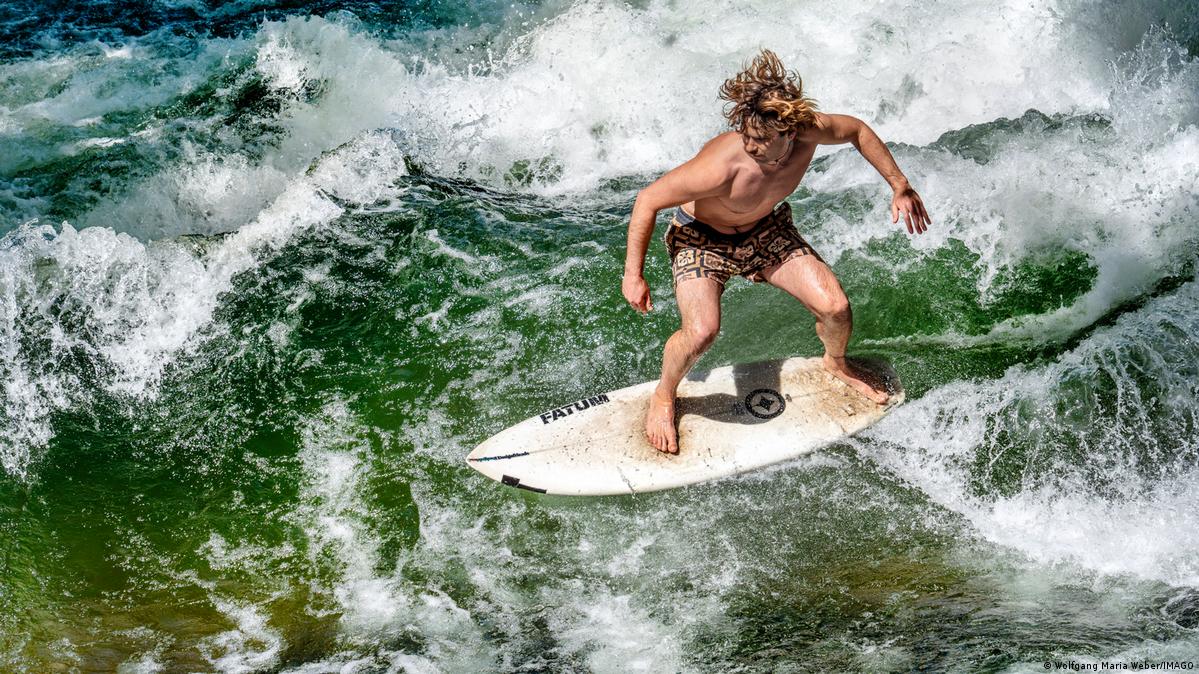
Surfing has resumed at Munich's Eisbach wave, in the city's famous English Garden after officials lifted a previous ban.
Green Party Mayor Dominik Krause approved the move by issuing a revised general decree shortly after a new city coalition was formed.
"Surfing on the Eisbach is an integral part of the Munich way of life; the Eisbach wave is a landmark of the city of Munich," Krause declared.
From the very beginning, he noted, his goal had been "to open the wave as soon as possible." To take this step, he worked closely with representatives of the Munich surfing community, who have organized themselves into two associations.
Only experienced river surfers are allowed to use the wave, and only until 10 p.m., with new safety rules including quick-release leashes to reduce risks in the strong current.
The site had been closed after a fatal accident in April last year, when a surfer was pulled underwater after her leash became trapped.
https://p.dw.com/p/5DW3XSkip next section Welcome to our coverage05/09/2026May 9, 2026Welcome to our coverage
Richard Connor | Louis Oelofse EditorGuten Tag from the DW newsroom in Bonn.
You join us as we learn that one of the world's strangest surfing venues, in the capital of landlocked Bavaria, is once again allowing tourists to catch a wave.
Meanwhile, Germany has already consumed its share of the Earth's resources for the year.
Stay with us for more on the latest stories from and about Germany.
https://p.dw.com/p/5DW3AShow more postsСхожі новини
Who is Victor Manuel Rocha, former US diplomat who will lose US citizenship over spying for Cuba?
Indian man dies in US, family says he battled a month with Valley fever
‘Labour are doomed’: Nigel Farage hits out at Starmer over Gordon Brown’s appointment after election rout