Germany: Difficult first year for Chancellor Friedrich Merz
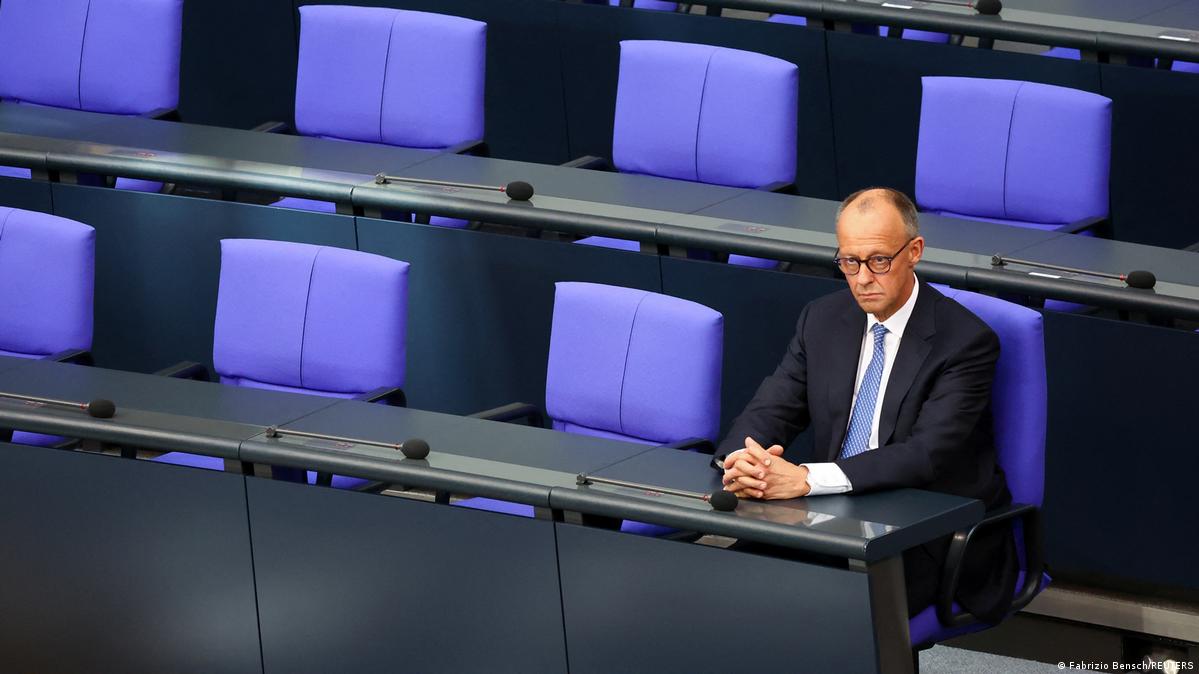
Is German Chancellor Friedrich Merz currently giving major interviews because of his one-year anniversary in the role, or because the coalition he leads — of the conservative Christian Democrats (CDU), its Bavarian counterpart the Christian Social Union(CSU) and the center-left Social Democrats (SPD) — is in crisis? One thing has probably led to the other.
There is, in the CDU and the CSU, "a growing resentment" about the compromises the coalition is agreeing to, Merz said Sunday on political talk show Caren Miosga on public broadcaster ARD. His personal public approval ratings are very low.
Crises were a feature of his chancellorship even before it began. On May 6, 2025 the vote in the Bundestag federal parliament to appoint him chancellor made history — for the first time in the Federal Republic of Germany, the candidate did not receive the necessary absolute majority during the first round. To become the 10th German chancellor, he required a second round of voting. That also said something about the fact that the so-called grand coalition is no longer so grand — it holds only just enough seats in parliament to have a thin majority.
No 'Autumn of reforms' in late 2025
During the (northern hemisphere) summer following his election, Merz announced that the coming fall season would be an "autumn of reforms." Realignments or changes to fundamental elements of the German welfare state, pensions, health, nursing care and reducing bureaucracy would be the focus. But none of that was confirmed in the following months.
Quickly decided upon was a one-off "special fund for infrastructure and climate neutrality" of €500 billion ($580 billion) by 2045. It is intended for projects such as upgrading the rail network and building new bridges — because Germany is struggling with crumbling infrastructure.
However, cooperation, especially between the cabinet ministers responsible for finance, Lars Klingbeil (also Vice Chancellor and co-leader of the SPD) and economics, Katherina Reiche (CDU), has turned into a constant conflict. Economy Minister Reiche is keen on numerous measures which would reverse steps by the previous government of 2021-2024 (a coalition of the SPD, environmentalist Greens and business-oriented Free Democrats) which combined economic policy and climate protection. It is also aimed at the growing calls from her party to resume civilian use of nuclear power, which was phased out by the CDU/CSU-led government under Angela Merkel from 2011 onwards.
In the ARD interview, as well as a major interview with news magazine Der Spiegel, it sounded like Merz thought it was mainly the CDU/CSU dealing with the burden of compromise in the coalition. He spoke of a "coalition with a larger partner and a smaller partner." It required "compromises", and compromises "are not one-way streets." It never seemed like a warning reminder to his own party.
The healthcare system should recover
A few days before its first anniversary, the coalition presented its first major package: its concept for reforming the health system. Nothing has been decided yet. First, there will be several months of deliberation in the Bundestag, during which changes are always expected.
DW Chief Political Editor Michaela Küfner has accompanied and observed Merz on numerous trips and public appearances during his first year in office. She views his halting start as not only negative. His first year, Küfner said, had made Germany not more stable, but more focused: "Just as Merz had to learn the limits of compromise for his coalition partner and his own party, so Germany has come to realize that things cannot continue as they are without structural reforms. That alone is societal progress."
Looking abroad
It is especially necessary for the German coalition government to present a united front on key issues, given current foreign policy challenges. Concerns are repeatedly raised about a collapse of Europe, an end to the NATO defense alliance and the transatlantic friendship. The sometimes-erratic political style of US President Donald Trump only heightens these concerns.
Trips by the chancellor or his foreign minister serve strategic interests, whether in Europe or other regions. Especially as Merz's first year was overshadowed by Trump's actions. Back in November 2020, the CDU politician expressed his certainty that "Trump and I, we would get along just fine." Somehow, that seems much longer than 5 and a half years ago.
Merz visited the White House three times during his first year in office. Until a few days ago, it seemed that he was one of the few European heads of state who had a connection with Trump and could speak openly with him.
However, this changed when he publicly expressed strong criticism of Trump's conduct in the US war with Iran. The Americans, Merz said a few days ago while visiting high schoolers in central Germany, "clearly don't have a truly convincing strategy" in the conflict; Iran has "humiliated" the US in the negotiations.
Trump rebuked the chancellor via his social media channel, Truth Social. Merz had no idea what he was talking about, Trump said, and should rather focus on taking care of his "broken country." Trump said Germany was doing poorly economically. He then announced the withdrawal of 5000 US soldiers from Germany and announced an increase in tariffs on car and truck imports from Europe, a blow to the already struggling automotive industry.
It is a new burden for the chancellor. He likes to point out that he speaks on the phone with Trump regularly. Several months ago, he invited the US president to visit the town in Rhineland-Palatinate where his ancestors are from. Referring to the latest disgruntlement during the ARD interview, Merz described the new situation as "difficult." He hoped "that we come out of this situation." One of his core beliefs was that "the transatlantic relationship is very valuable for us all."
On the topic of Europe, Merz wants to drum up optimism even though the situation is uncertain. He values "keeping Europe together.". Therefore, he travels a lot throughout the European Union "from a deep conviction that we really need to hold this EU together now."
Everything has its political price
DW chief political editor Küfner has observed a pattern emerging: In view of his direct criticism of Trump, Merz "often pays a high political price for his verbal clumsiness."
The question remains: "whether this chancellor, with his unprecedented talent for scoring political own goals, can translate his recognized economic expertise into political action." One thing is clear to Küfner: "Given the current situation in the world, there is one thing Germany and Europe can least afford: another breakdown of a German government."
This article was originally written in German.
AdvertisementСхожі новини

Після рішень — новий рух: прогноз за оракулом Ленорман на 6 травня

До України слідом за спекою суне небезпечний удар стихії: синоптики попередили, де вдарить негода
Польща хоче побудувати платну дорогу до Львова та збирати з неї кошти