Germany: AfD benefits from discontent with Merz's government
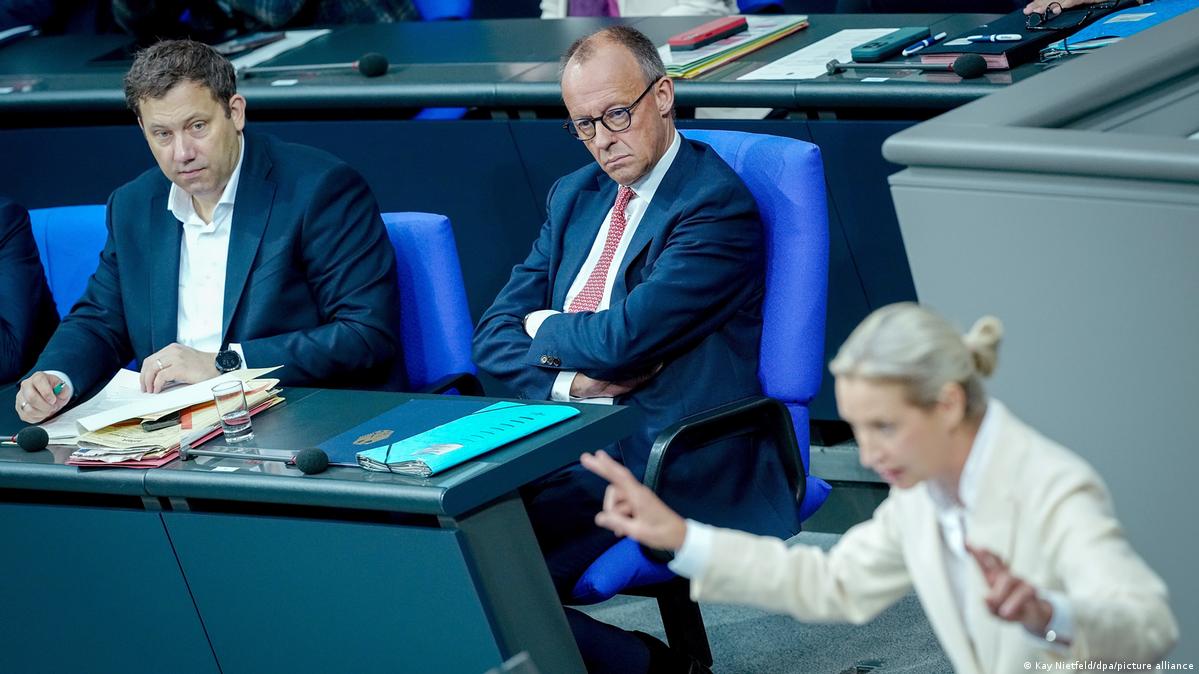
Voters' expectations could not have been higher when Chancellor Friedrich Merz and his government coalition of center-right Christian Democrats (CDU), Christian Social Union (CSU) and the center-left Social Democratic Party (SPD) took office on May 6, 2025.
Economic recovery was to be the top priority. Within just a few months, citizens would feel that Germany was moving forward, the Chancellor promised in his first policy statement, while also holding out the prospect of major reforms to be made in the autumn of that year.
After one year in office, the Chancellor has been forced to admit that a country like Germany cannot be steered in a new direction within just a few months. His centrist coalition is prone to conflict and the arduous search for compromises has slowed it down more than expected. The economy is failing to gain momentum. Throughout the country, disappointment with the government's performance is palpable.
Merz's first year marked by coalition tensions, AfD gains
To view this video please enable JavaScript, and consider upgrading to a web browser that supports HTML5 video
AfD on the rise
Overall, 86% of respondents in the latest ARD-Deutschlandtrend survey by pollster infratest dimap say they are dissatisfied with the government. The pollster conducted a representative survey of 1,303 eligible German voters between May 4 and May 6, 2026. This level of dissatisfaction marks a record: Never before in the history of the *Deutschlandtrend*— which has been conducted every month since 1997 — has a federal government been rated so negatively after one year in office.
Only 44% of respondents believe that Merz's government should remain in office until the next general election scheduled for 2029. But what would happen if early fresh elections were held?
According to the Deutschlandtrend poll, the ruling coalition would lose its majority. For the first time, there is a clear majority in support of the Alternative for Germany (AfD) — a party of which several regional chapters are classified as right-wing. At 27% nationwide, it has reached a new record high.
Compared to April, the conservative CDU/CSU bloc has lost two percentage points, dropping to 24% and second place. The SPD remains at 12%, the socialist Left Party remains at 10% and the environmentalist Greens have improved slightly to 15%. The Sahra Wagenknecht Alliance (BSW) and the business-oriented Free Democrats (FDP) are polling below the 5% thresshold to enter parliament.
The AfD performs even more strongly in regional polls in the eastern federal state of Saxony-Anhalt. A new state parliament is set to be elected there this September, and the AfD is currently polling at 41%, far ahead of the incumbent CDU at only 26%.
Can Merz pull off a turnaround?
Chancellor Merz sees no alternative to the coalition with the SPD. But difficult negotiations lie ahead. Following the presentation of a draft bill for healthcare reform in April, the next task is the reform of the pension system, which is scheduled to be discussed before the summer recess.
By the end of the year, a major income tax reform is to be drafted, aimed primarily at providing relief to low- and middle-income earners. However, it is yet unclear how to finance such cuts. The SPD advocates for higher taxes on the wealthy, a stance rejected by the Union.
The economy, social security issues, and curbing irregular immigration remain high on the voters' agenda. Yet, according to the Deutschlandtrend survey, they show little confidence that the government can make much progress in these areas.
While in June 2025, just over half of respondents still trusted the new conservative-led government to boost the economy, that figure has now dropped to only 25%.
The impact of geopolitics
In interviews marking the first anniversary of his administration, Merz argued that no chancellor before him has had to contend with conditions as difficult as his own. He argued that, in light of global crises and wars, the world currently finds itself in a historic state of emergency.
However, voters are unwilling to accept these challenging circumstances as an excuse for the government's performance: Six out of 10 respondents consider the government's actions to be inadequate.
Only 16% of those surveyed said they are "somewhat satisfied" with Chancellor Merz — the lowest approval rating ever recorded for a chancellor. Eight out of 10 people criticize his communication style.
Finally, a look at two aspects of foreign and security policy. The German Navy is deploying two of its vessels to the Mediterranean. The minesweeper Fulda has set sail from Kiel, and the supply ship Mosel, which is currently operating in the Aegean Sea, is being prepared for a potential deployment.
Should an international naval mission be launched in the Strait of Hormuz off the coast of Iran following the cessation of hostilities, these ships are intended to be ready for action on short notice. According to the Deutschlandtrend poll, one in two respondents believes it is right for the Navy to participate in such a mission.
While the relationship between US President Donald Trump and Chancellor Friedrich Merz initially appeared quite harmonious, distinct differences of opinion have recently emerged.
German voters support Merz in standing his ground and asserting his own viewpoints. Across the entire political spectrum, the consensus is that the German government should stick to its positions — even if doing so risks antagonizing Trump. Only one in five respondents favors a more restrained approach by Germany in foreign policy disputes, aimed at avoiding any provocation of Donald Trump.
This article was translated from German.
AdvertisementСхожі новини
Непомітне зараження: як врятувати вишні і черешні від хробаків вже в травні
Відома київська мережа пекарень відкриє заклад у Львові
Хороші новини для тих, кому заважала спека: Наталка Діденко розповіла прогноз на вихідні